
[Let this slide sit for a breath before you speak.]
Read the book’s first lines, slowly: “If you’re raising, loving, or helping care for someone with special needs, let me say this first: Breathe. You’ve got this.”
Then introduce yourself in one or two sentences: your name, and why this conversation matters to you. Keep it short. The room is here for their families, not for us.
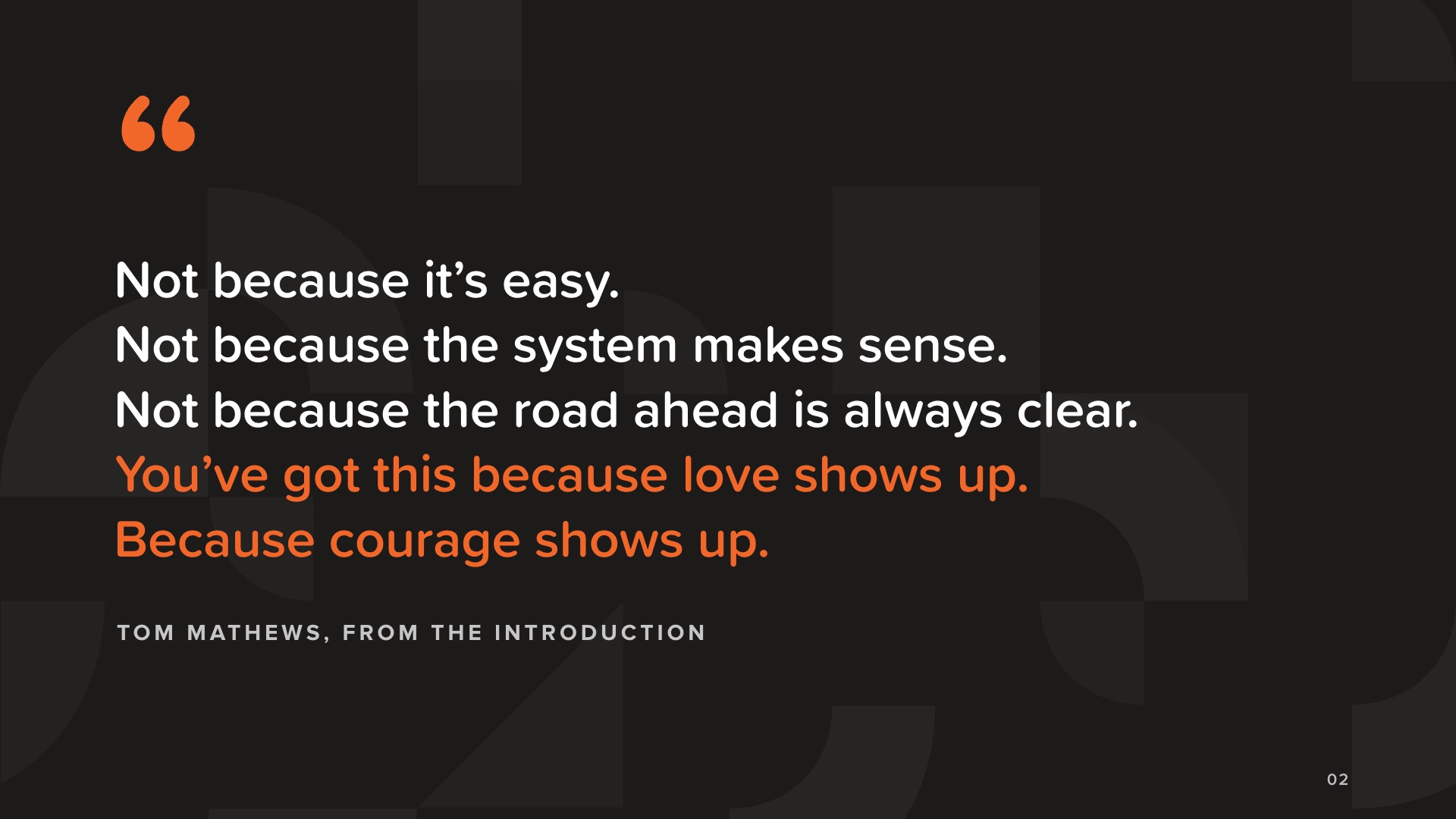
These are Tom Mathews’ words from the book’s Introduction. Read them as written, with pauses.
Then finish the passage for the room: “Because families like yours show up every single day, even when you’re tired, stretched, worried, and carrying more than most people will ever fully understand.”
Let that land. Then say: tonight isn’t about having every answer. It’s about understanding the road, and finding the next right step.
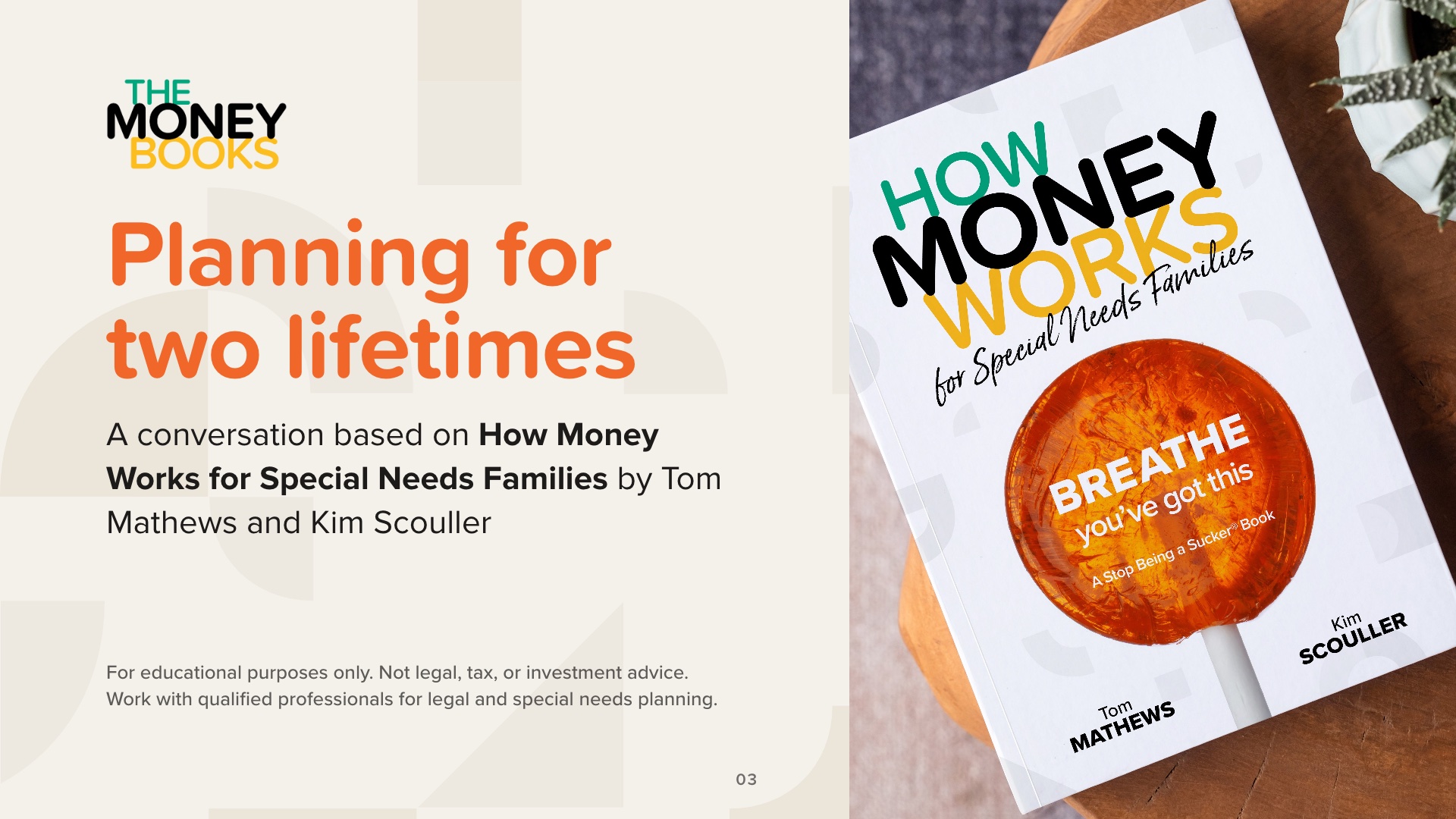
Today we’ll walk through How Money Works for Special Needs Families, by Tom Mathews and Kim Scouller, part of TheMoneyBooks series.
Set expectations, and read the line at the bottom of the slide out loud: this is education only. We won’t recommend any products, and nothing tonight is legal, tax, or investment advice. For legal and special needs planning, families should work with qualified professionals. We’ll talk later about who belongs on that team.
The plan for our time together has five parts:
1. Realities: what special needs families face
2. Programs: the government programs, in plain words
3. Concepts: three money concepts
4. Milestones: the 7 Money Milestones, including the documents that protect your child’s future
5. Next steps
The small squares at the top of each slide show which part we’re in.
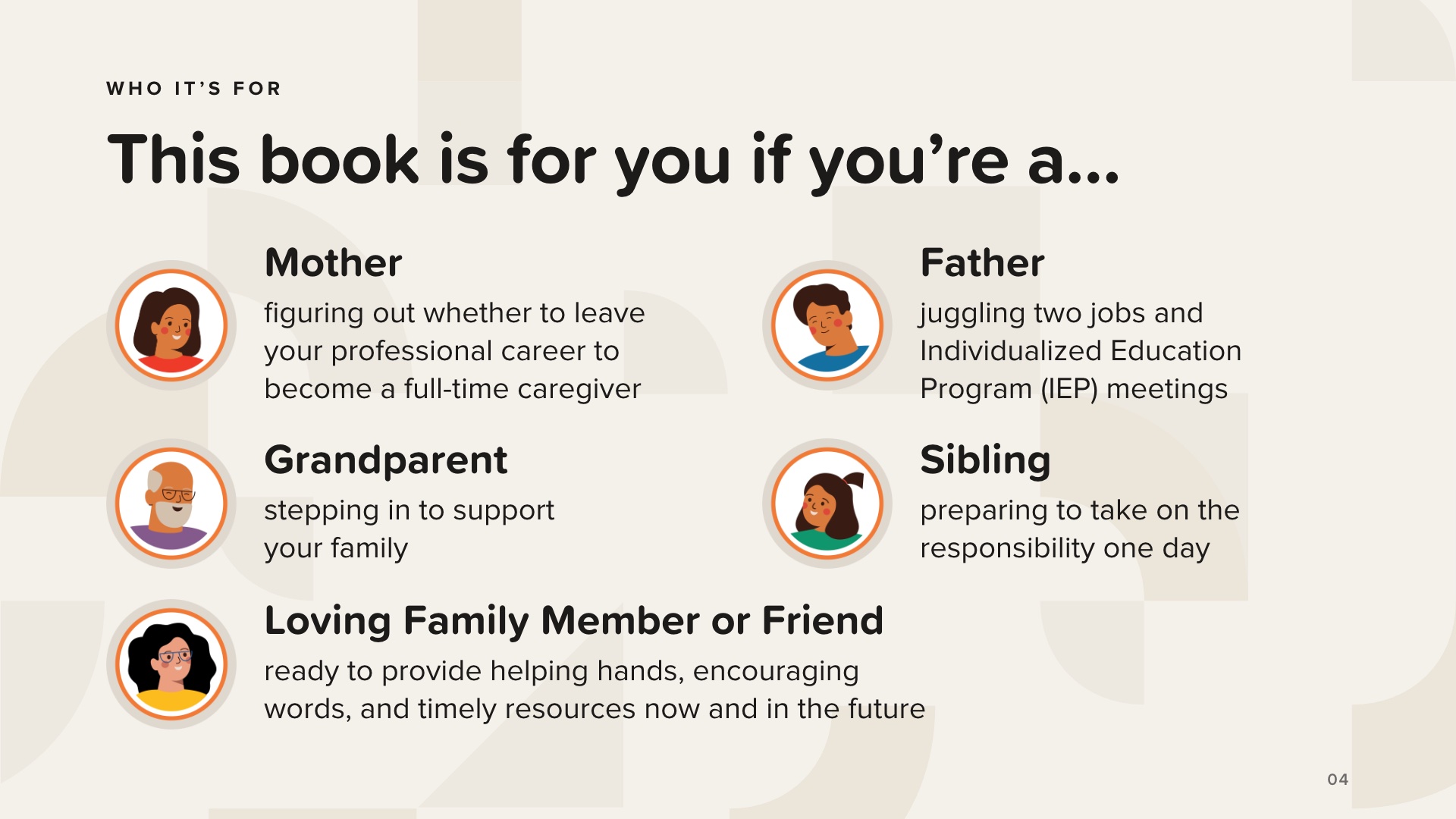
The book was written for everyone in the circle, not just parents. These five come straight from the book, and the last one is for the people around the family: a loving family member or friend, ready to provide helping hands, encouraging words, and timely resources now and in the future.
Read each one. Then say: if you see yourself on this slide, you’re in the right room.
Optional, only if the group is comfortable: ask for a show of hands for parents, grandparents, siblings, and family members or friends. Never put anyone on the spot, and don’t ask anyone to share a diagnosis or a story.
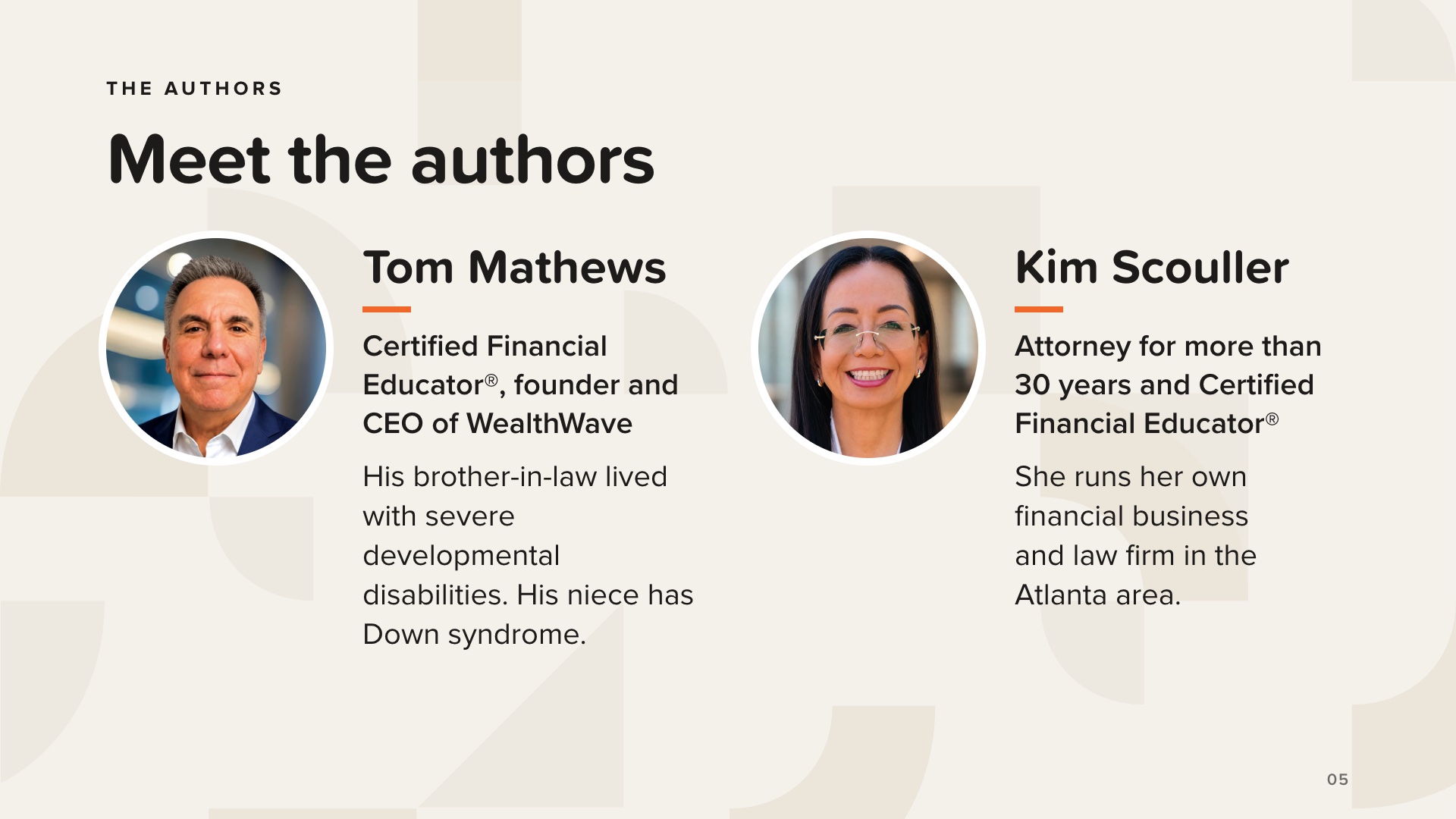
Tom Mathews is a Certified Financial Educator®, and the founder and CEO of WealthWave. In the book’s Introduction he explains why this book is personal: his brother-in-law lived with severe developmental disabilities, including cerebral palsy and epilepsy, and his niece has Down syndrome.
Kim Scouller has been an attorney for more than 30 years. She was in-house counsel and president of a broker-dealer, and today she runs her own financial business and law firm in the Atlanta area. She is also a Certified Financial Educator®. In the book she writes “As both a financial professional and an attorney…”, and that pairing is why the book covers money and legal documents side by side.
Don’t add personal details about the authors beyond what’s here.

Like every book in TheMoneyBooks series, this one has a cast of characters.
Val leads the conversation. She’s 31, a blogger and social media influencer, and a single mom whose son is on the spectrum. She’s the book’s subject-matter expert.
The rest of the cast learns alongside her and asks the questions many families are afraid to ask: Dana, 42, hospital director; George, 67, retired military officer; Sarah, 49, real estate agent; Clark, 36, ride share driver; Mei, 56, history professor; TJ, 32, medical sales; Zoey, 19, university student; and Hector, 28, restaurant owner.
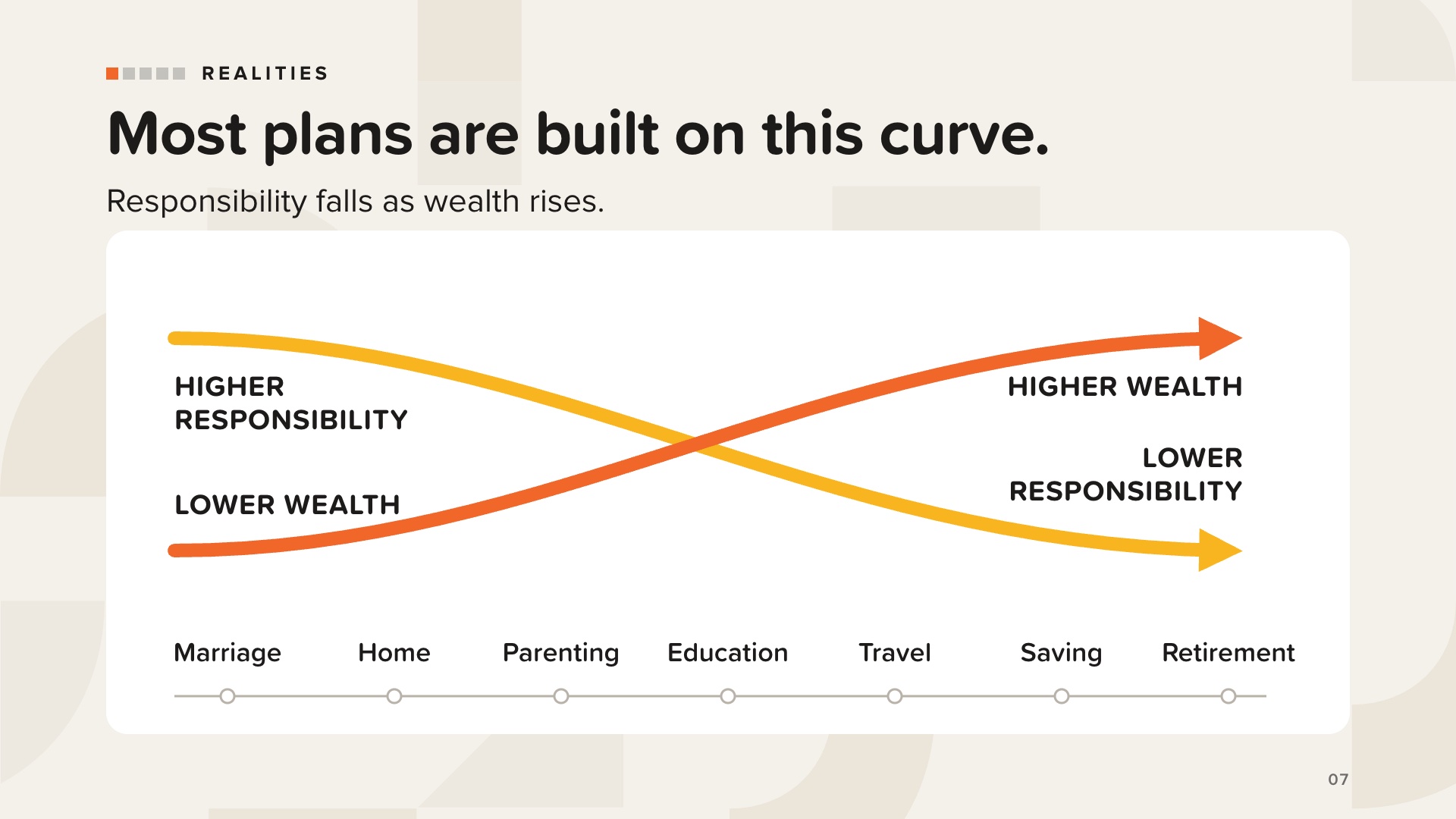
Nearly every financial plan in America is built on this curve.
When children are young, parents carry the most responsibility with the least wealth. Kids grow up, careers mature, savings build. Parents expect their financial responsibility to fall as their wealth rises, and they hope their children become financially self-sufficient and start families of their own.
That’s the traditional X-Curve: falling responsibility (yellow) and rising wealth (orange).
[Advance to show what changes for special needs families.]
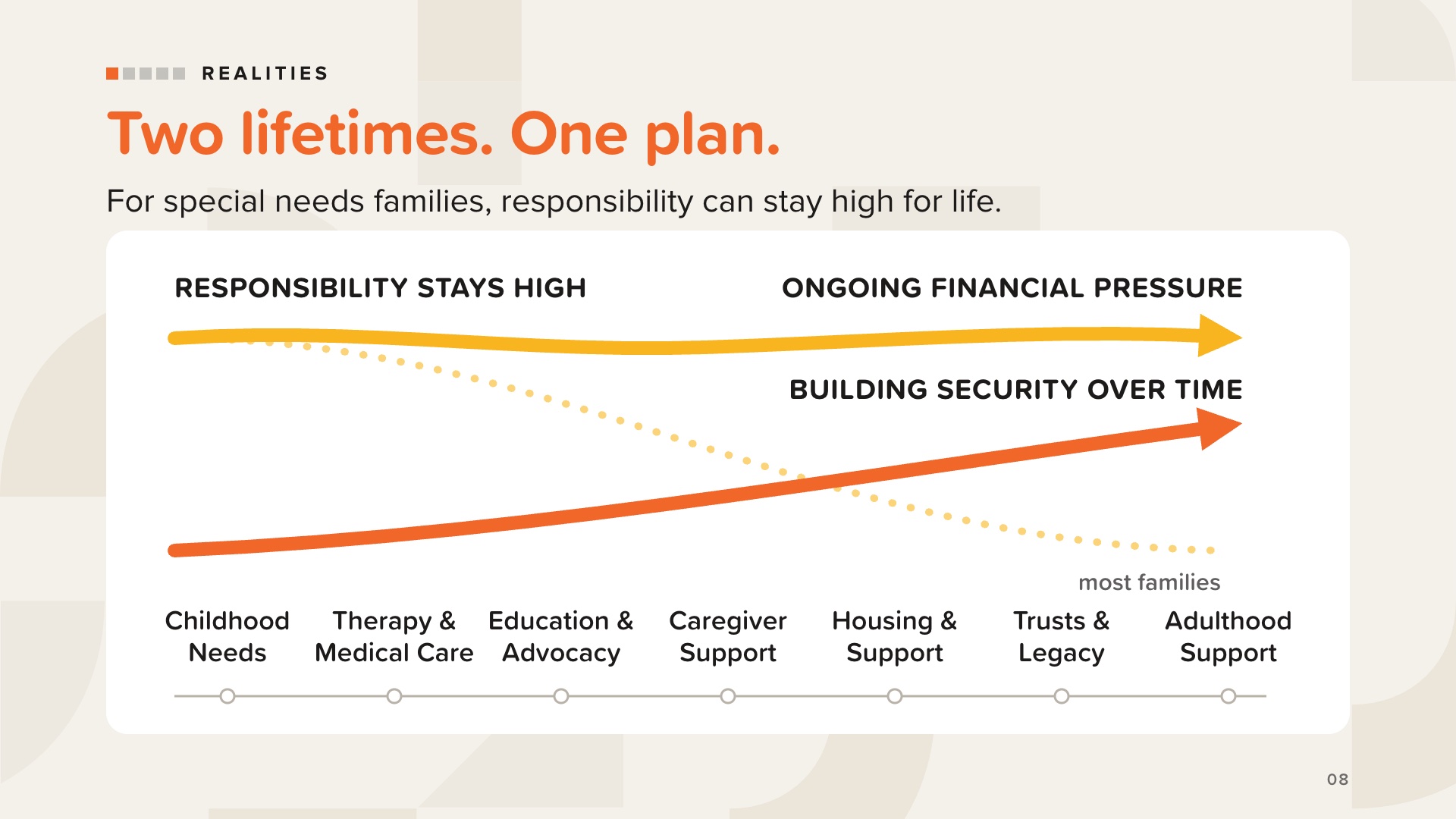
For parents of children with disabilities, the story is different. The curve that falls for other families may stay high for life.
On top of what most parents plan for, many families also pay for more doctor visits, medications, hospital stays and surgeries; therapies; individualized education programs; caregiving services; specialized equipment; and home and vehicle modifications.
So these parents do two jobs at once. They pay for higher living and medical costs today, and they plan for two lifetimes: their own and their child’s.
The dashed line is the curve from the last slide: the falling responsibility most families expect. Point to it, then to the yellow line that stays high.
As the book puts it, it’s the heaviest financial assignment a family can receive, and it also comes with an answer. Two lifetimes. One plan. That’s the purpose of the book.
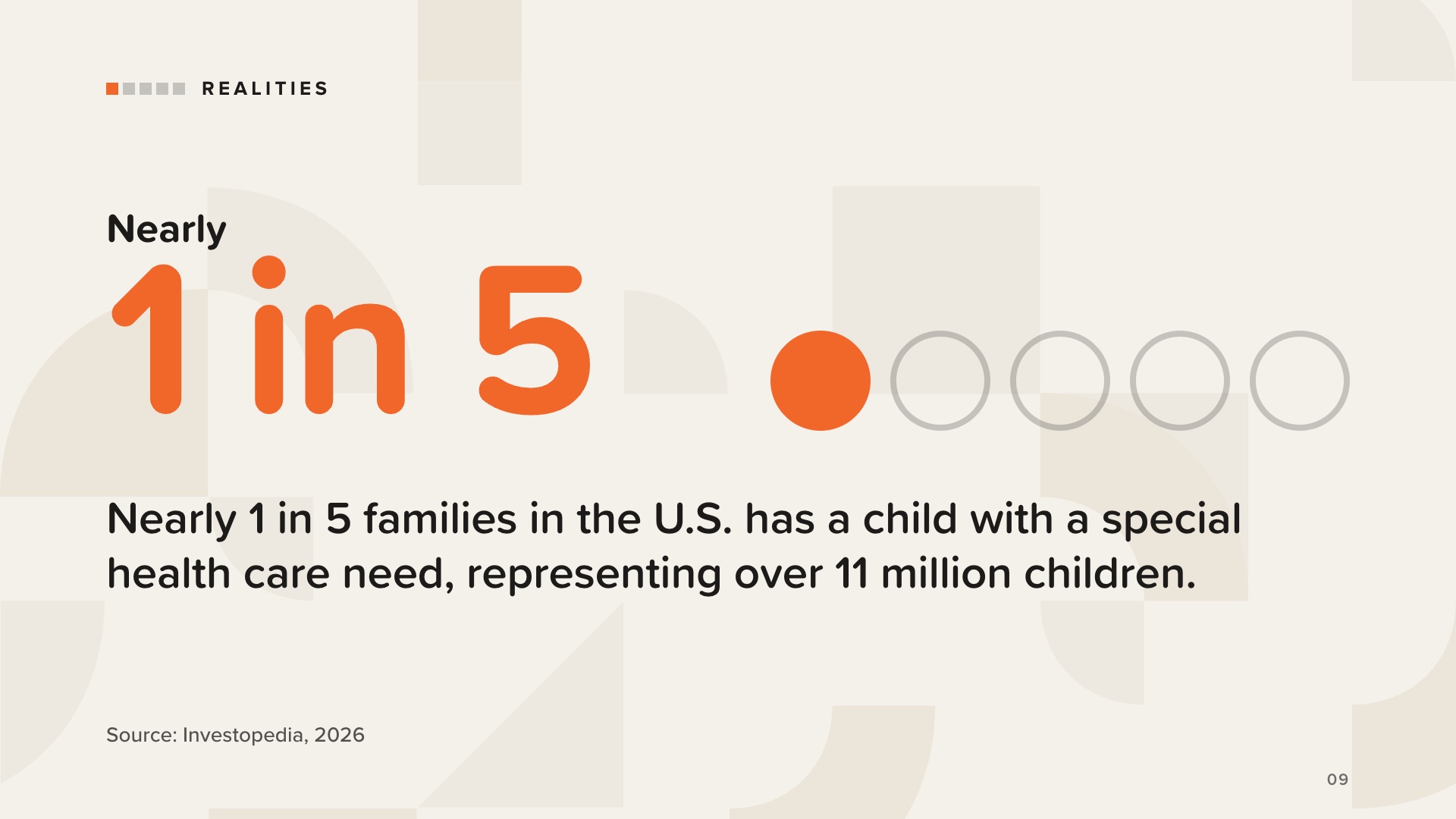
Start with how many families are on this road. Nearly 1 in 5 families in the U.S. has a child with a special health care need, representing over 11 million children.
If you’re in this room because you love one of those children, you are far from alone.
Use this wording exactly; it’s the figure the book uses.
Source: Investopedia, “Financial Planning for Families Living With Disabilities: An Essential Guide,” Matt Ryan Webber (Jan 6, 2026).
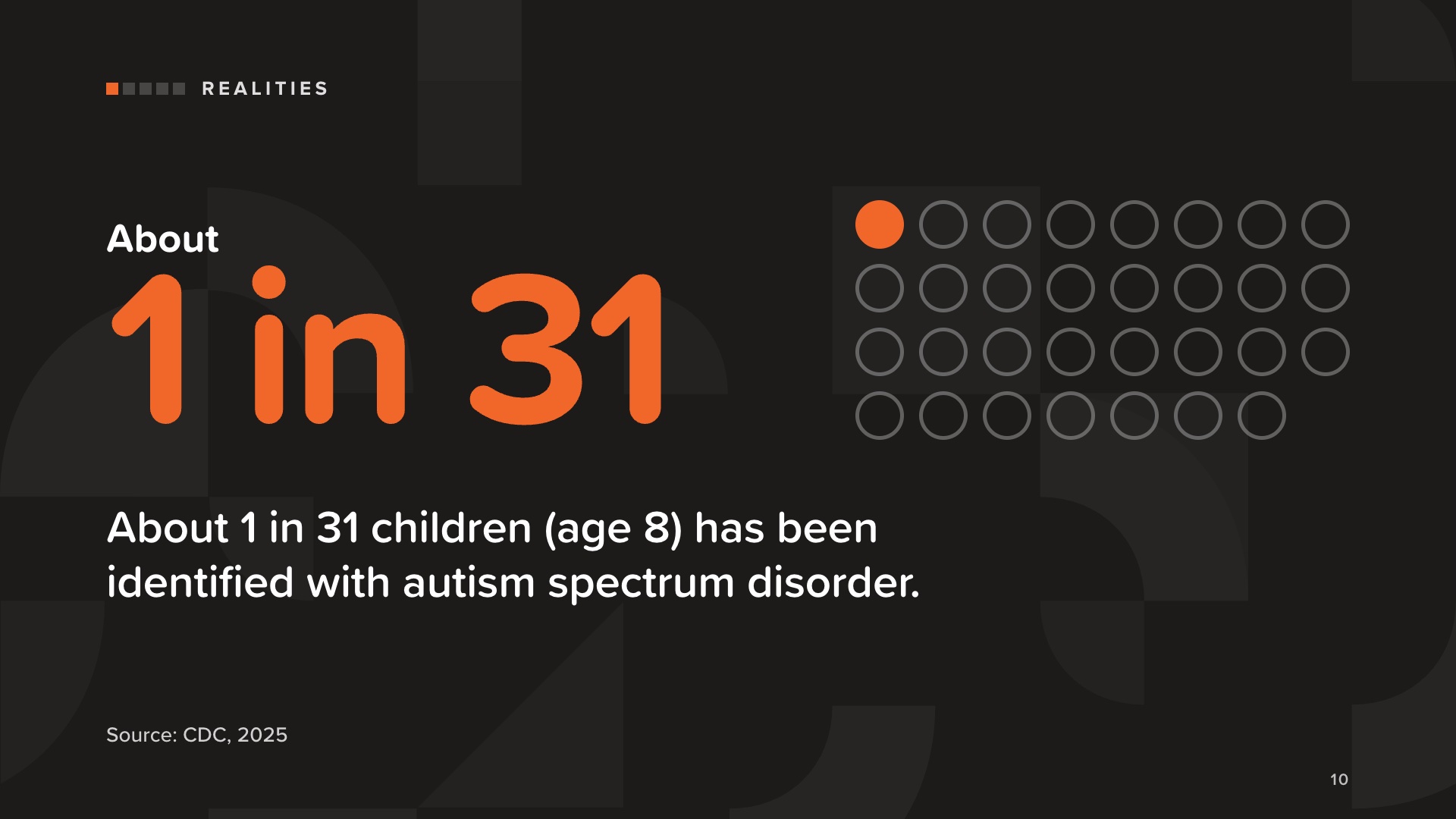
About 1 in 31 children (age 8) has been identified with autism spectrum disorder. In the book, Val’s son is on the spectrum.
Keep the language people-first: “a child with autism” or “a child on the spectrum.” Avoid words like “suffers from.”
Source: Centers for Disease Control and Prevention, “Prevalence and Early Identification of Autism Spectrum Disorder Among Children Aged 4 and 8 Years — ADDM Network, 16 Sites, United States, 2022,” MMWR Surveillance Summaries 74(SS-2), Apr 17, 2025.
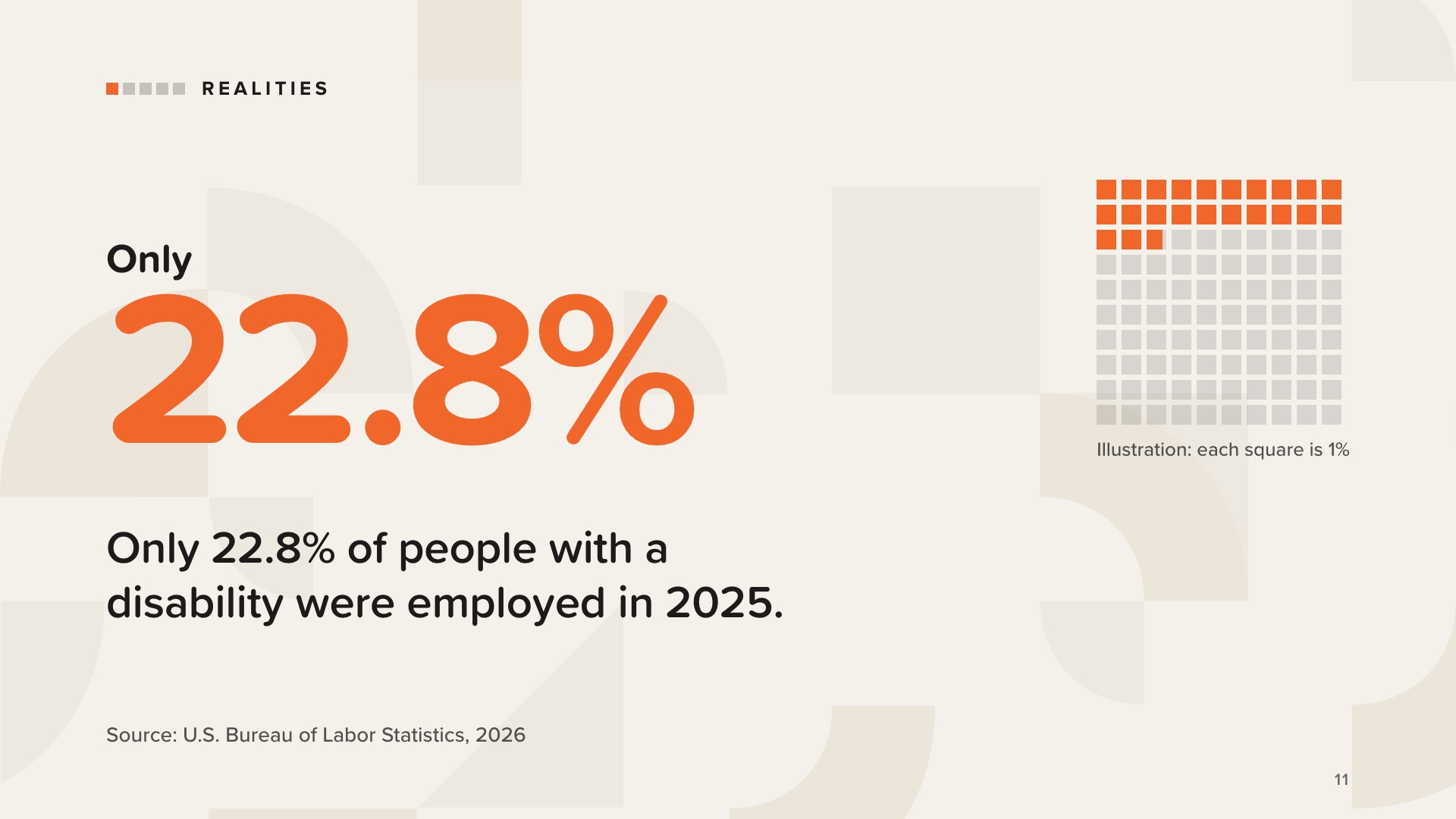
For many families, responsibility continues long after childhood ends. Only 22.8% of people with a disability were employed in 2025.
That means many adults with disabilities rely on government benefits, family, and other resources for living expenses and health care, through childhood and adulthood. This is why the plan has to cover two lifetimes.
The squares are a picture of the same figure: each one is 1% of people with a disability.
Source: U.S. Bureau of Labor Statistics, “People with a Disability: Labor Force Characteristics — 2025,” news release USDL-26-0364, Mar 3, 2026.
Caring for a child with special needs takes time: medical appointments, therapy sessions, school meetings, and sometimes constant supervision. Many childcare settings can’t take children with special needs, and private care can cost more than most budgets allow.
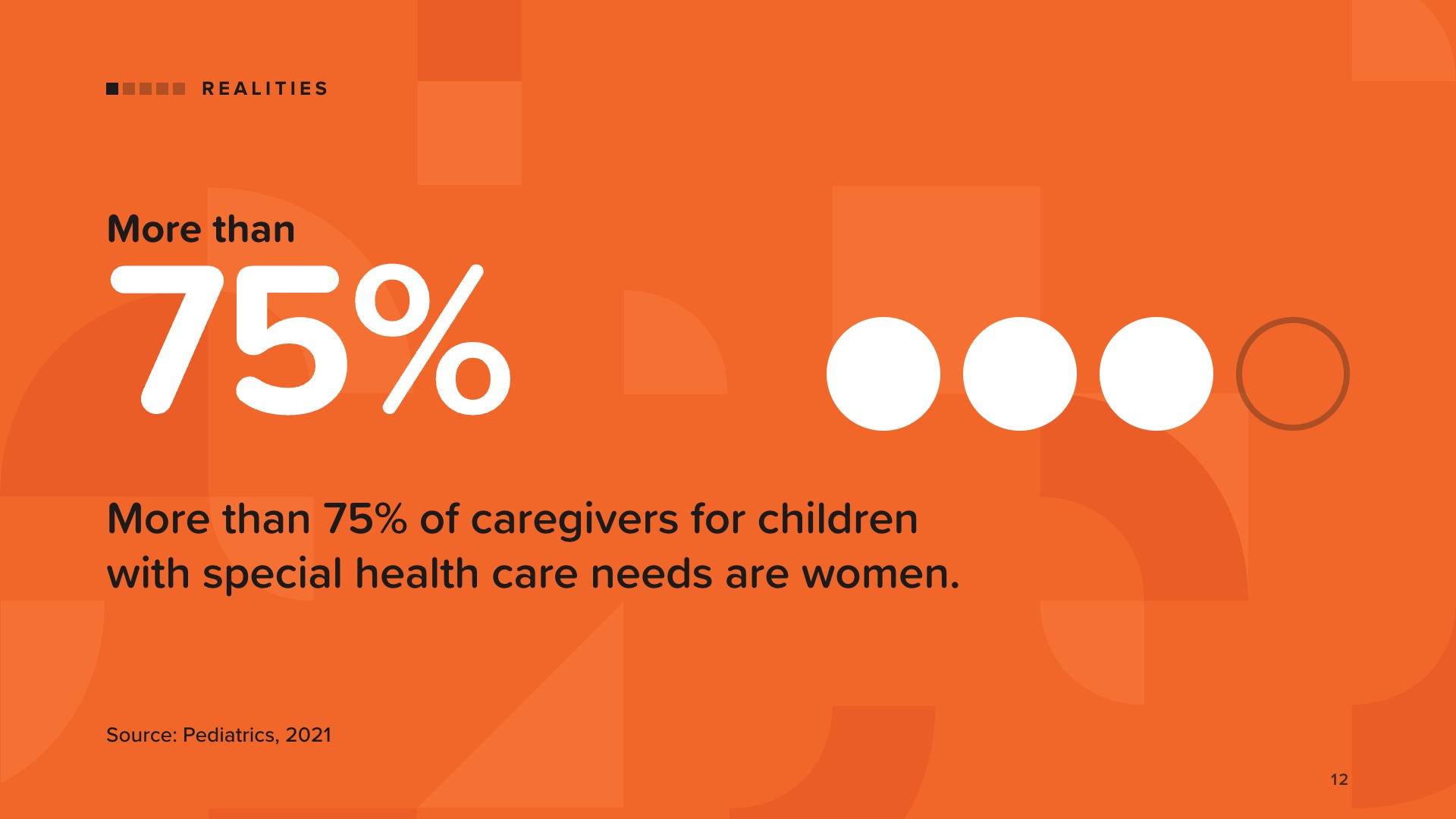
So one parent often looks for a more flexible job, works part-time, or leaves work entirely. Usually that parent is the mother. More than 75% of caregivers for children with special health care needs are women.
Source: Foster, Chorniy, Kwon, Kan, Heard-Garris and Davis, “Children With Special Health Care Needs and Forgone Family Employment,” Pediatrics 148(3), Sep 2021. (The study figure is 76.4%.)
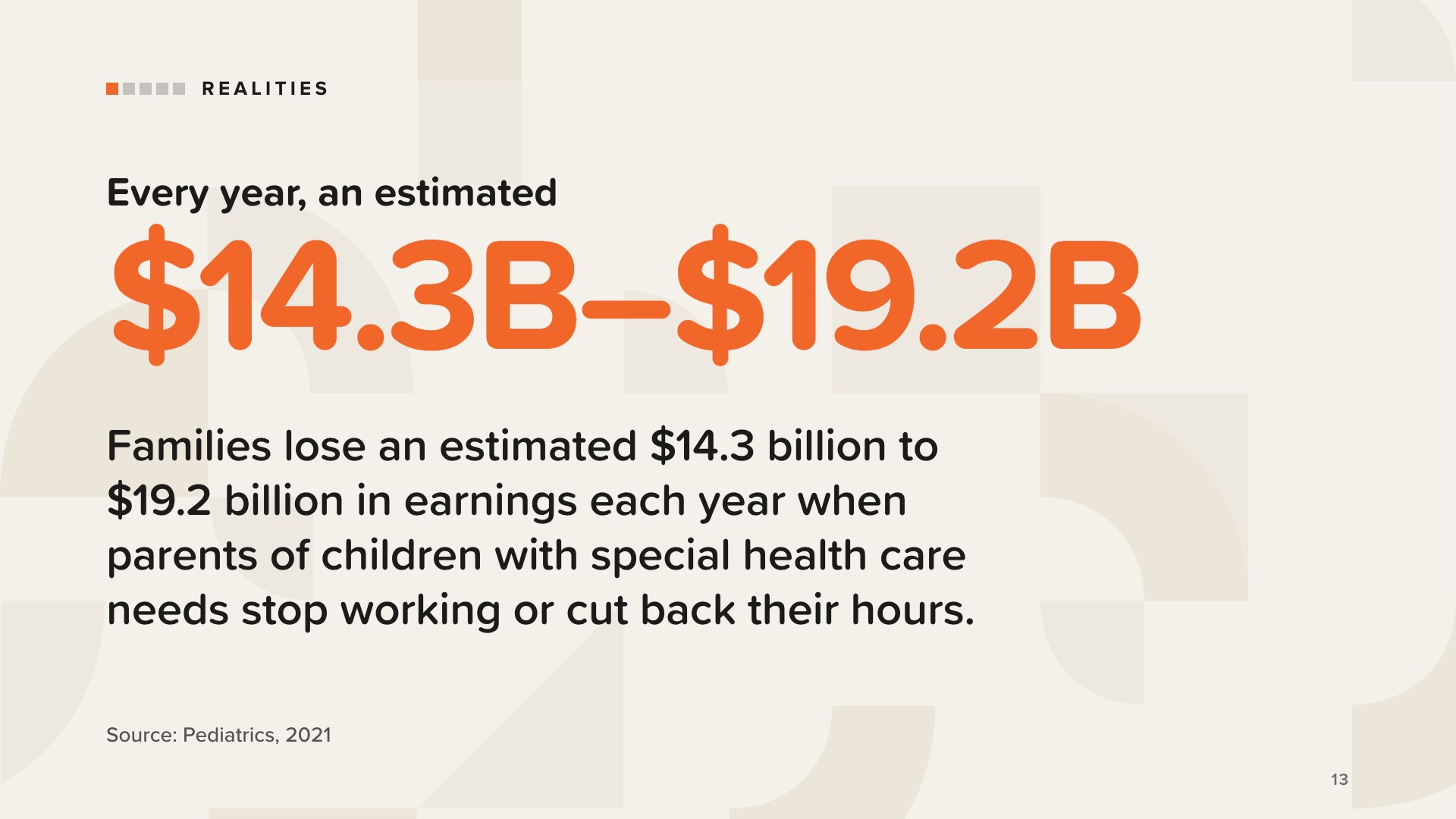
When a parent steps back from work, the family loses more than a paycheck. The book lists what else can go: retirement contributions, employer matching dollars, Social Security earnings history, health benefits, career momentum, professional networks, and future income growth.
Those losses may not show up right away, but they add up over the years.
The book also offers questions to ask before deciding: What is the real net income? What benefits would be lost? What is the long-term career cost? What happens to retirement security? What risks come with a single income? How are future benefits for loved ones affected? Are there other options, like flexible hours?
Source: Foster et al., “Children With Special Health Care Needs and Forgone Family Employment,” Pediatrics 148(3), Sep 2021.
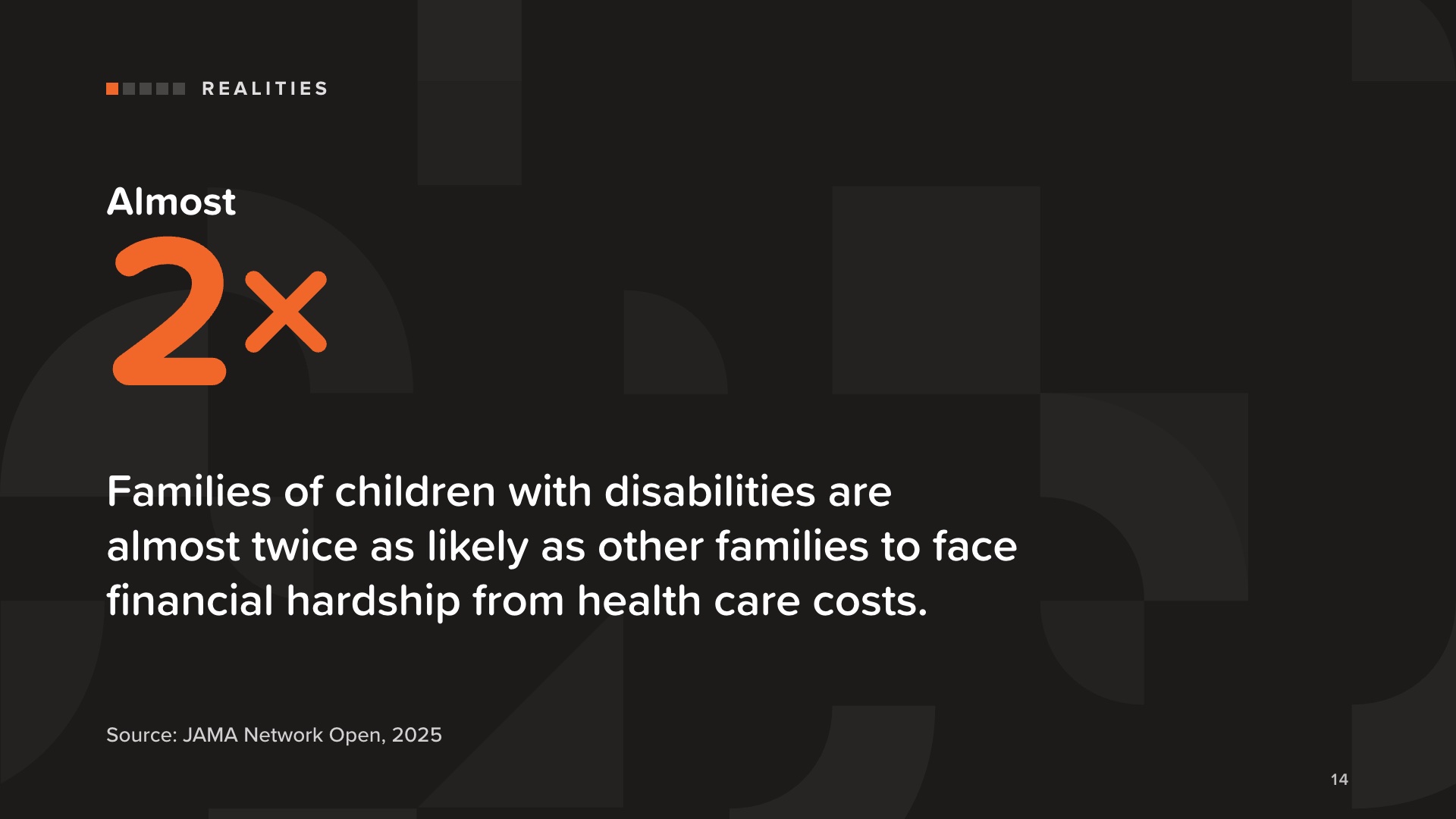
Families of children with disabilities are almost twice as likely as other families to face financial hardship from health care costs.
Say it plainly: this isn’t a personal failing. It’s the reality many families live with, and it’s why financial education and a plan matter so much.
Stick to the wording on the slide. Don’t add “lose sleep” or other details that aren’t in the study.
Source: Houtrow, Shearer, McKernan, Kuhlthau and Agrawal, “Health Care Cost Concerns and Hardships for Families of Children With Disabilities,” JAMA Network Open 8(4):e257826, Apr 24, 2025.
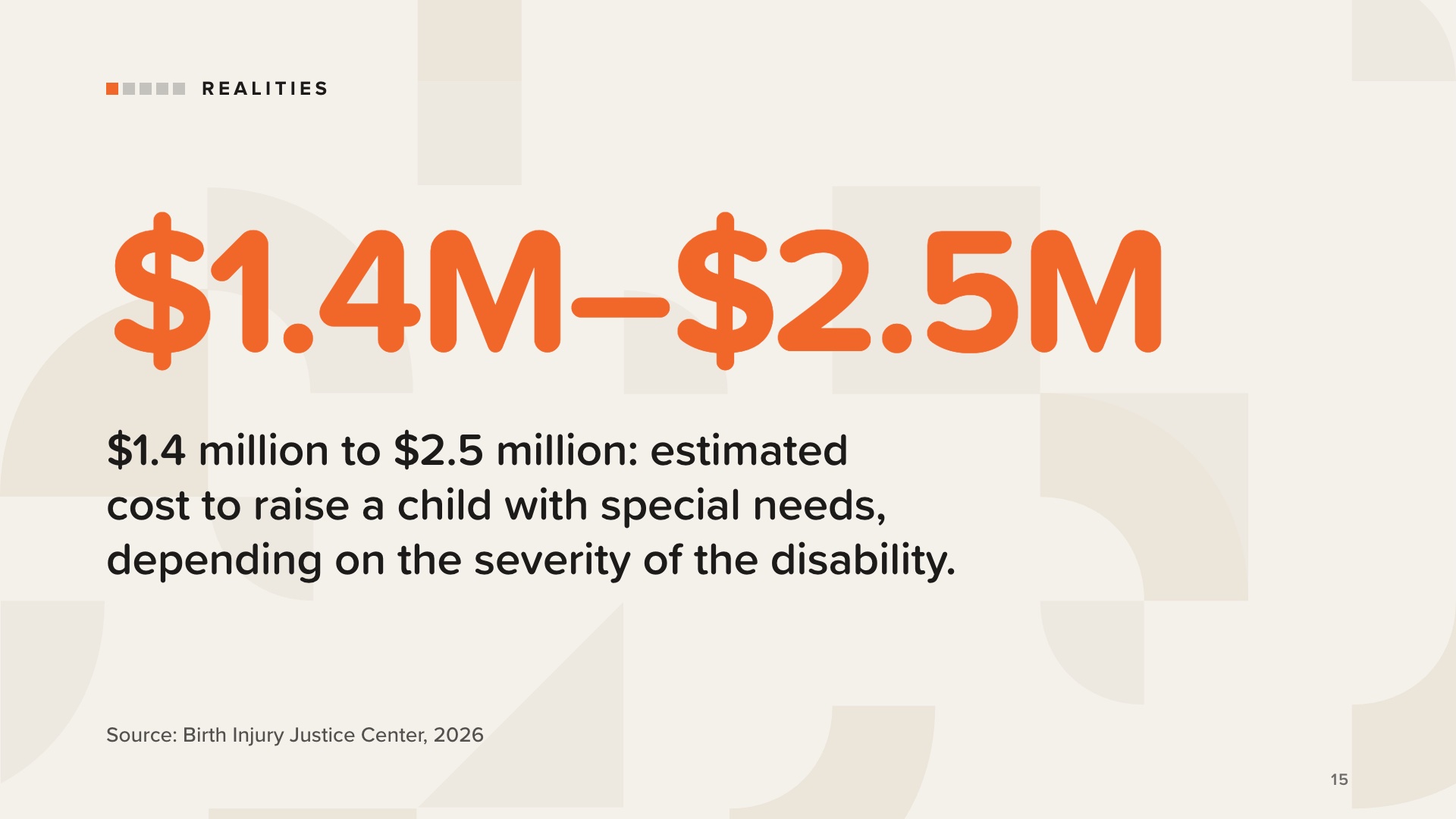
$1.4 million to $2.5 million is the estimated cost to raise a child with special needs, depending on the severity of the disability.
It’s an estimate, not a prediction for any one family.
The point isn’t to frighten anyone. Every family’s numbers are different, which is why a plan has to be built on your own numbers.
Source: Birth Injury Justice Center, “Financial Support for Children With Disabilities,” Katie Lavender, RN (Jan 5, 2026).
Now the government programs, in plain words. Help exists. It can just be complicated to find and keep.
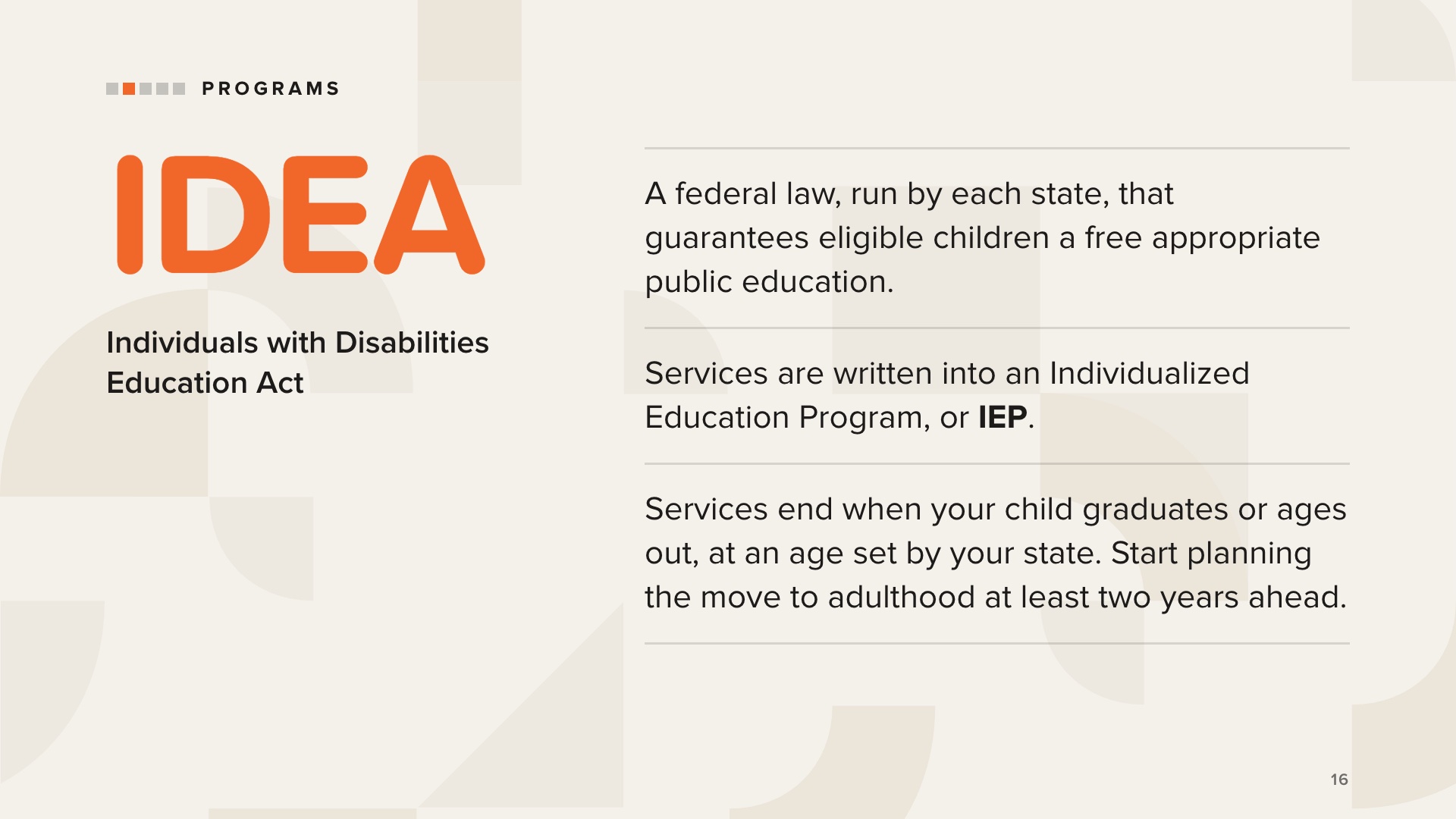
IDEA, the Individuals with Disabilities Education Act, is a federal law run through the states. It guarantees a free appropriate public education, in the least restrictive environment, to eligible children with disabilities. It covers early intervention for infants and toddlers, and special education services during the school years.
Services are delivered mainly through an IEP, developed with parents, educators, and other professionals.
Here is the important part. These services end when your child graduates or ages out, and the age depends on your state. After that, the main responsibility for education services shifts to the family. The book suggests preparing for that transition at least two years before services end.
Each state also has a federally funded Protection and Advocacy System that provides legal advocacy for people with disabilities. The National Disability Rights Network lists them.
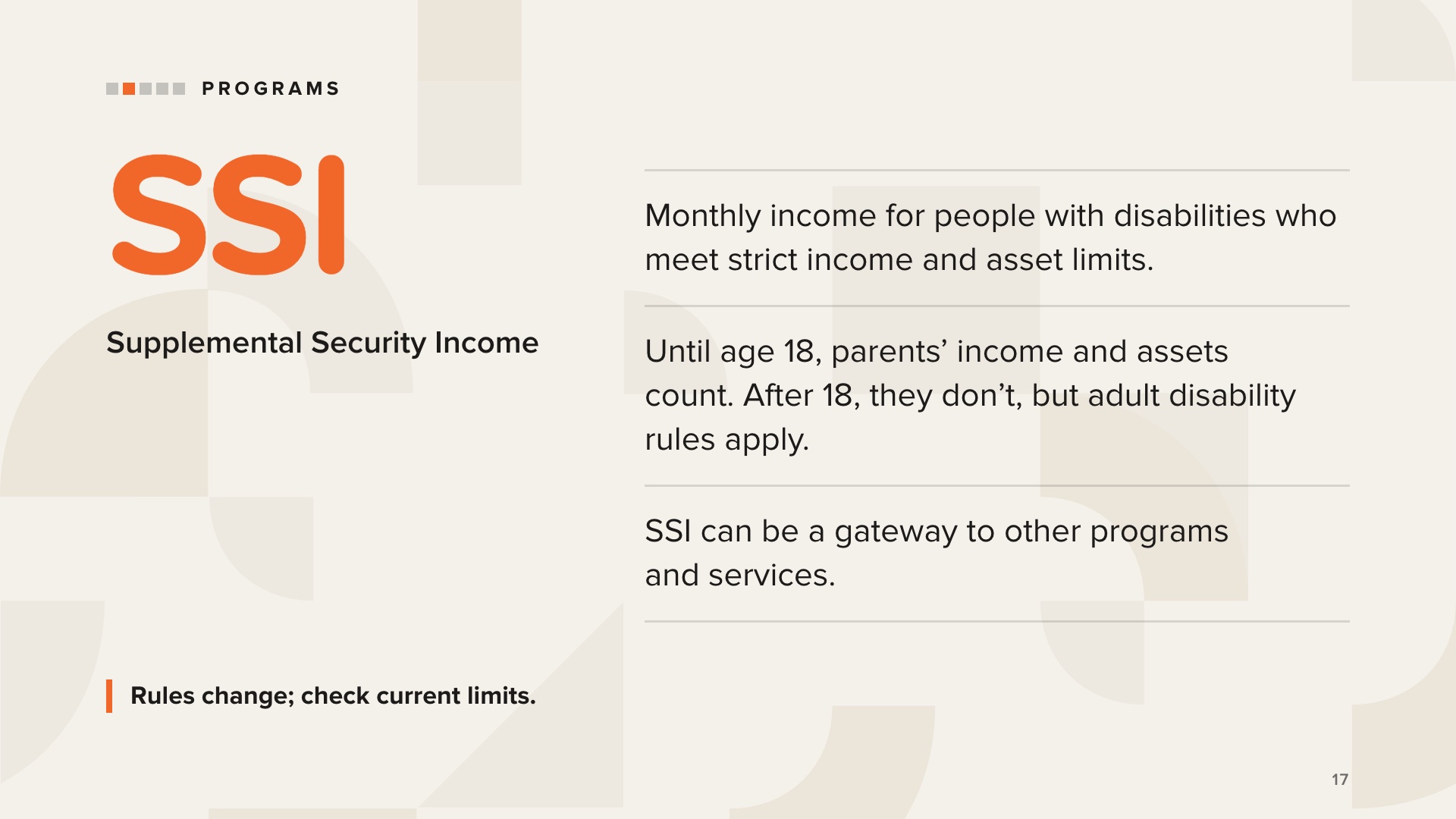
SSI, Supplemental Security Income, provides monthly cash flow for people who meet its eligibility rules.
It’s “means-tested.” Until a child turns 18, the parents’ income and assets are counted, and the limits are very low, so many families don’t qualify while their child is a minor.
At 18, the parents’ income and assets no longer count. But Social Security reviews eligibility again using the adult disability rules. That’s the next slide.
SSI eligibility often opens the door to other programs and services.
Don’t quote dollar limits from memory, and never tell anyone they will or won’t qualify. Rules and limits change, so point families to Social Security (ssa.gov) and their own professionals for current figures.
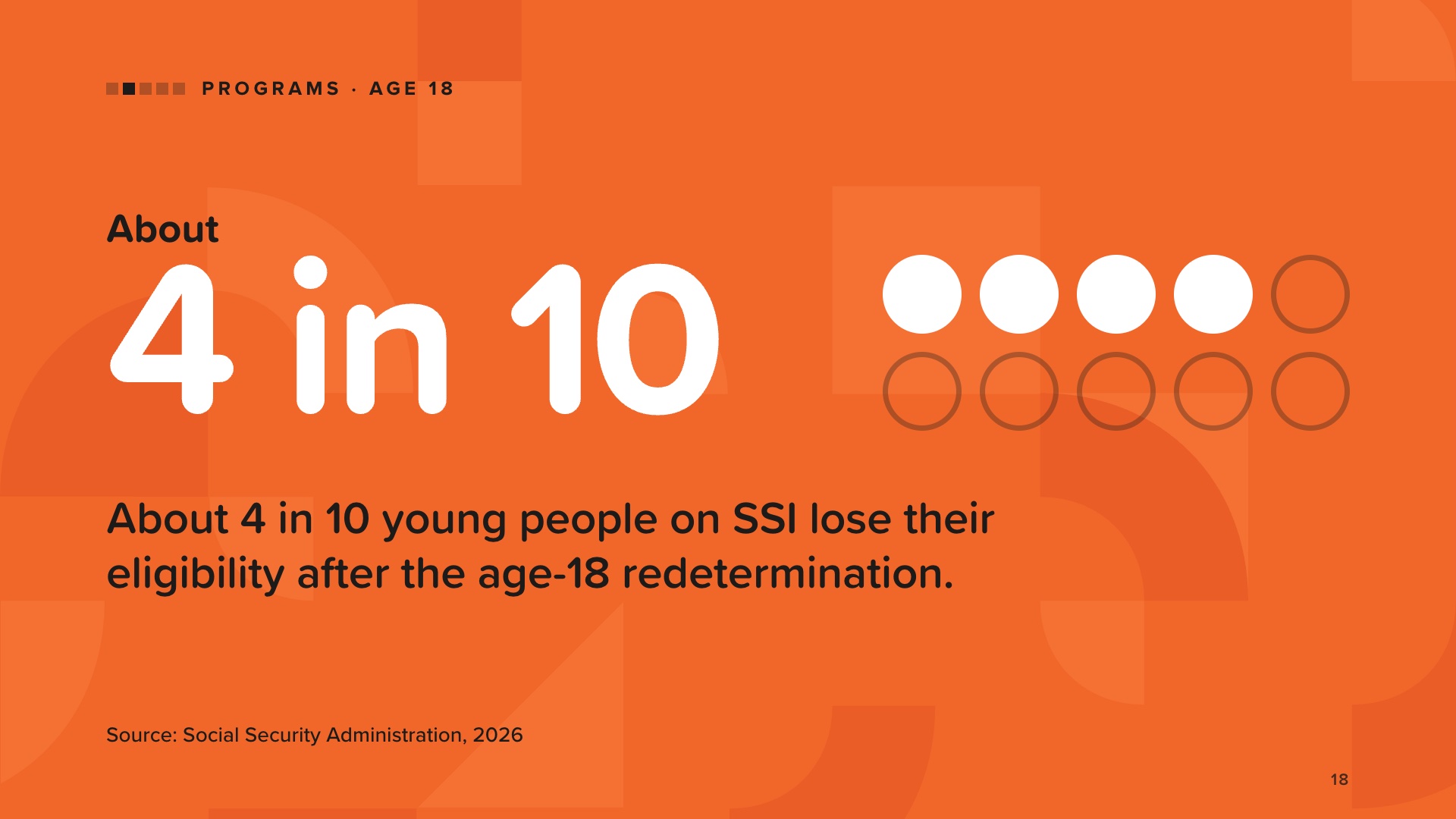
At 18, Social Security reviews whether a young person can keep receiving SSI, using the adult disability rules instead of the rules for children. It means new forms and documentation showing a severe impairment that prevents substantial work.
About 4 in 10 young people on SSI lose their eligibility after the age-18 redetermination.
What families can take from this: know the review is coming, and prepare the records early. Each state’s Protection and Advocacy System can help with SSI appeals and benefit disputes.
Use “about 4 in 10.” If someone asks about a different figure, this is the most recent Social Security data (2026 SSI Annual Report).
Source: Social Security Administration, “2026 Annual Report of the Supplemental Security Income Program,” Table V.D4, Jul 22, 2026.
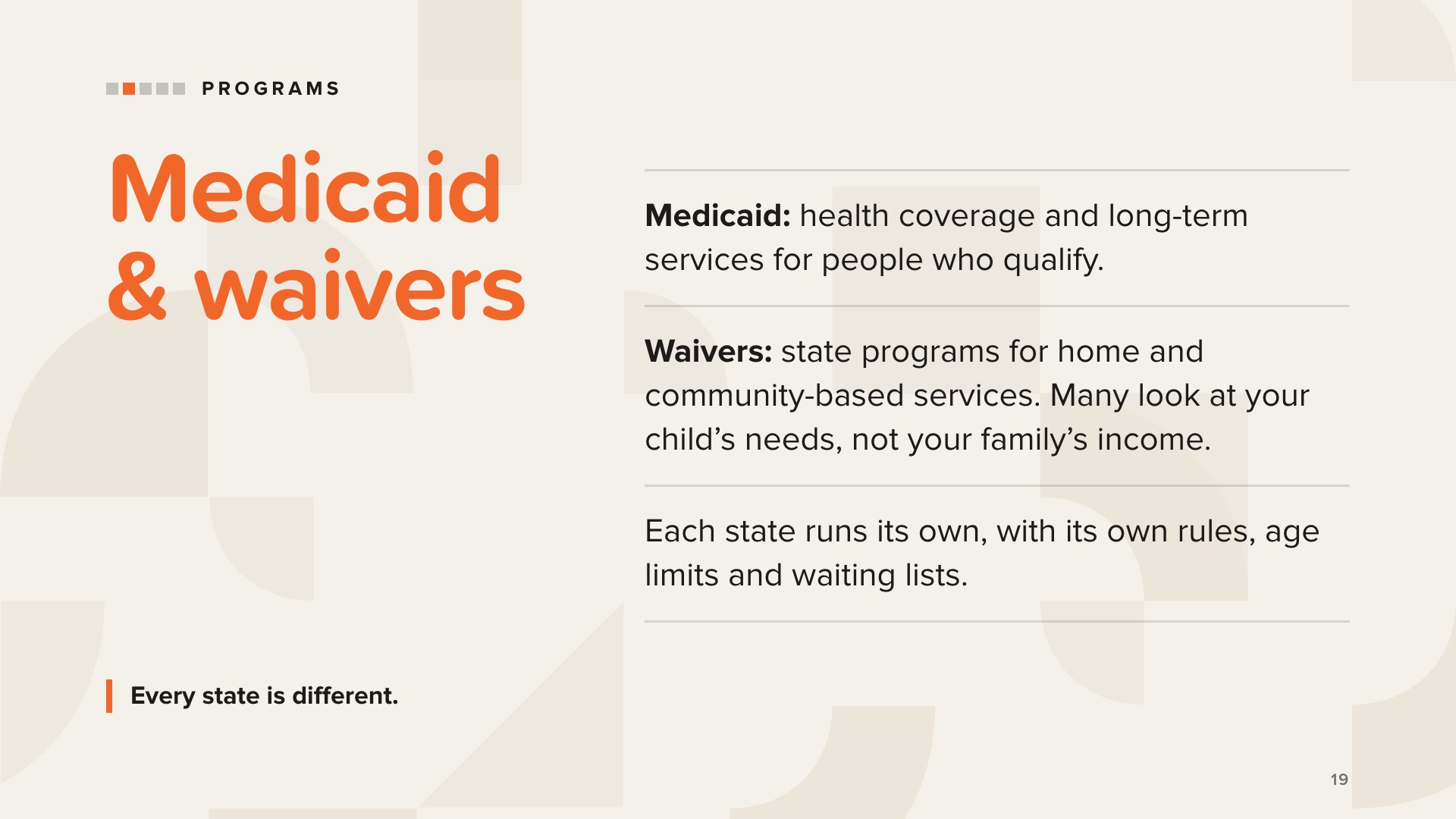
Medicaid is a needs-based program. Besides medical and dental care, it can fund day programs for adults with special needs, and in some states it can pay family caregivers. In most states, people who receive SSI also qualify for Medicaid. Families should check their own state.
Waivers are the next place to look for families who don’t qualify for Medicaid. The most common is the home and community-based services (HCBS) waiver. Many waivers look at the disability or the level of care needed rather than the parents’ resources.
An example from the book is the Katie Beckett waiver, also called the Deeming Waiver or TEFRA Medicaid. It’s available in many states for children 18 and younger, and it sets aside the parents’ resources.
Watch for age limits and yearly renewals. Some waivers end at 18 or 21, and some must be renewed every year.
Medicaid.gov lists waivers by state. Never promise anyone eligibility.
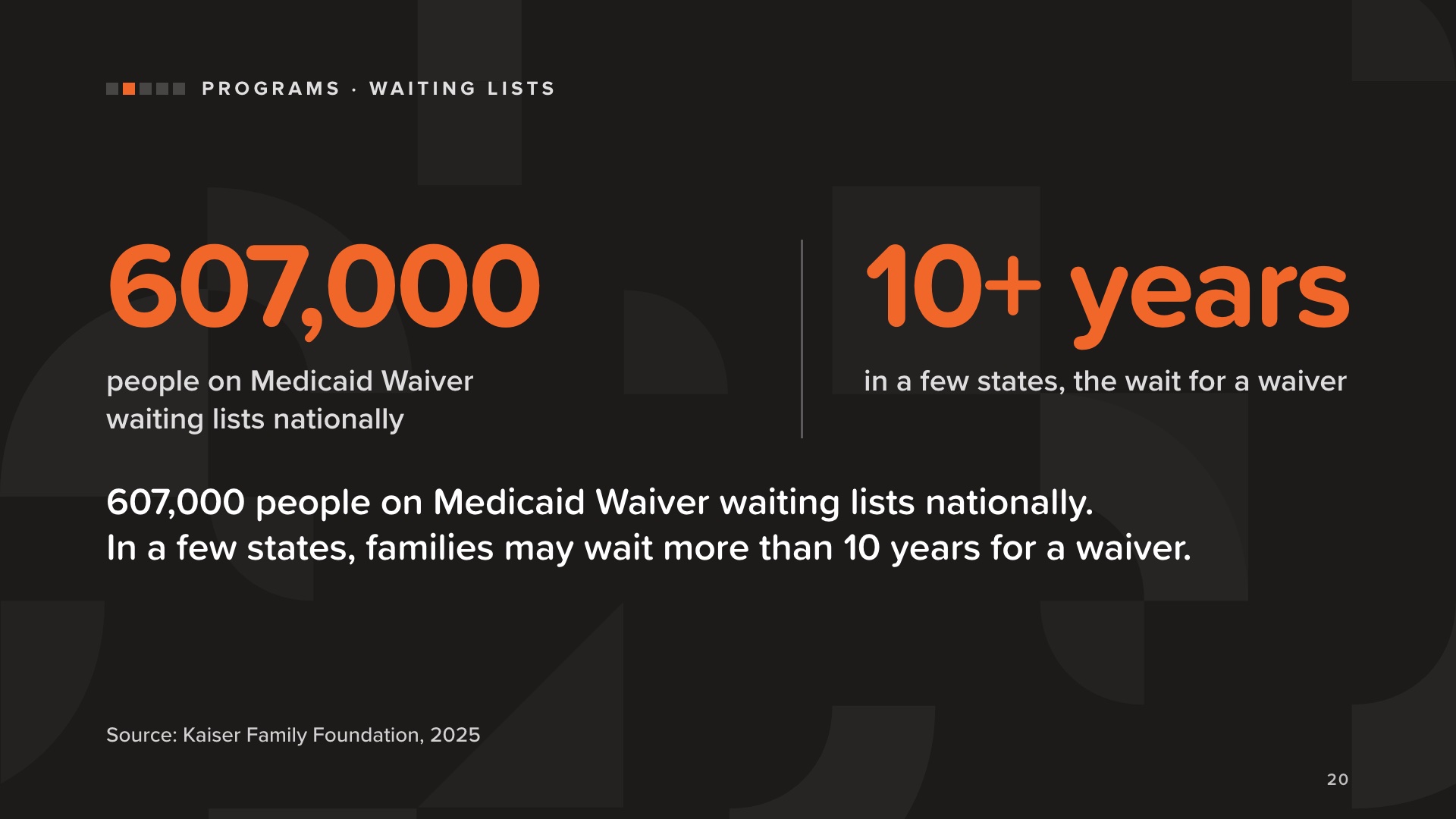
Each state has a limited number of waiver slots, so many families wait months, and sometimes years.
607,000 people are on Medicaid Waiver waiting lists nationally. And as the book puts it, in a few states families may wait more than 10 years to receive approval.
What families can take from this: ask about waiting lists early, and learn how your state’s list works.
Source: Kaiser Family Foundation, “A Look at Waiting Lists for Medicaid Home- and Community-Based Services from 2016 to 2025,” Alice Burns, Abby Wolk, and Molly O’Malley Watts (Nov 20, 2025). The “more than 10 years” line is from the book (p.23), which cites the same KFF report.
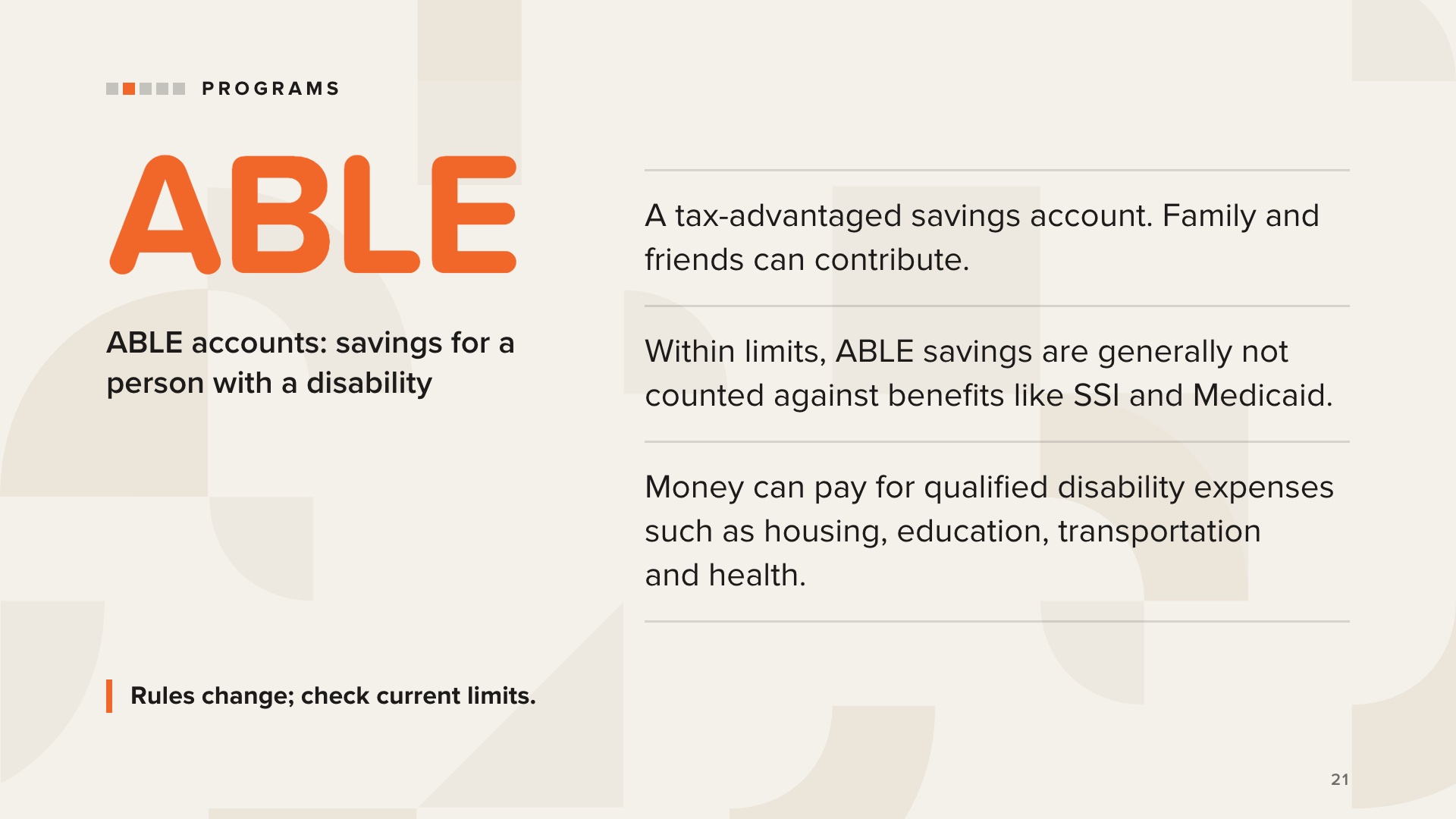
ABLE accounts come from the federal ABLE Act (Achieving a Better Life Experience). They’re sometimes called 529A accounts.
They were designed so people with disabilities can save and grow money without losing critical government benefits, within limits. Family members, friends, and others can contribute.
Withdrawals for “qualified disability expenses” can cover education, housing, transportation, employment training, assistive technology, health, basic living expenses, and more.
Things to know:
• A person can have only one ABLE account.
• Eligibility depends on the age when the disability began.
• Contribution limits and balance limits apply, and they change. Check the ABLE National Resource Center (ablenrc.org) or your state’s plan for current rules.
• After the account owner dies, Medicaid may claim what’s left.
We describe how ABLE accounts work. We don’t recommend any plan or investment.
Start with the simplest idea in the book: interest. Interest is what money earns while it waits. When you save, interest can work for you. When you borrow, you pay it instead. It’s the same force running in two directions.
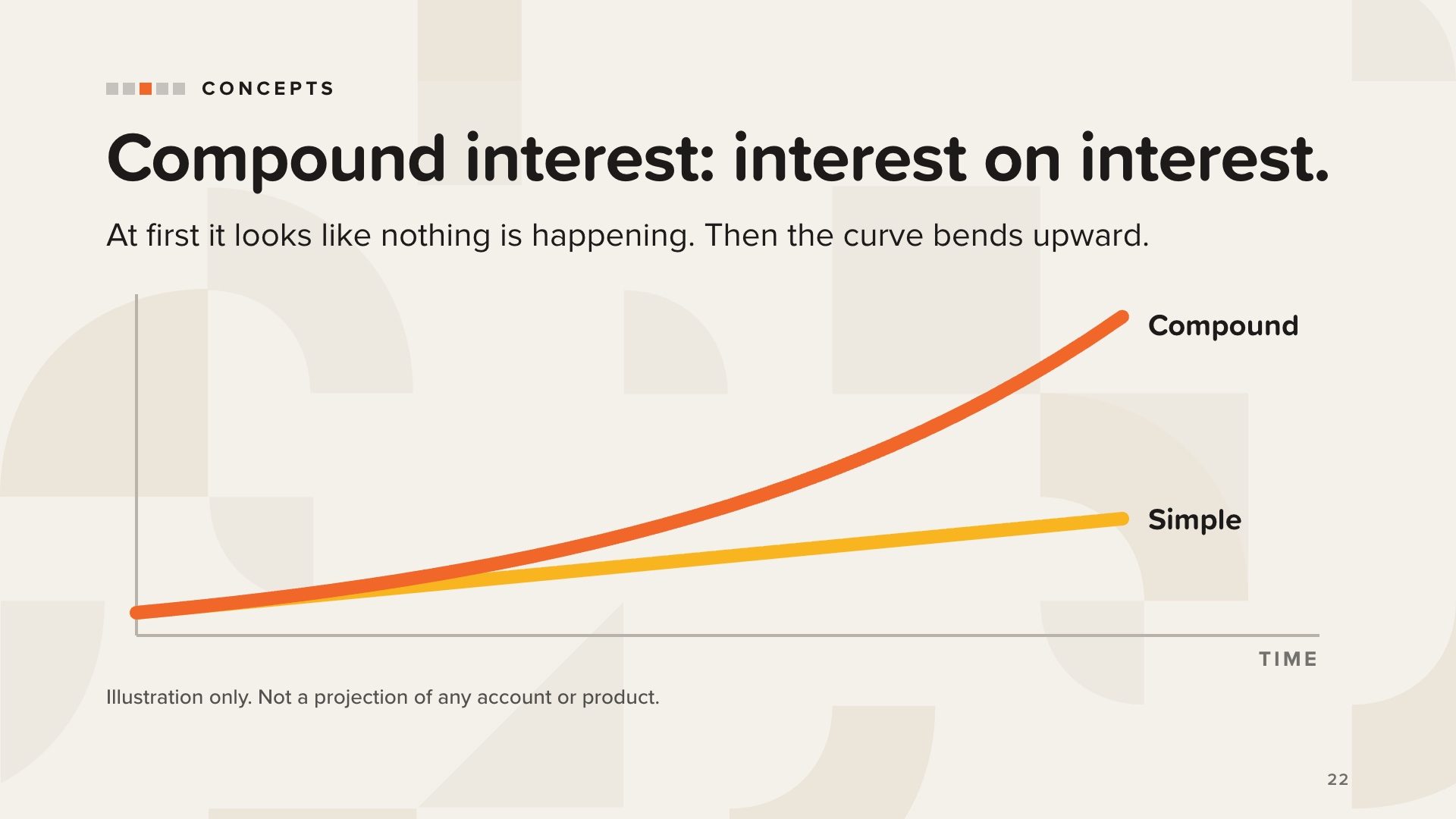
Simple interest is calculated only on the amount you started with, so it grows in a straight line (yellow).
Compound interest is calculated on the starting amount plus all the interest already earned. It’s interest on interest, so it grows in a curve that keeps bending upward (orange).
At first, the compound curve looks unimpressive. Then the interest starts earning interest, and the curve climbs in a way that surprises almost everyone.
The same math works against you on credit card balances.
This is a picture of the idea, not a projection. Don’t quote rates of return or dollar outcomes.
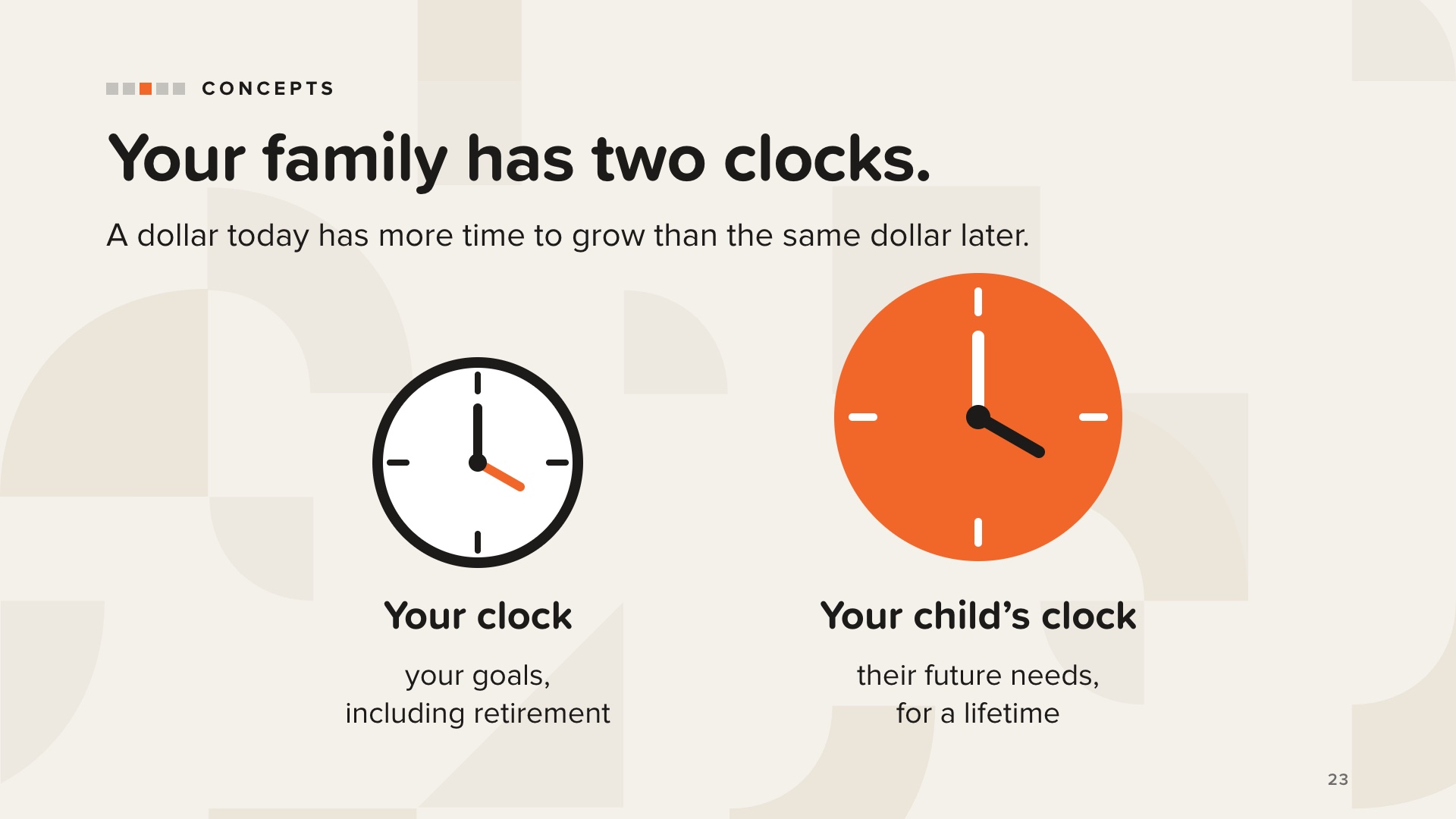
The time value of money means a dollar you have today is worth more than the same dollar later, because today’s dollar has more time to earn.
The book says your family has two clocks. One measures your timeline and your goals, including retirement. Depending on your age, your clock may have 20, 30, or 40 years. The other is your child’s clock, and it may run 40, 60, or even 80 years. On that clock, time is an incredibly valuable asset.
The book’s question to ask about any dollar: which clock is it on? Yours, or your child’s?
The sooner you start, the less you need to set aside. And it’s never too late to begin.
Concept only. Don’t quote rates or dollar targets.
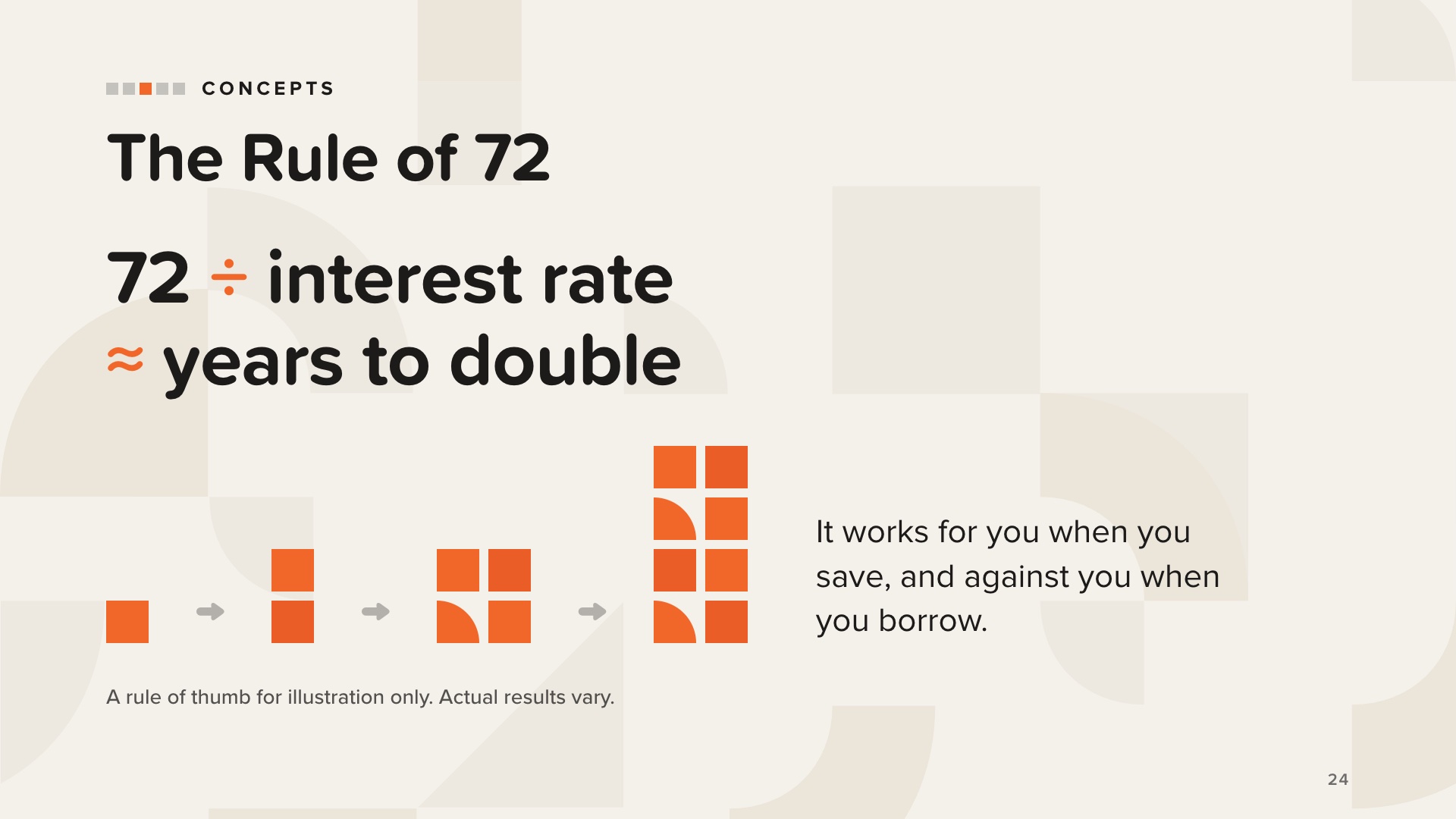
The Rule of 72 is a quick way to estimate how long it takes money to double: divide 72 by the interest rate.
Like compound interest, it works for you when you save and against you when you borrow. The same math that doubles savings also doubles what you owe on a high-interest balance.
The book’s homework: gather your bank, retirement, and investment statements, plus your credit card and loan statements. Look at what each one earns or charges, and use the Rule of 72 to see how many doubles are working for you and how many are working against you.
Keep it conceptual. Don’t quote rates, compare products, or suggest where anyone should move money.
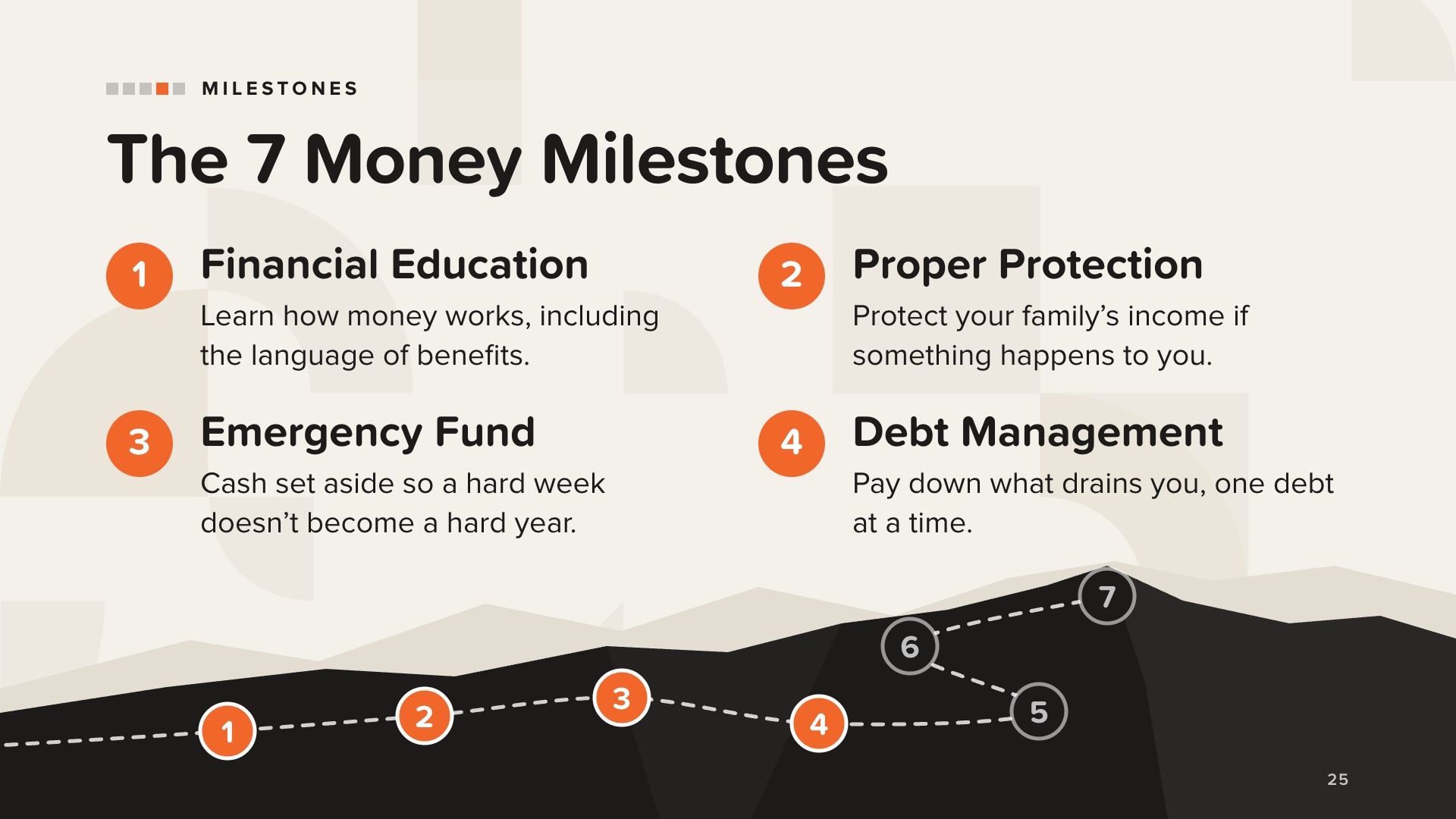
The 7 Money Milestones are the roadmap in every book in TheMoneyBooks series. This book applies them to special needs planning. The path up the hill is the book’s own picture of the milestones: each one builds on the one before.
1. Financial Education comes first because every other milestone builds on it. For special needs families there’s a second shelf of vocabulary: government benefits, ABLE accounts, beneficiary designations, Special Needs Trusts, Letters of Intent. Nobody should feel behind for never being taught this.
2. Proper Protection: if your child depends on you for everything, protecting your family if something happens to you matters even more. One caution from the book: if a child receives, or may someday receive, government benefits, money left directly to the child can affect eligibility. We’ll come back to that under Protect Wealth.
3. Emergency Fund: cash for what you can’t predict. For these families, “emergency” covers more, like equipment that can’t wait or care that has to be paid for while benefits are pending. Start small if you need to.
4. Debt Management: no more late payments, and target one debt at a time.
Education only. Don’t recommend specific products or amounts.
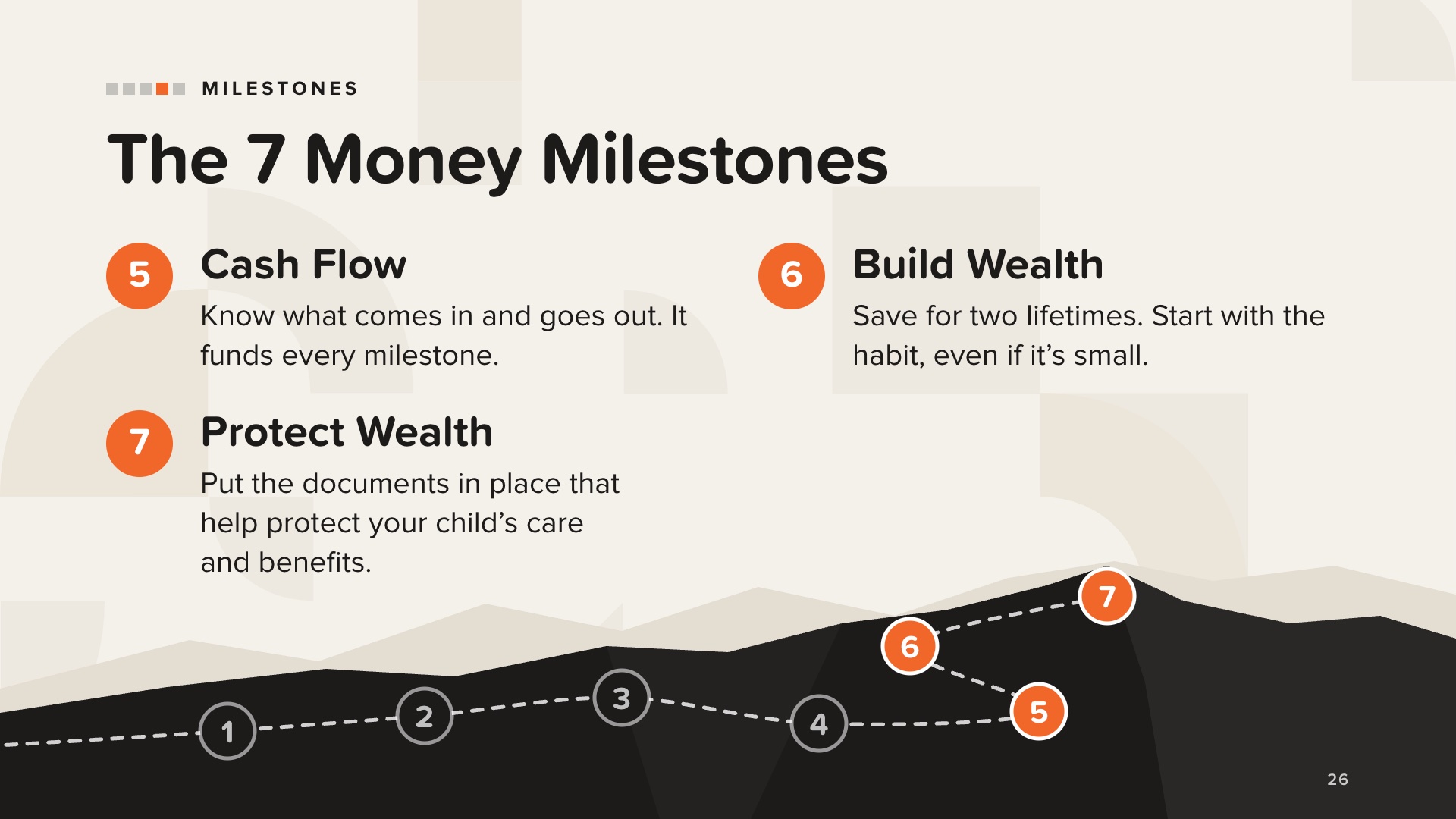
5. Cash Flow is money coming in and money going out. Whatever is left over funds everything else: the emergency fund, protection, paying off debt, and building wealth. The book includes a monthly budget with lines specific to special needs families, like therapies, equipment, and benefits as income.
6. Build Wealth: you’re saving for two lifetimes, yours and your child’s. Start with the habit and set aside something every payday, even a small amount. This is also where the book covers ABLE accounts.
7. Protect Wealth is the milestone many parents put off longest, because it asks the hardest questions. Parents of children with special needs can’t afford to delay it. The book calls it a way to show love for your child: you create and fund the plan for their care when you’re no longer here.
The next four slides cover the key documents.
A Special Needs Trust is designed to hold assets for a person with a disability in a way that, when it’s set up and managed correctly, helps preserve eligibility for government benefits. Because the trust owns the assets, they aren’t considered owned by the child. The trust pays for things benefits don’t cover, like education, travel, entertainment, personal care, and other goods and services that improve the child’s life.
The book describes three types:
• Third-party trusts are usually set up by parents to receive gifts and inheritances from family and friends. They can be named as the beneficiary of life insurance, retirement accounts, and wills.
• First-party trusts hold assets the child already owns, such as an inheritance left directly to them or a settlement. These are subject to Medicaid repayment at the child’s death.
• Pooled trusts are managed by a nonprofit organization.
This is legal work. The book is clear: consult an attorney or legal service that specializes in this area, because it’s too important to risk your child’s benefits. Don’t give legal advice.
A Letter of Intent is an informal document parents write to help future caregivers if something happens to them. You know your child better than anyone, and this is where you write it all down.
It covers medical history, diagnoses, medications, and treatment plans. It also covers the things that make your child who they are: what a good day looks like, the routines that help them feel safe, what makes them happy and comfortable, and what triggers their biggest fears. It lists everyone on their team, from caregivers and case managers to teachers, therapists, and doctors.
It isn’t legally binding, but it’s the roadmap for whoever takes the lead when you can’t. The book calls it a living document that should be updated at least once a year.
The book includes a full checklist, and sample letters are available online, for example from The Arc.
Some assets pass automatically to whoever is named on a beneficiary form. They don’t go through a will or trust. These include life insurance, annuities, IRAs, and 401(k)s and other retirement plans.
Money that passes directly to a child who receives benefits can put those benefits at risk. That’s why the book says the child’s Special Needs Trust, once it’s set up, is the beneficiary to name.
Two action items from the book:
1. Check every beneficiary designation, including old 401(k)s from previous employers.
2. Talk with grandparents and other family members about their own beneficiary forms, wills, and trusts.
The book tells a true story. Parents in their 80s left IRAs split between their daughter and their son, who has a disability and depends on government benefits. Because the money was left to him directly, the family faced hard choices, and the fix cost the daughter a big tax bill. The book’s point: reviewing beneficiary forms early, with an attorney, can help families avoid situations like this one.
Point families to their attorney. Don’t tell anyone how to fill out a form.
Before 18, parents are usually a child’s legal guardians. At 18, the child is an adult in the eyes of the law. They have their own right to privacy, and parents lose automatic access to medical and financial information.
If your child can take care of themselves and make their own decisions, the book suggests talking with them about a power of attorney and an advance healthcare directive that name you as their agent. You become a support, not the decision-maker.
If your child can’t manage their personal care, finances, or health decisions, you can ask your local family or probate court to appoint you as guardian or conservator. The book describes two kinds: guardian of the person (care, health, living arrangements) and guardian of the estate (property and finances, which the court watches closely).
The book recommends working with an attorney who knows the process. Start the conversation before your child turns 18.
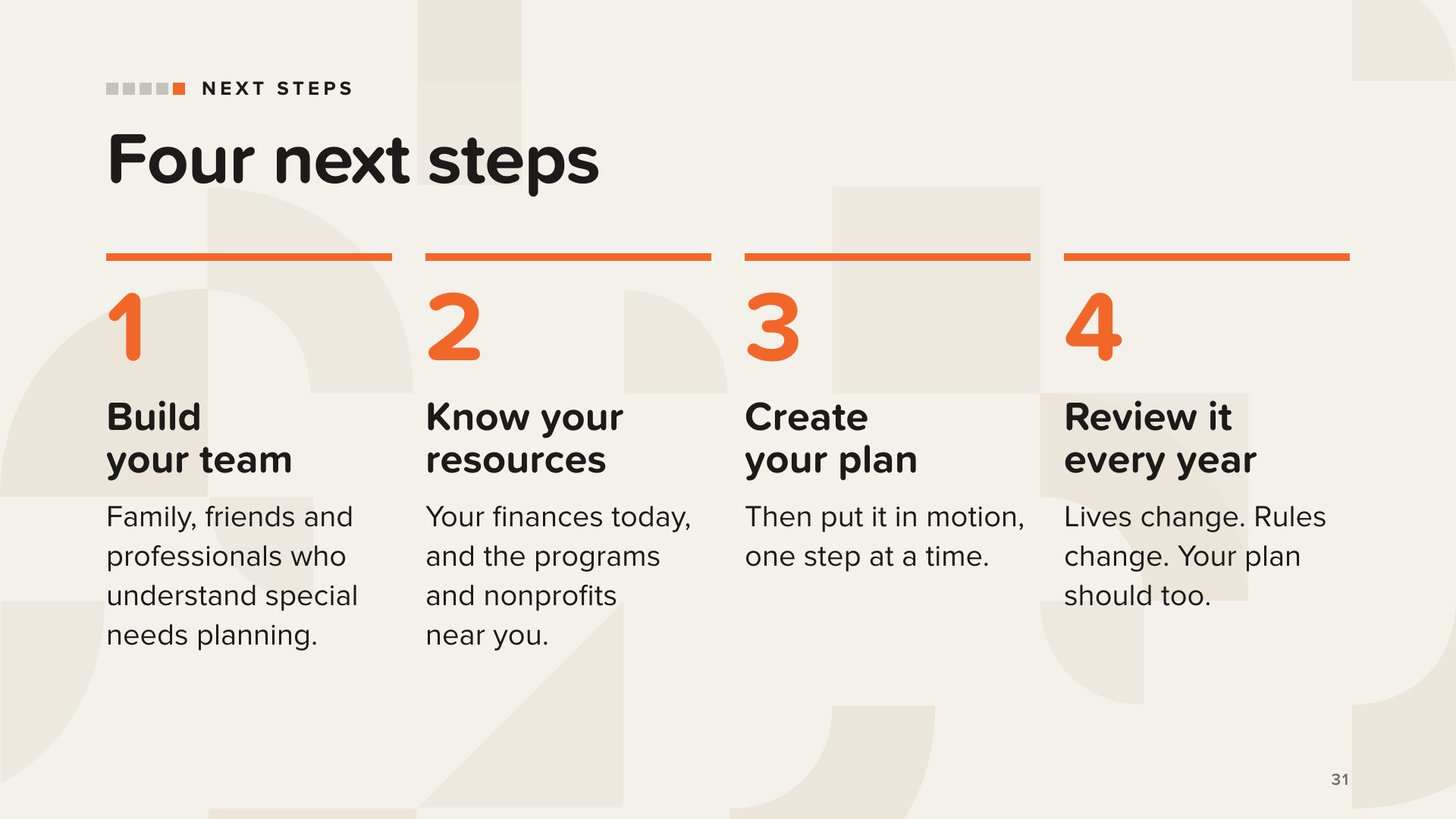
The book closes with four next steps.
1. Build your network and team. In the book, a friend who also has a child with special needs gave Val the advice that changed everything: find a financial professional with experience helping special needs families, and build a team of friends and family to support you at every step. Your team may also include an attorney who specializes in special needs planning, a tax professional, and your child’s care team.
2. Know your financial situation and available resources: where you stand today, and which government programs and nonprofits are available near you.
3. Create and implement your plan. You don’t need a perfect plan to begin. You need the right next step.
4. Review and revise your plan every year. Children grow, needs change, and program rules change.
Keep this slide educational. Don’t pitch services here.
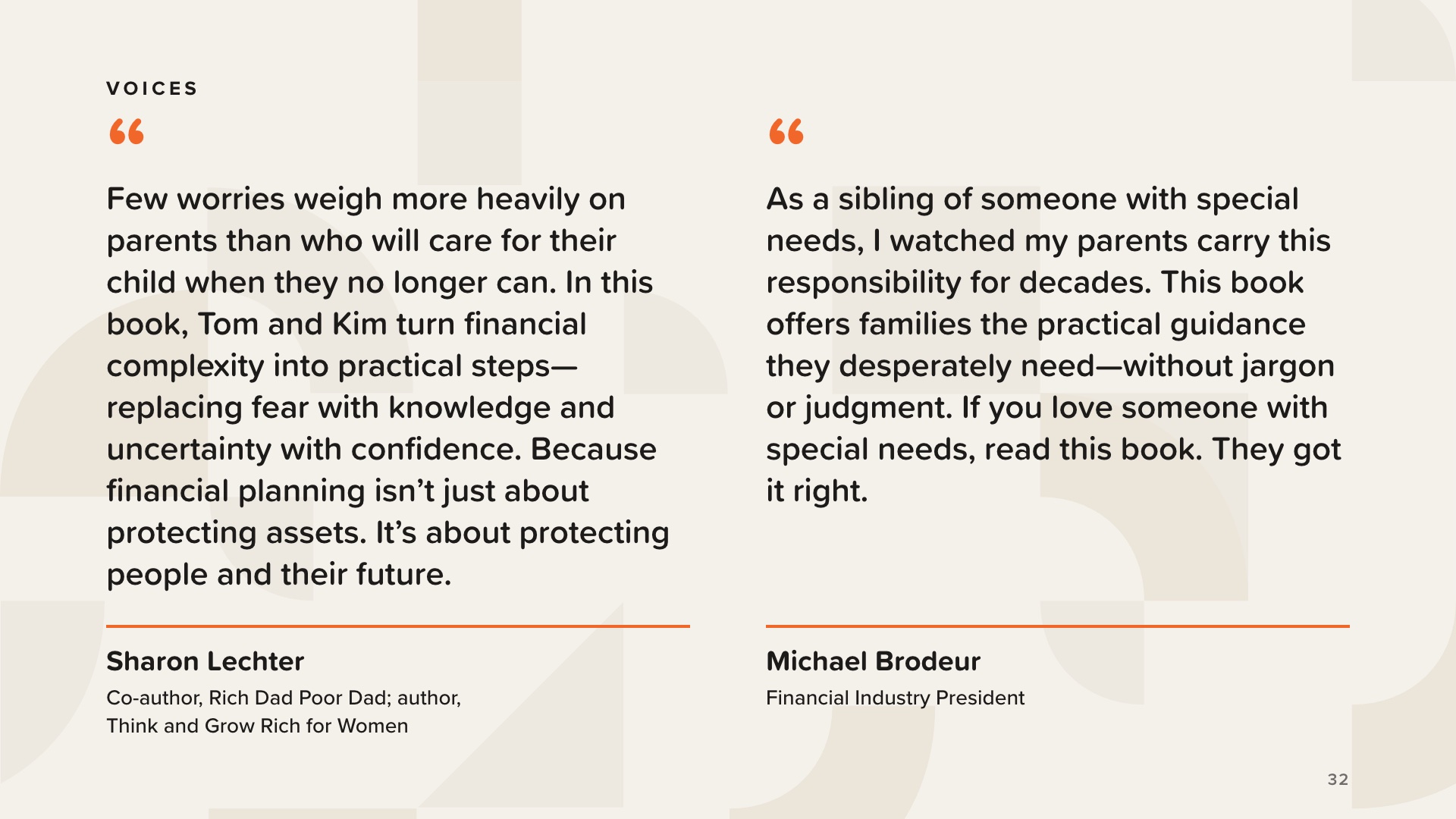
Two voices from the back cover of the book. Both quotes are shown in full: read them word for word, and don’t paraphrase.
Sharon Lechter is co-author of Rich Dad Poor Dad and author of Think and Grow Rich for Women.
Michael Brodeur is a financial industry president. He writes as a sibling: he watched his parents carry this responsibility for decades.
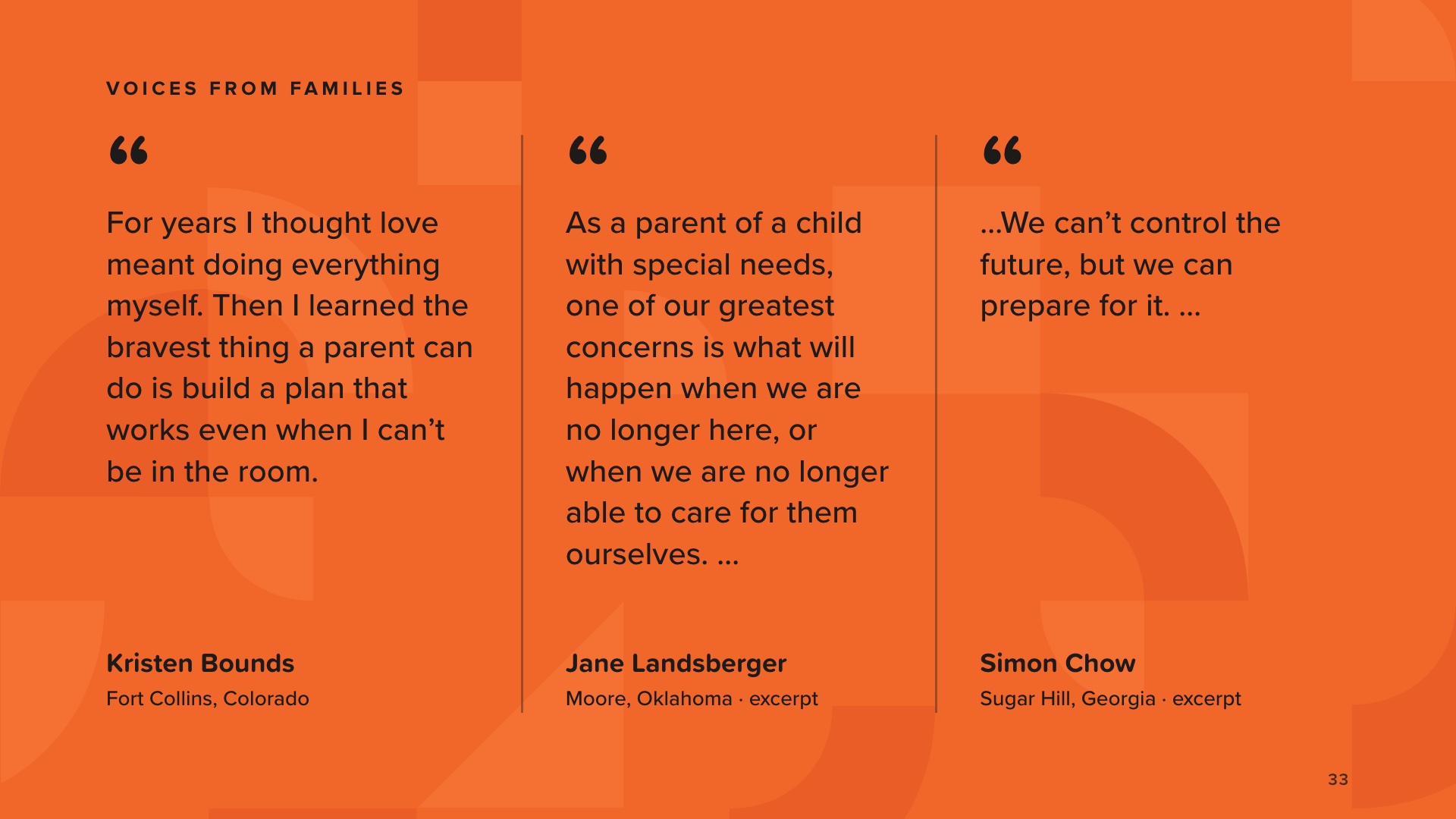
These are voices from the book, from people who know this road firsthand. Read them slowly, word for word.
Jane Landsberger’s and Simon Chow’s quotes are excerpts. Jane’s continues: “The daily responsibilities can take an incredible amount of energy.”
Simon Chow, from Sugar Hill, Georgia, is the father of a daughter with special needs. His full quote begins: “Being the father of a child with special needs, one of my biggest fears is wondering what happens to her, not if, but when my wife and I aren’t here.”
Other voices in the book you can mention: Dennis Farrar, a father who hosts a social media group of several thousand families, and Christyn Scouller, a sibling preparing to take the lead on her brother Frankie’s care. Quote them only word for word from the book.

Close with Tom’s words from the Introduction, read word for word: “You’re not behind. You’re not disqualified. You’re not alone. And it’s not too late. You don’t need a perfect plan to begin. You need the right next step.”
Invite everyone to read the digital book, and tell them you’ll send the link. Send [your link] in the chat (online) or in a follow-up text (in person).
[your link] is the address of the book page on your own TheMoneyBooks website, in this format: howmoneyworks.com/[your-name]/bookpages/howmoneyworks-for-special-needs-families. To get it, open your TheMoneyBooks website, go to the book page for How Money Works for Special Needs Families, and copy the address. The page has a short sign-up form; after signing up, the digital book opens, and the contact comes to you. Share only your own link, and always send the link, never the book itself. If someone asks about a printed copy: the printed book is available in November.
Read the disclaimer out loud: for educational purposes only, not legal, tax, or investment advice, and work with qualified professionals for legal and special needs planning.
Thank the room, and offer to stay for questions. End where we started: Breathe. You’ve got this.