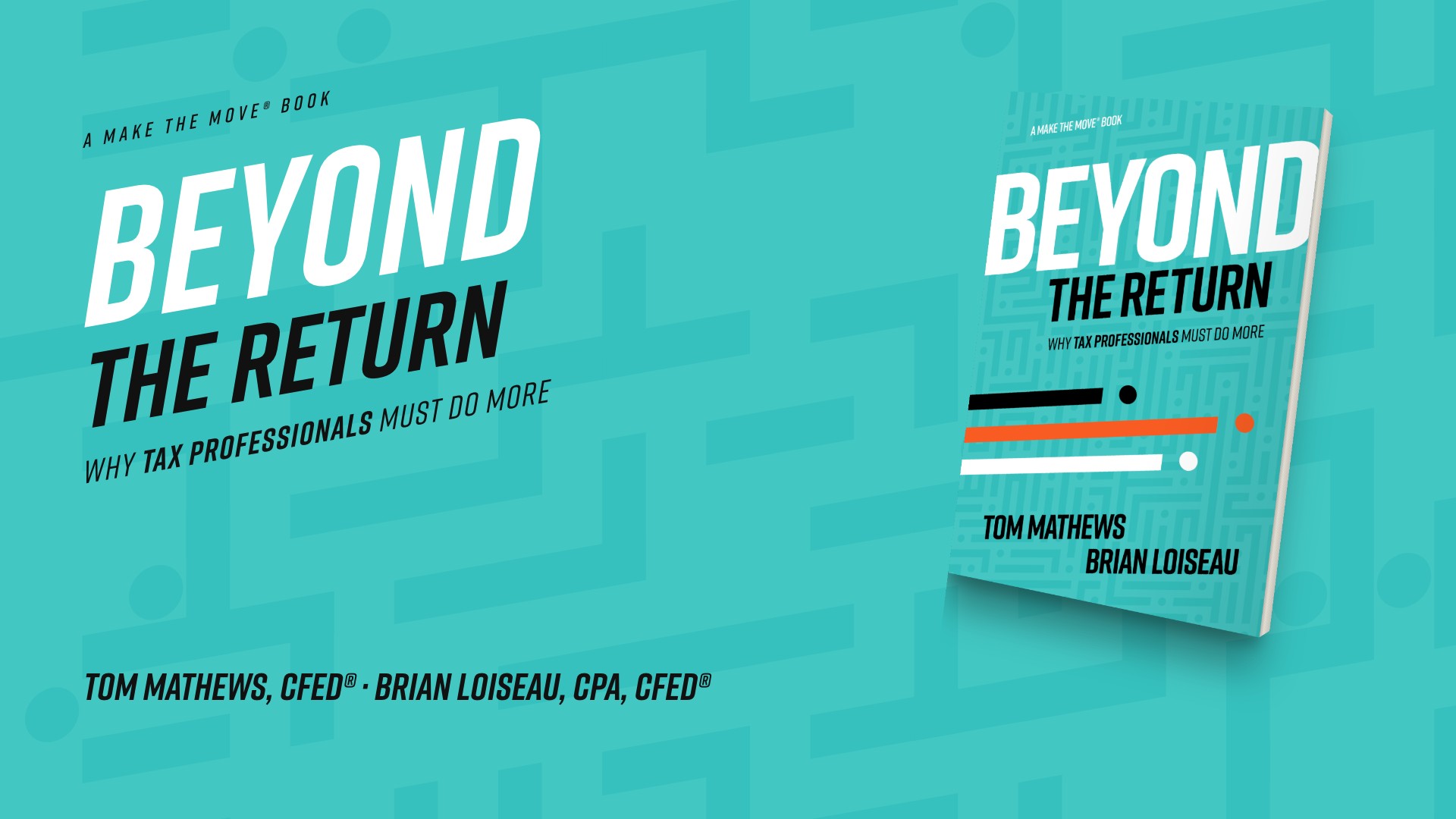
Welcome, and thank you for your time. Today I want to walk you through a book written for people in your profession: Beyond the Return, by Tom Mathews and Brian Loiseau.
Brian is a CPA. Tom grew up in his father's CPA office and has spent four decades teaching families how money works. The book makes one argument: the tax return was never the finish line. For the next 30 minutes I'll show you the case the book makes, the asset you already hold, and a practical system for acting on it.
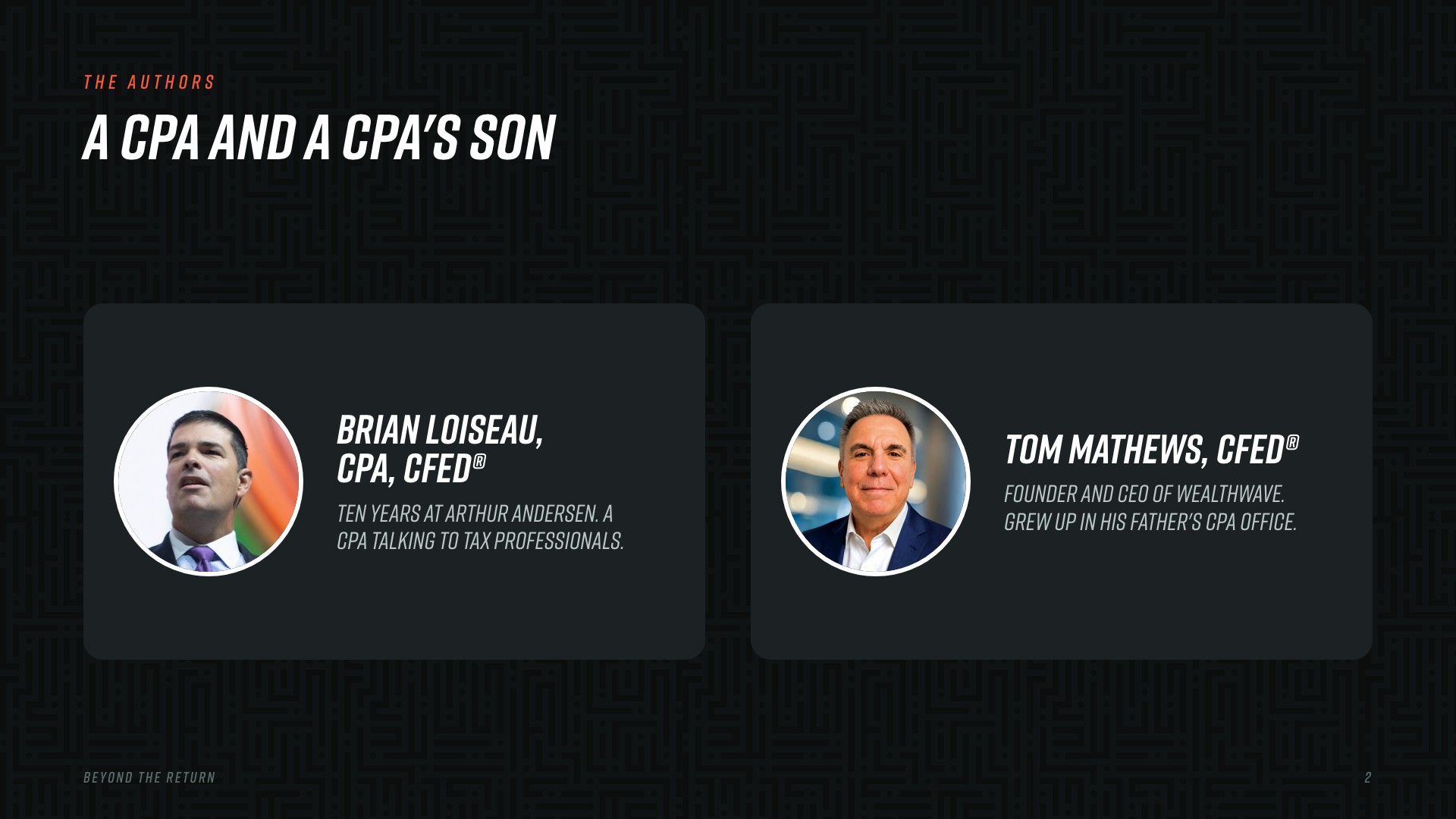
Two authors, two angles on the same profession.
Brian Loiseau is a CPA. He started at Arthur Andersen straight out of college and spent ten years there. He writes as one of you: someone who knows what it feels like when every number has to align and every box has to be checked.
Tom Mathews is the founder and CEO of WealthWave. His father was a CPA, and Tom grew up in that office, watching clients tell his dad everything. Tom has spent four decades teaching families how money works. Together they wrote this book for CPAs, enrolled agents and tax preparers.
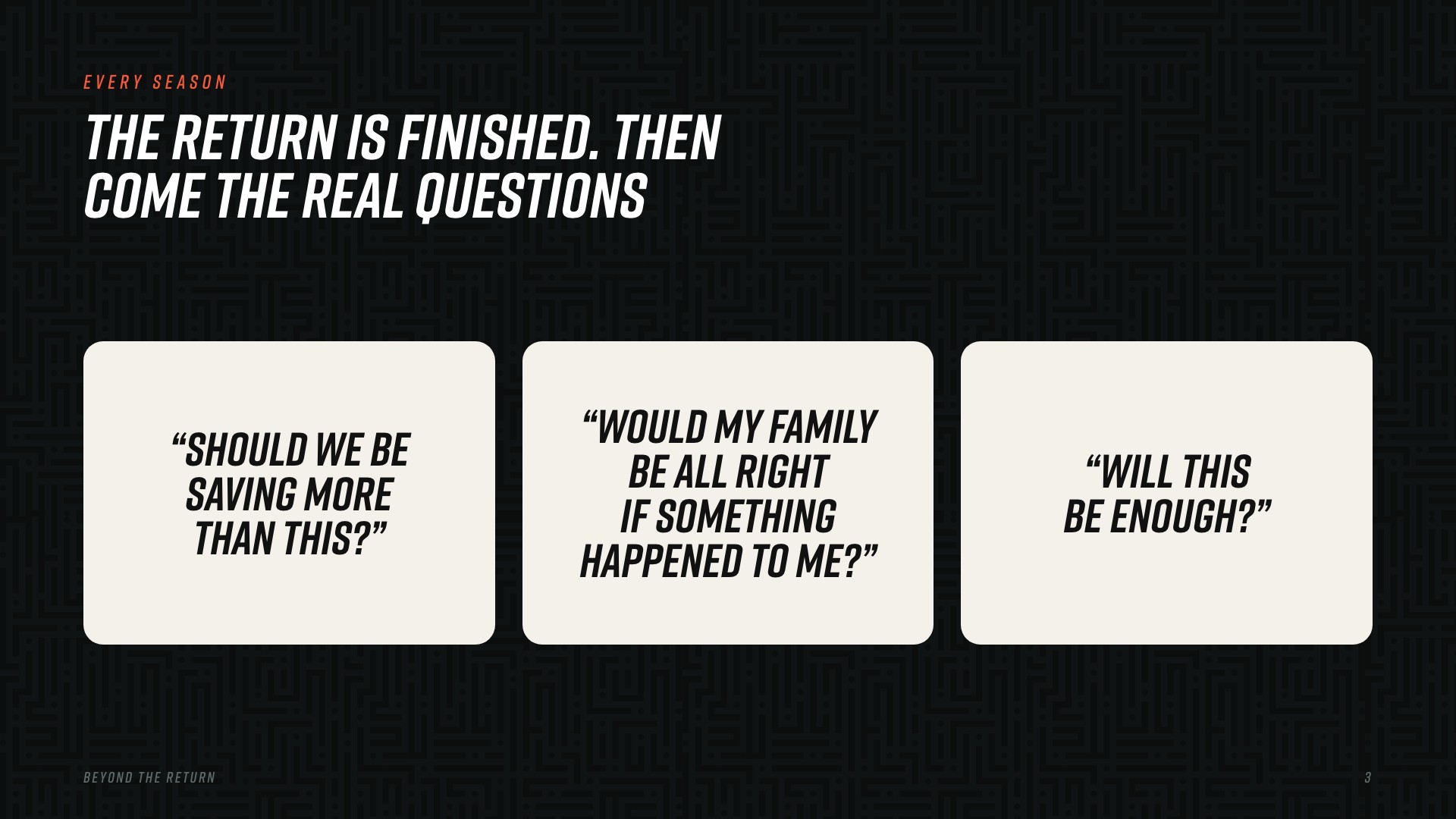
You know this moment. The return is done. The client picks up their folder, stands up to leave, and then turns around.
Should we be saving more than this? Would my family be all right if something happened to me? Will this be enough?
They are not asking you because it's your job. They're asking because you are the person they trust with the most complete picture of their financial life. The book starts right here.
Think about what a client hands you every year: a sworn, verified record of their financial life. Income. Debt. The house. The business. The kids. The retirement accounts, or the absence of them.
No banker, no insurance agent, no investment professional sees all of that. You do. The book's point is simple: that seat comes with an opportunity, and with a responsibility.
Part One of the book is about the pressure on the profession. None of it is a criticism of the profession. It's the ground everyone in this room is standing on.
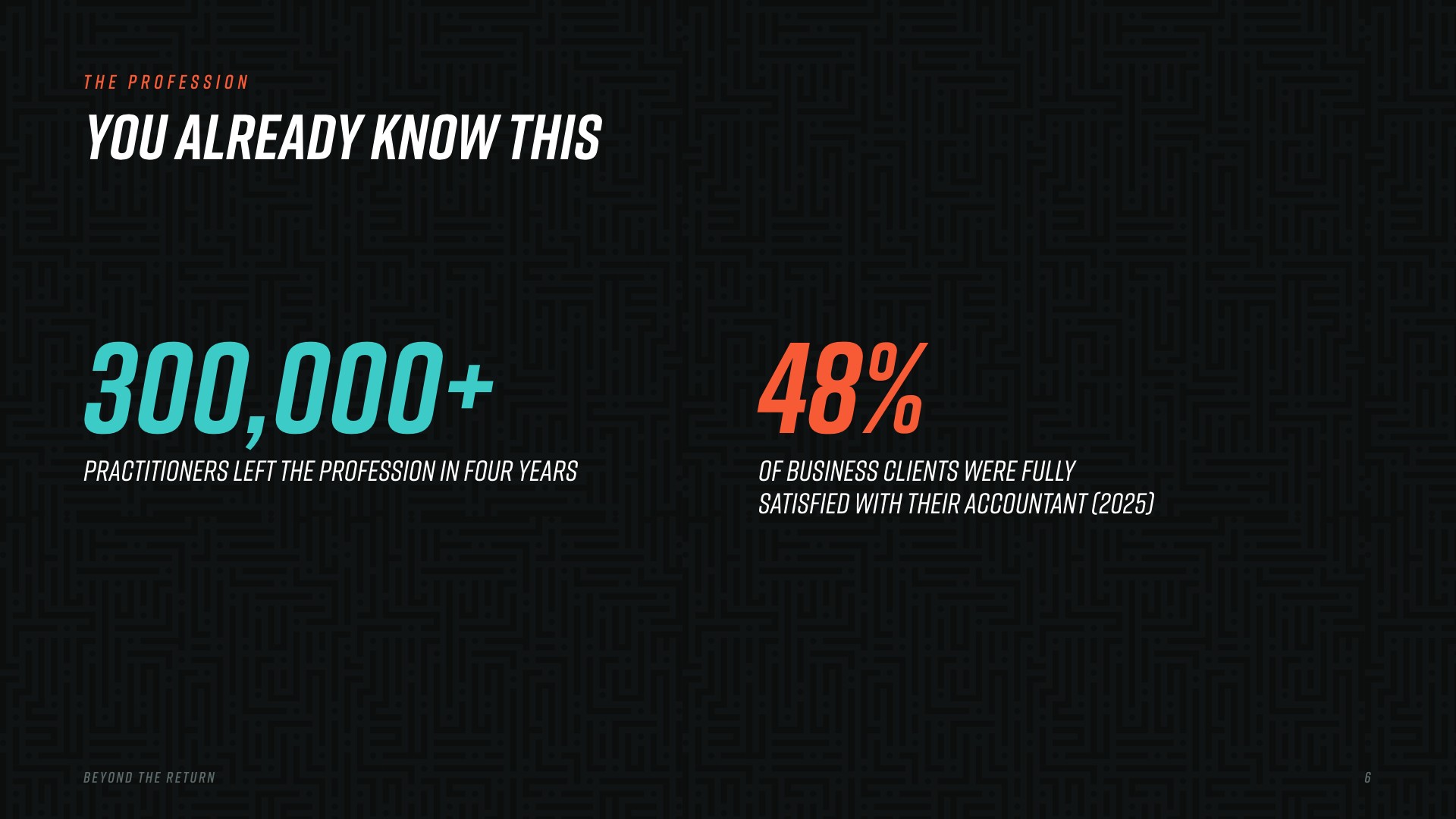
The book lays out numbers you already feel in your own practice.
More than 300,000 practitioners left the profession in four years. Fewer students are choosing accounting. And when TaxDome surveyed business clients in 2025, only 48 percent said they were fully satisfied with their accountant's services. Not because the returns were wrong. Because clients want more than the return.
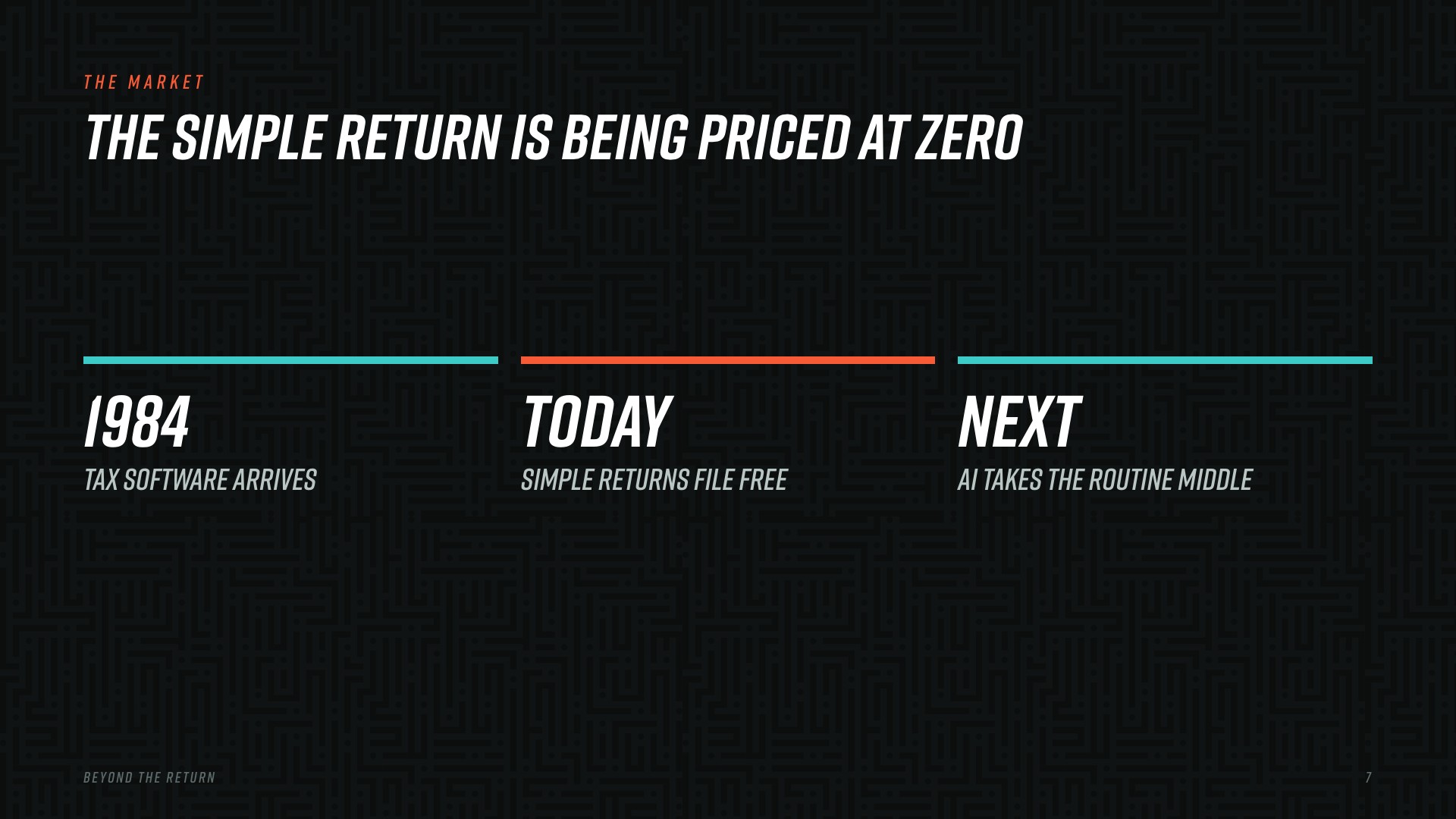
Now the pressure from the outside. Consumer tax software arrived in the 1980s. Today, a qualifying simple return can be filed for free, and artificial intelligence is filing returns for $89.
When the market prices basic preparation near zero, it tells you where the value is moving: away from the form, and toward the person who understands what's behind it.
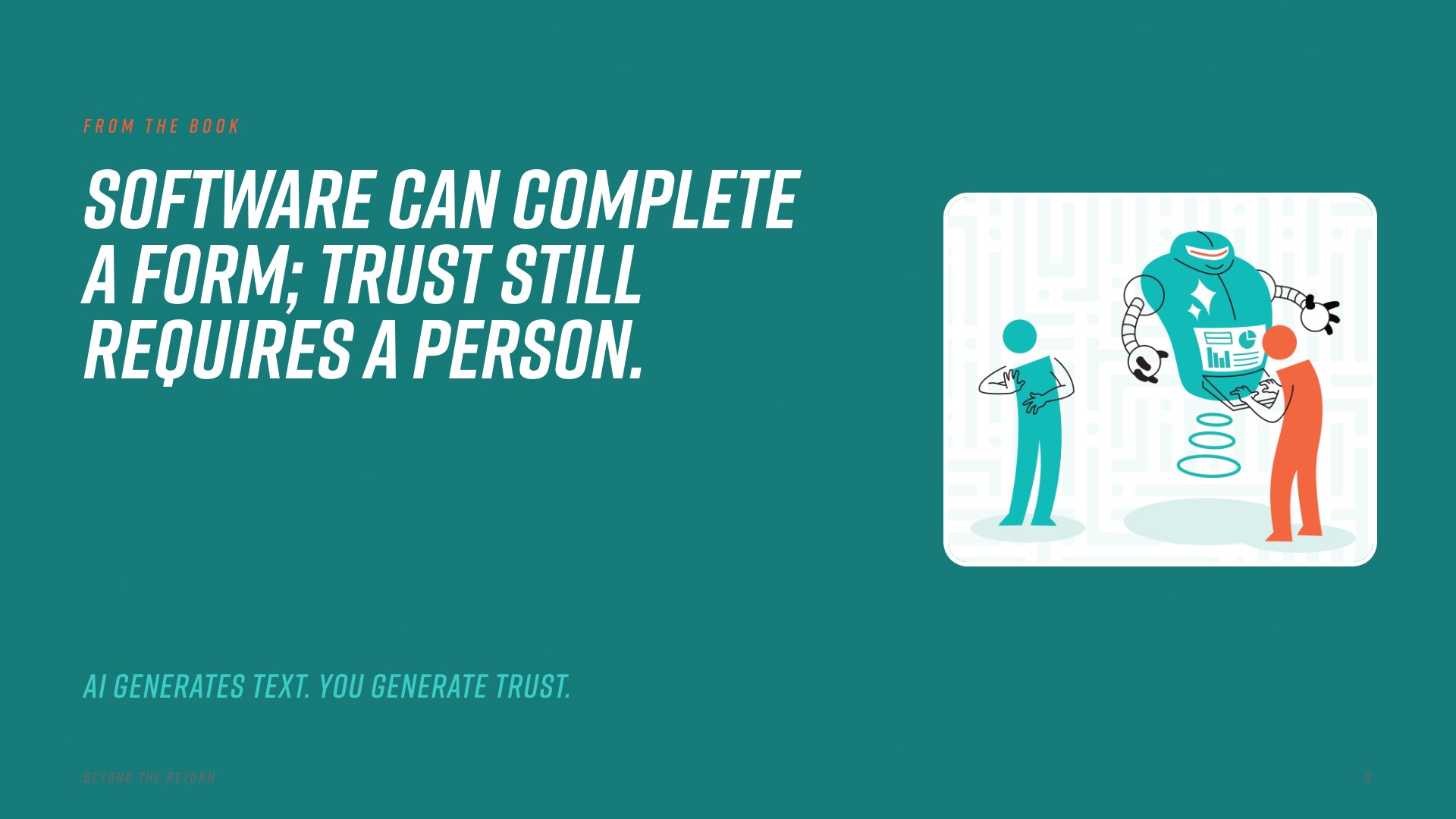
This is the line from the book I'd ask you to remember. Software can complete a form; trust still requires a person.
Software can't sit across from a client, hear what isn't being said, and connect one tax document to an entire financial life. As the book puts it: AI generates text. You generate trust. That isn't a slogan. It's a competitive advantage no software company can copy.
Part Two is about the asset you're already sitting on. The book's message is that you are not starting from behind.
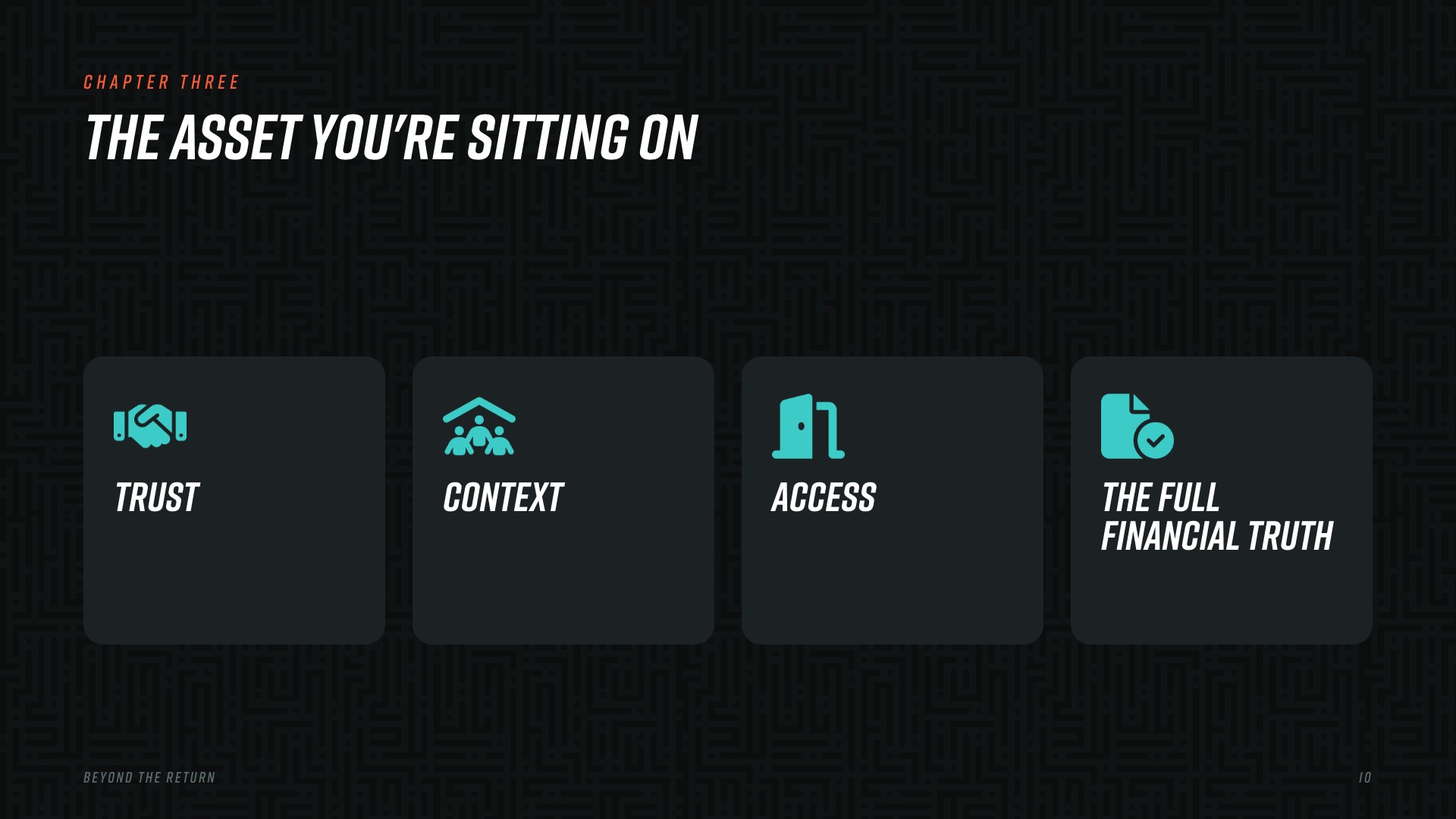
Chapter Three names four things most financial professionals spend years trying to earn, and that you already have.
Trust, earned over years of accurate, high-stakes work. Context: you know the family and the story behind the numbers. Access: clients come back every single year and bring everything with them. And the full financial truth: a verified record no one else sees.
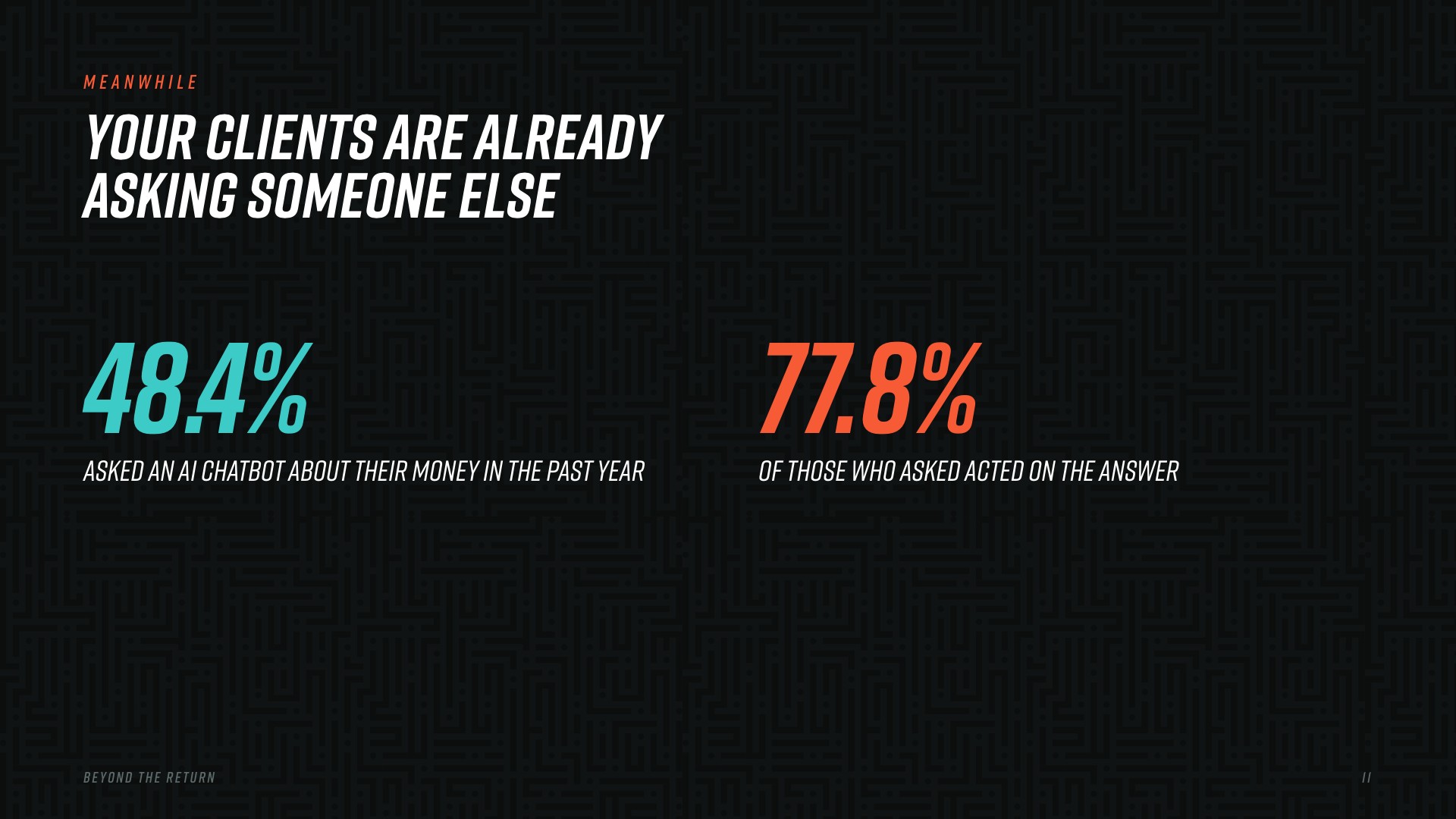
If we don't answer those questions, something else will. In a national study of 1,981 adults who make their household's financial decisions, released in October 2026, 48.4 percent had asked an AI chatbot about their money in the past year. Of those who asked, 77.8 percent acted on the answer.
The book's response isn't to tell people to stop. It's: ask AI, then ask a financial professional. Someone has to be that professional.
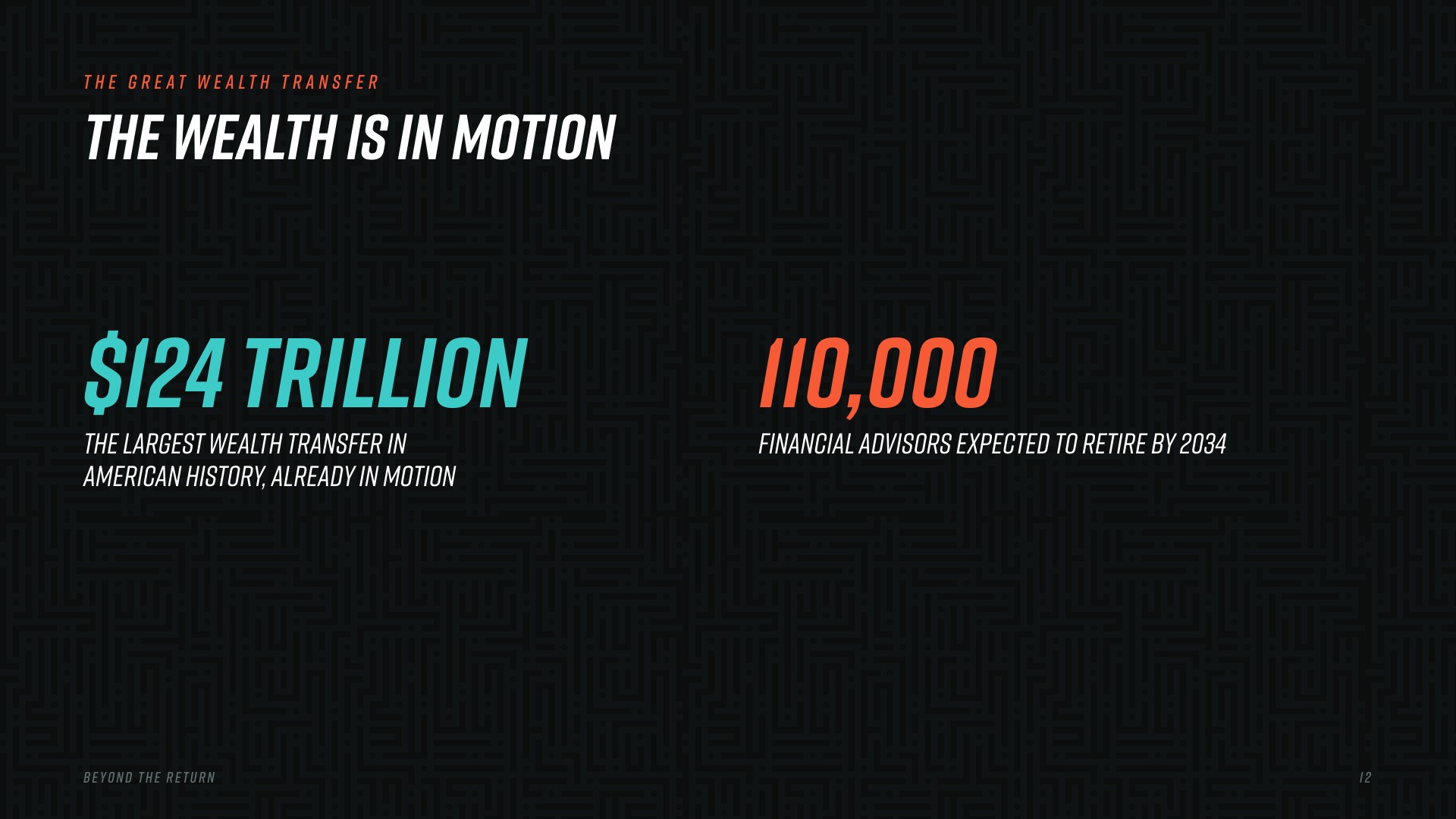
One more force. The largest wealth transfer in American history, $124 trillion, is already in motion, one family at a time. At the same time, about 110,000 financial advisors are expected to retire by 2034, roughly 38 percent of the current workforce.
Your clients' families are moving money and making decisions, and fewer people will be there to help them. That vacuum needs to be filled.
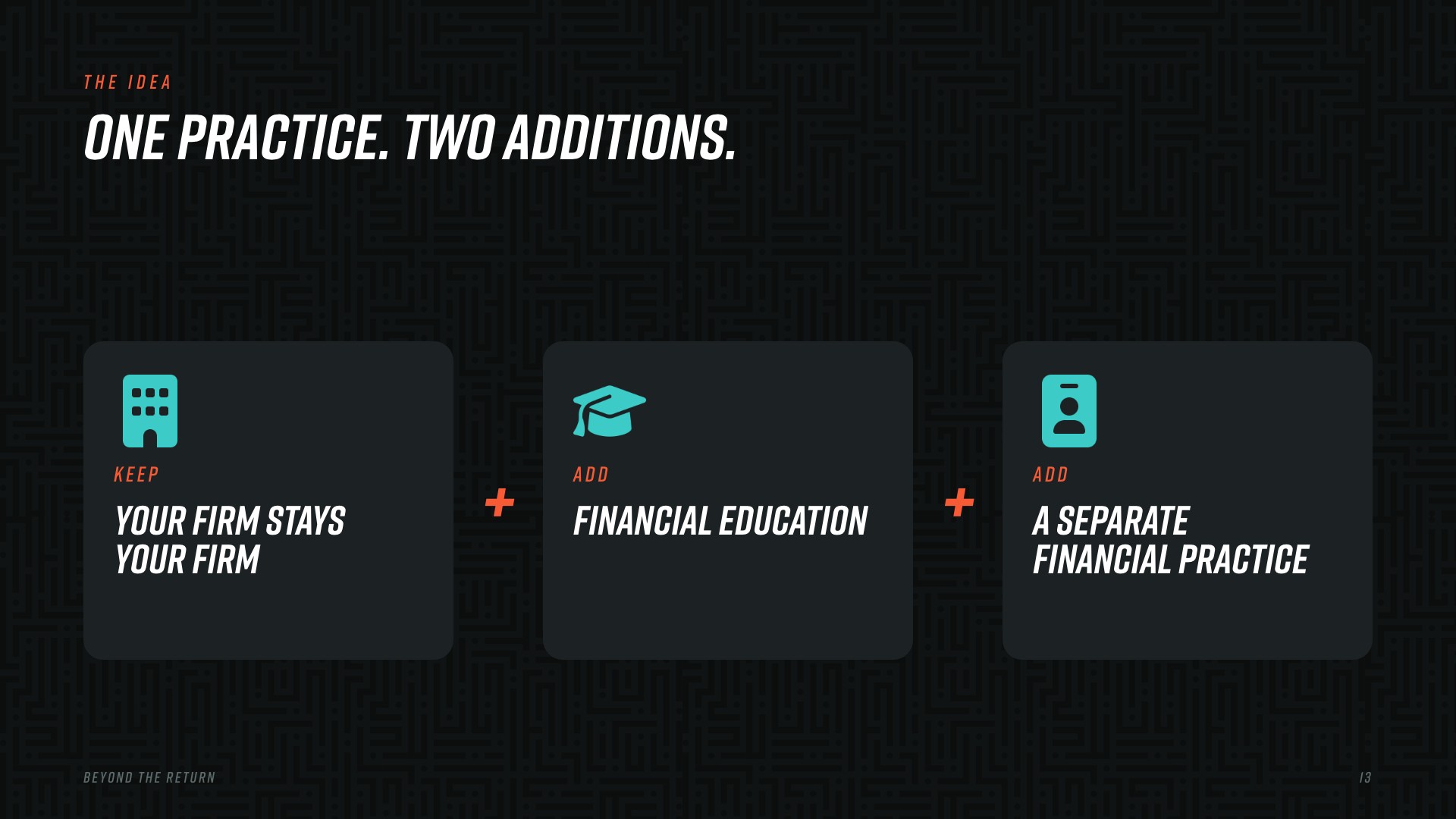
Here's the idea, and it's simpler than you might expect.
Keep: your firm stays your firm. Your tax practice, your clients, your name on the door.
Add, number one: financial education. You teach clients how money works.
Add, number two: a separate financial practice, with its own licenses, kept apart from the CPA firm. No financial services run through your CPA firm.
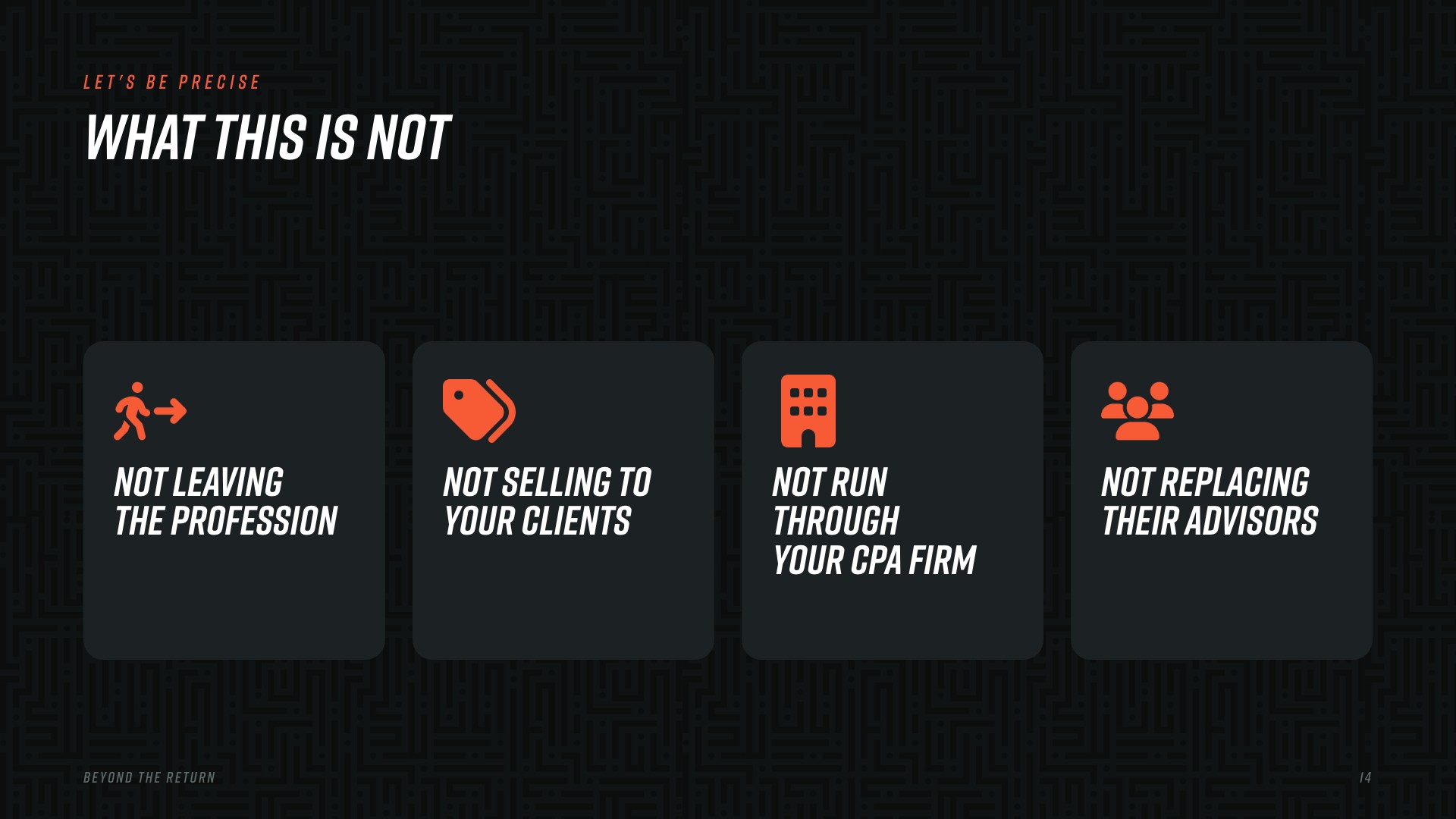
A room full of CPAs is thinking about what could go wrong, so let's say what this is not.
It is not leaving the profession. It is not selling to your clients. It is not run through your CPA firm. And it is not replacing the advisors your clients already have and trust. The book is careful about every one of these, and so are we.
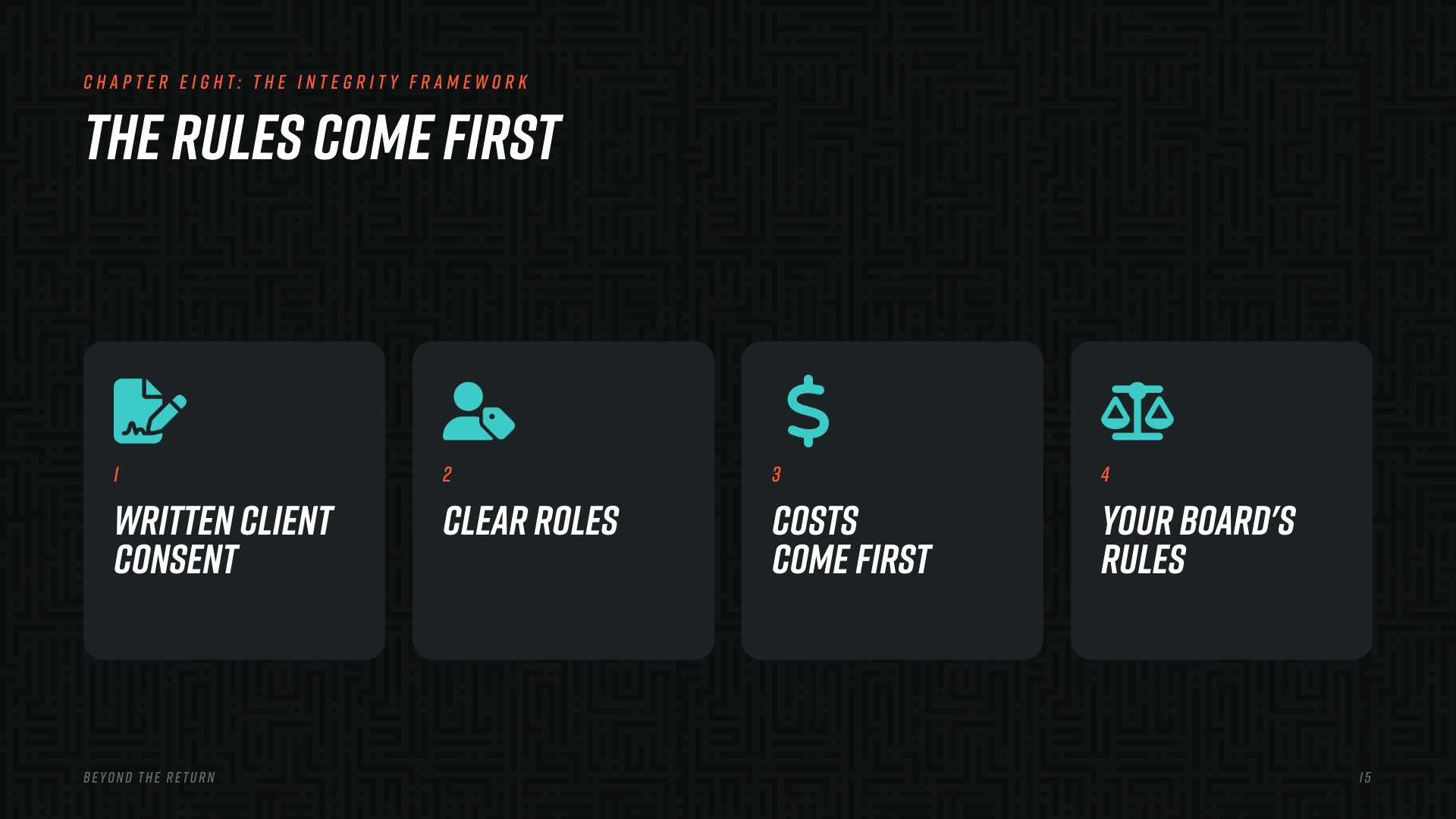
The question every careful professional should ask: what about my rules? Client information, commissions, independence, my state board.
Chapter Eight starts with the rules. Written client consent before any client information is used for anything beyond the return. Clear roles, so a client always knows which hat you're wearing. Costs explained first. And your own board's rules, which always come first.
The book has a line for the fear a lot of professionals carry: You're not starting over. You're starting from ahead.
You already have what most financial professionals spend years trying to earn: trust, context, access, and the full financial truth.
Part Three is the practical part: how a tax professional actually does this, step by step.
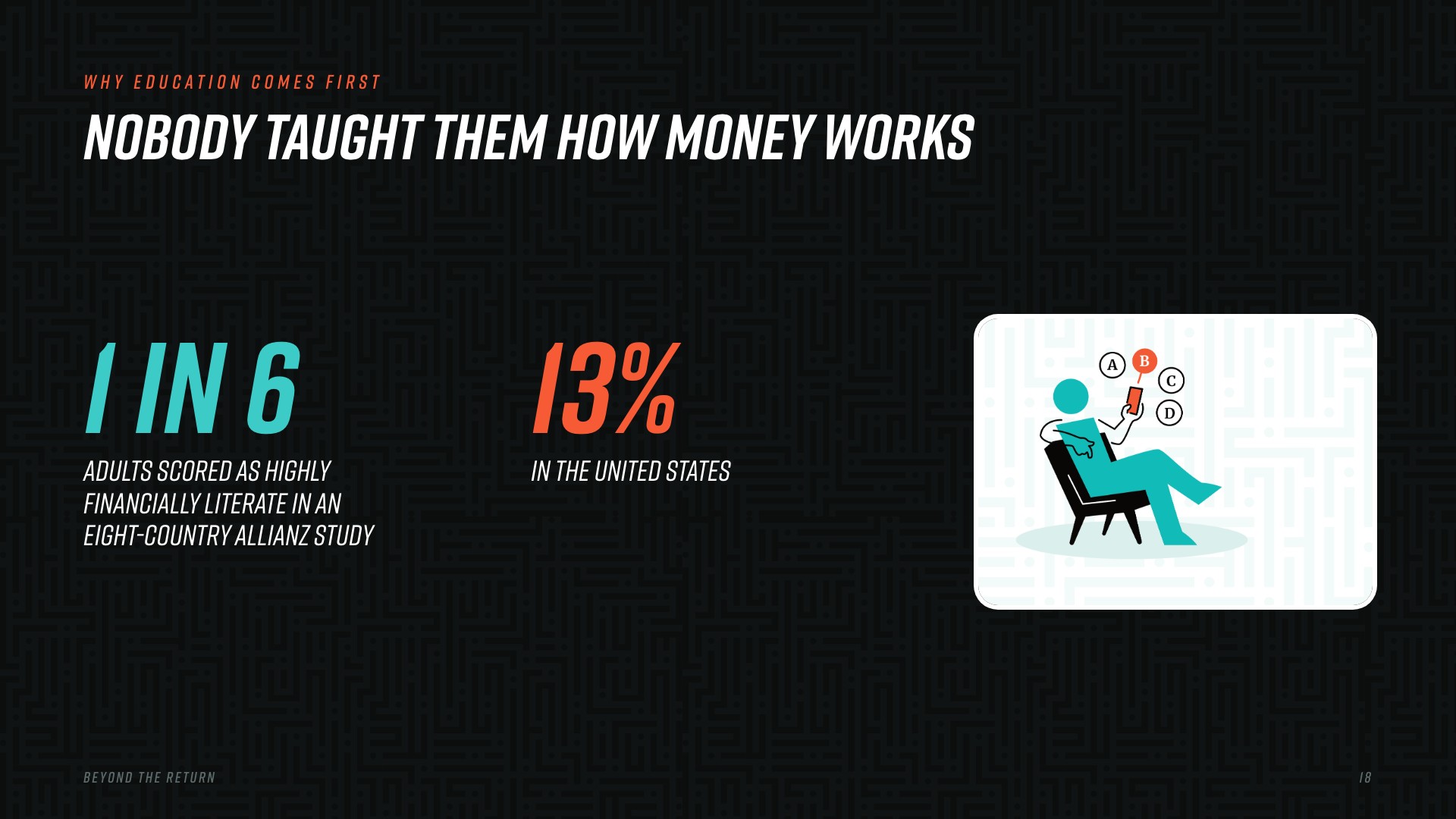
Why does it start with education? Because nobody taught most people how money works.
In a 2026 Allianz study of eight countries, only 17 percent of adults, about one in six, scored as highly financially literate. In the United States it was 13 percent. Your clients are smart people. They were simply never taught.
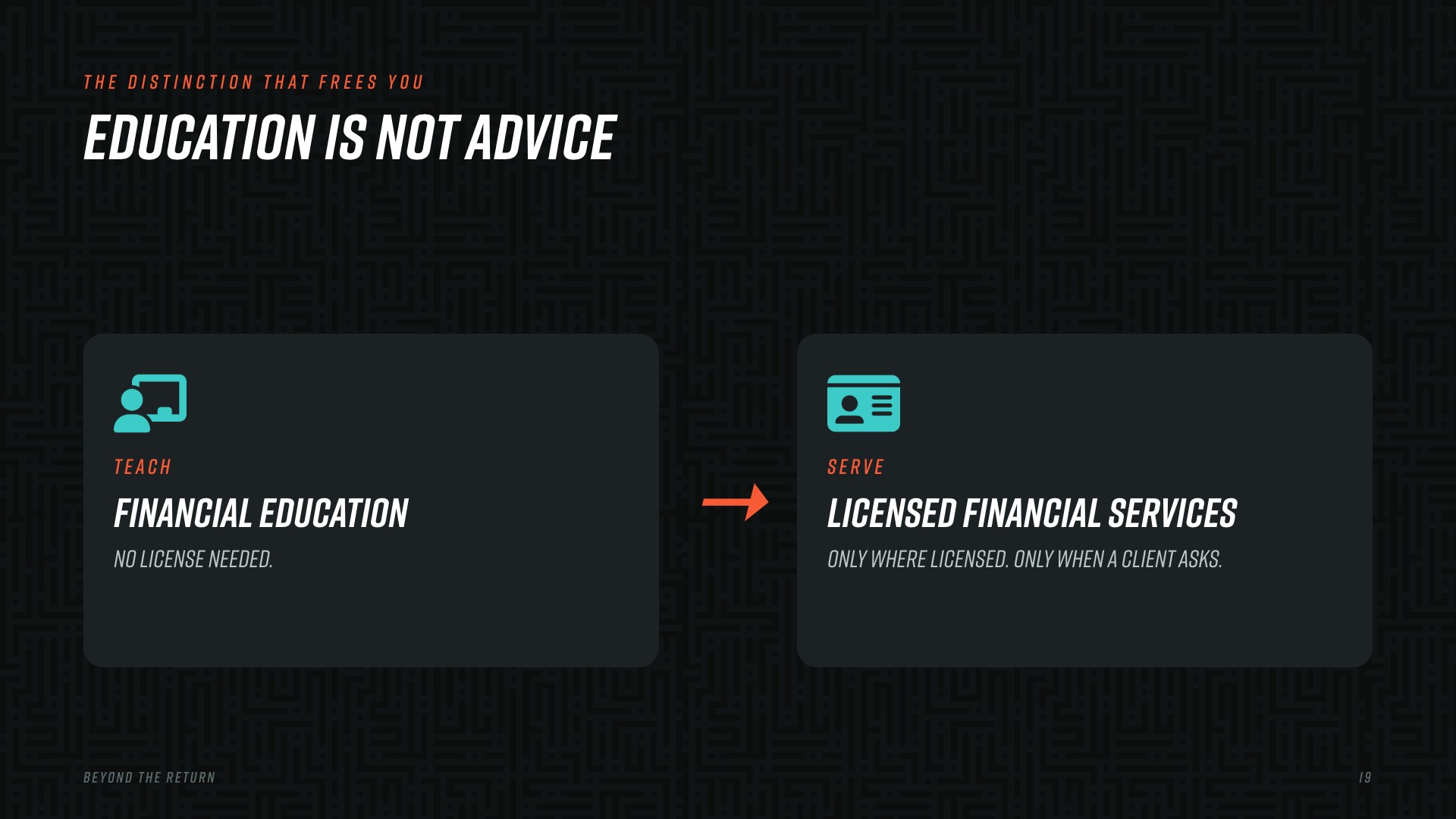
Here's a distinction that removes a barrier many professionals carry. Financial education is not financial advice.
Recommending a specific product requires a license and operates under a regulatory framework. Teaching how money works does not. You can teach how compound interest works, why an emergency fund matters, how debt behaves, without recommending anything. Licensed financial services come later, only where you're licensed, and only when a client asks.
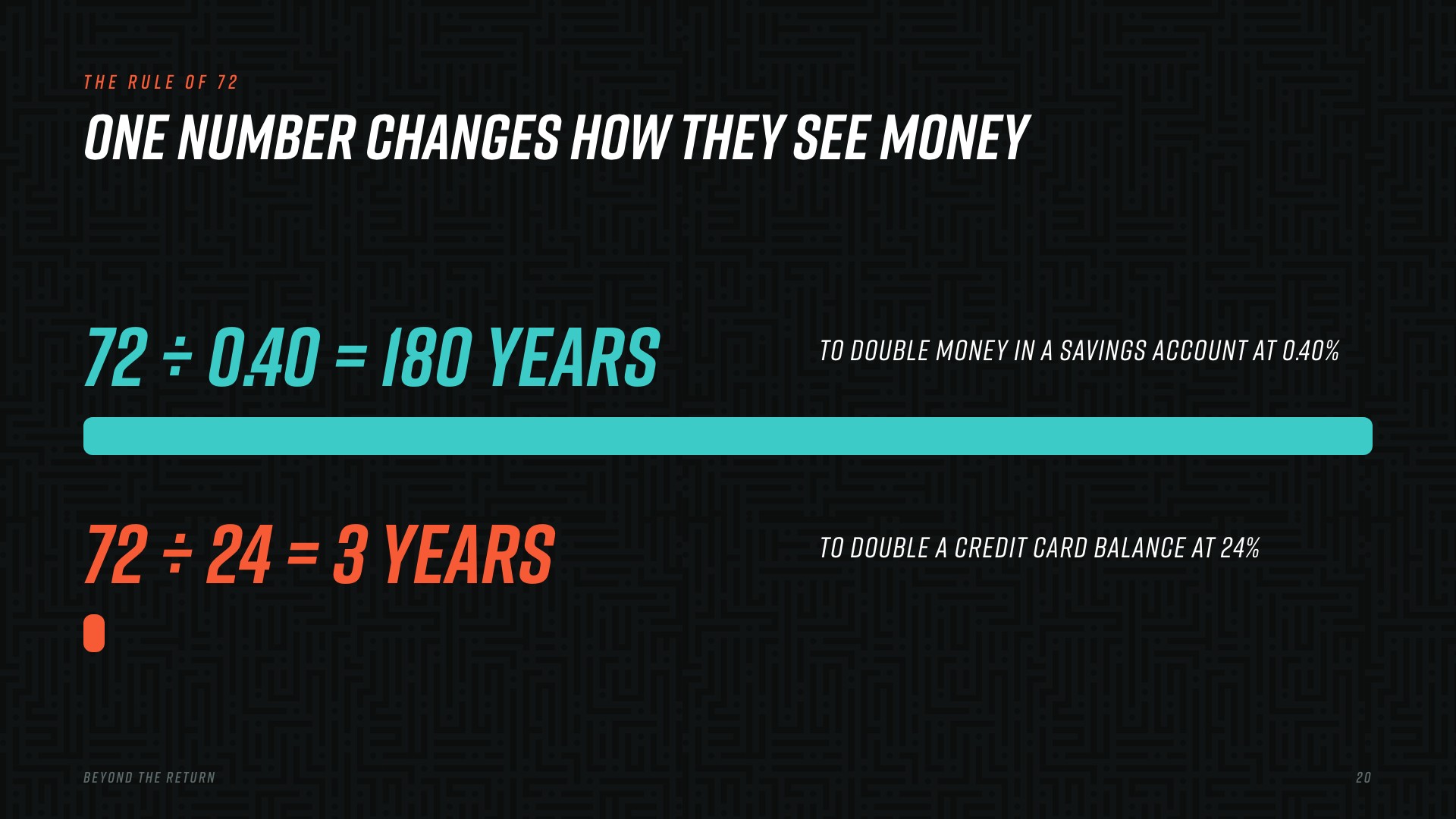
Here's what teaching looks like. One rule: divide 72 by an interest rate and you get roughly the number of years it takes money to double.
A savings account paying four-tenths of one percent: 72 divided by 0.40 is 180 years to double. A credit card at 24 percent: 72 divided by 24 is 3 years, and that's the balance doubling against them.
That is education, not advice. And it changes how a client sees every dollar.
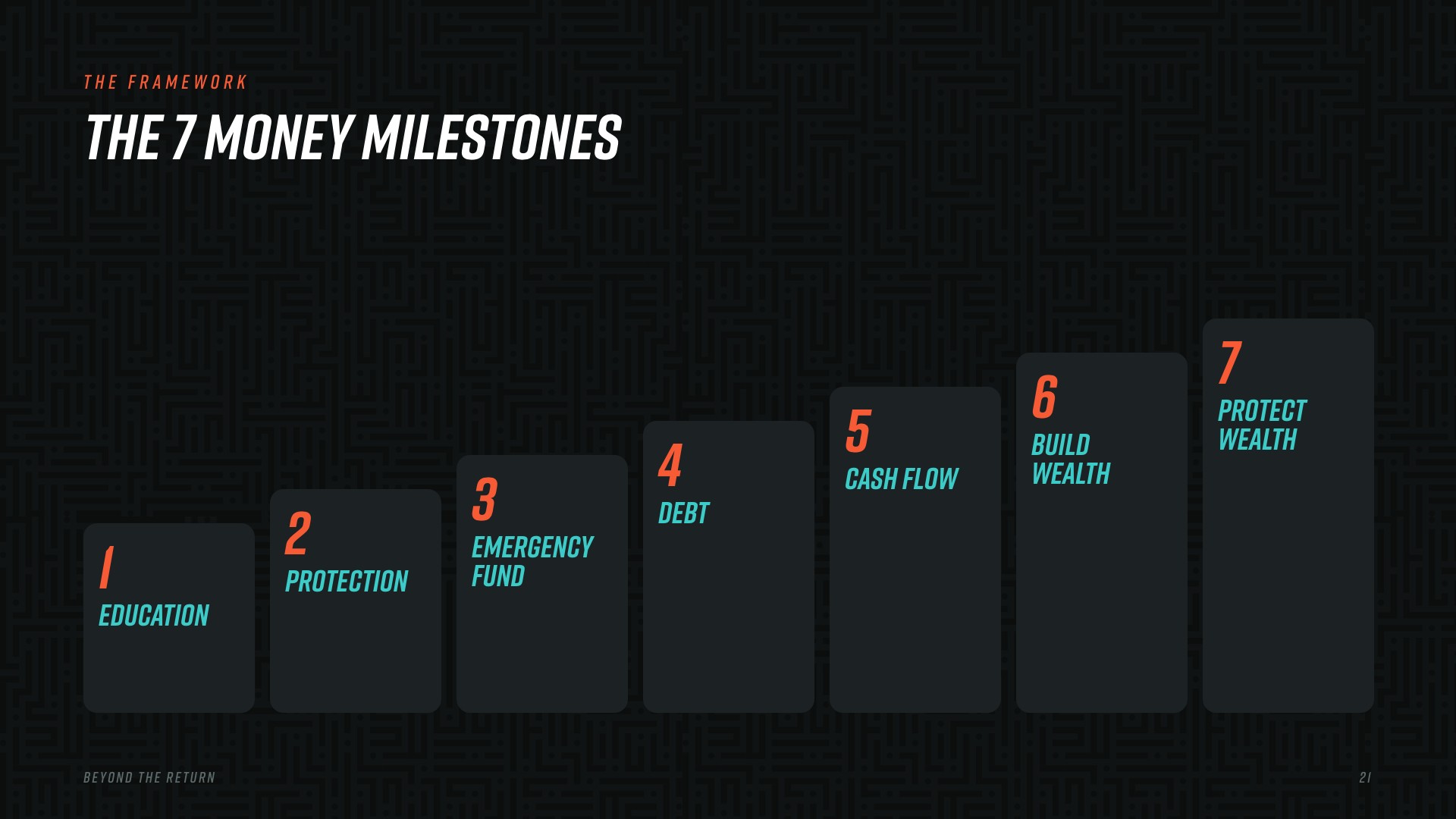
This is the framework at the center of what WealthWave teaches: the 7 Money Milestones. Education. Protection. Emergency fund. Debt. Cash flow. Build wealth. Protect wealth.
It's a map, not a promise: a way for a family to see their whole financial life at once and know which step comes next. The Client Edition of the book walks a client through each one.
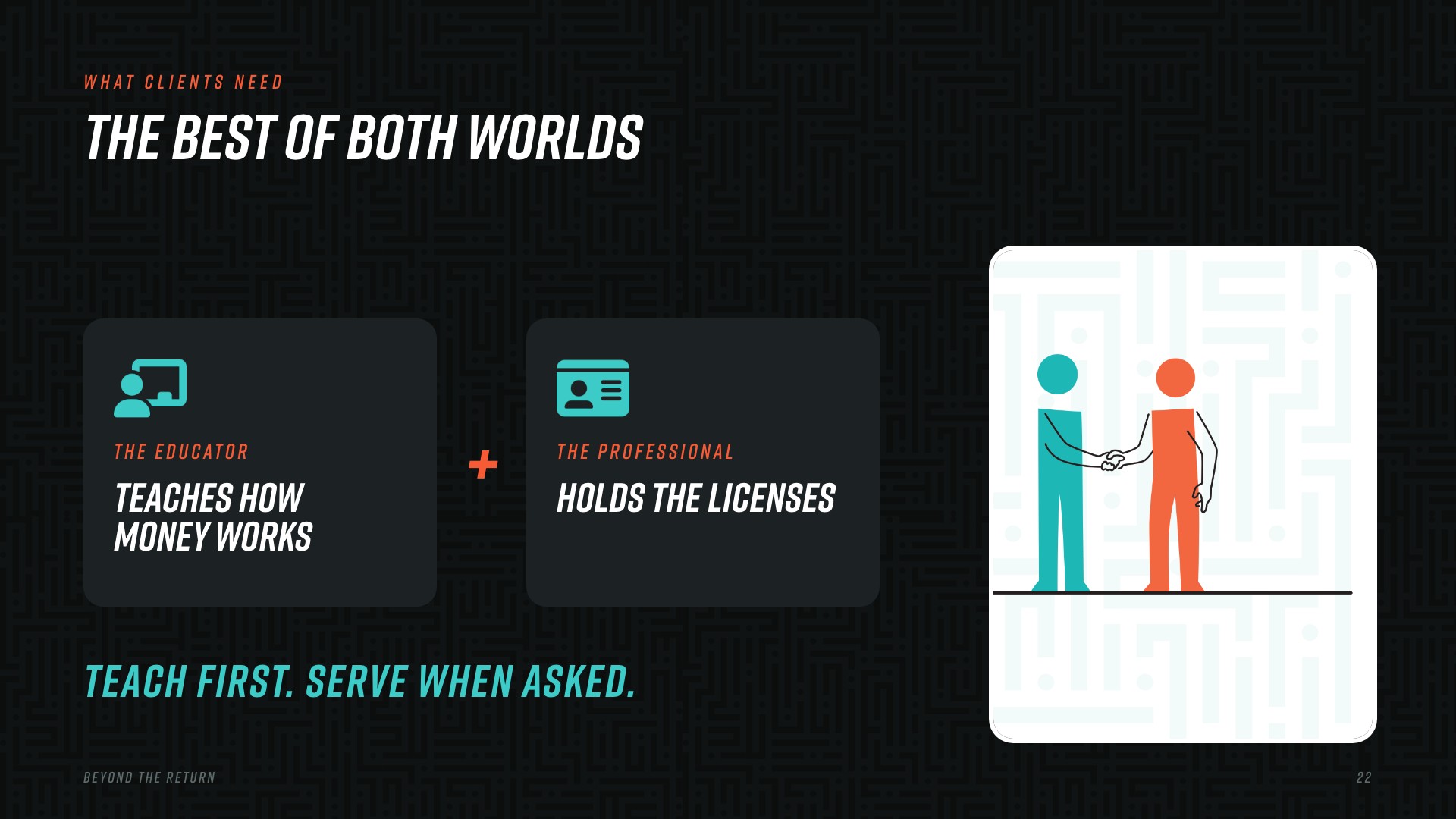
So what do clients actually need? A financial educator who is also a licensed financial professional. The educator teaches them how money works so they can make informed decisions. The professional holds the licenses, carries the responsibility, and helps them take action.
One person, both jobs. The book sums it up in four words: Teach first. Serve when asked.
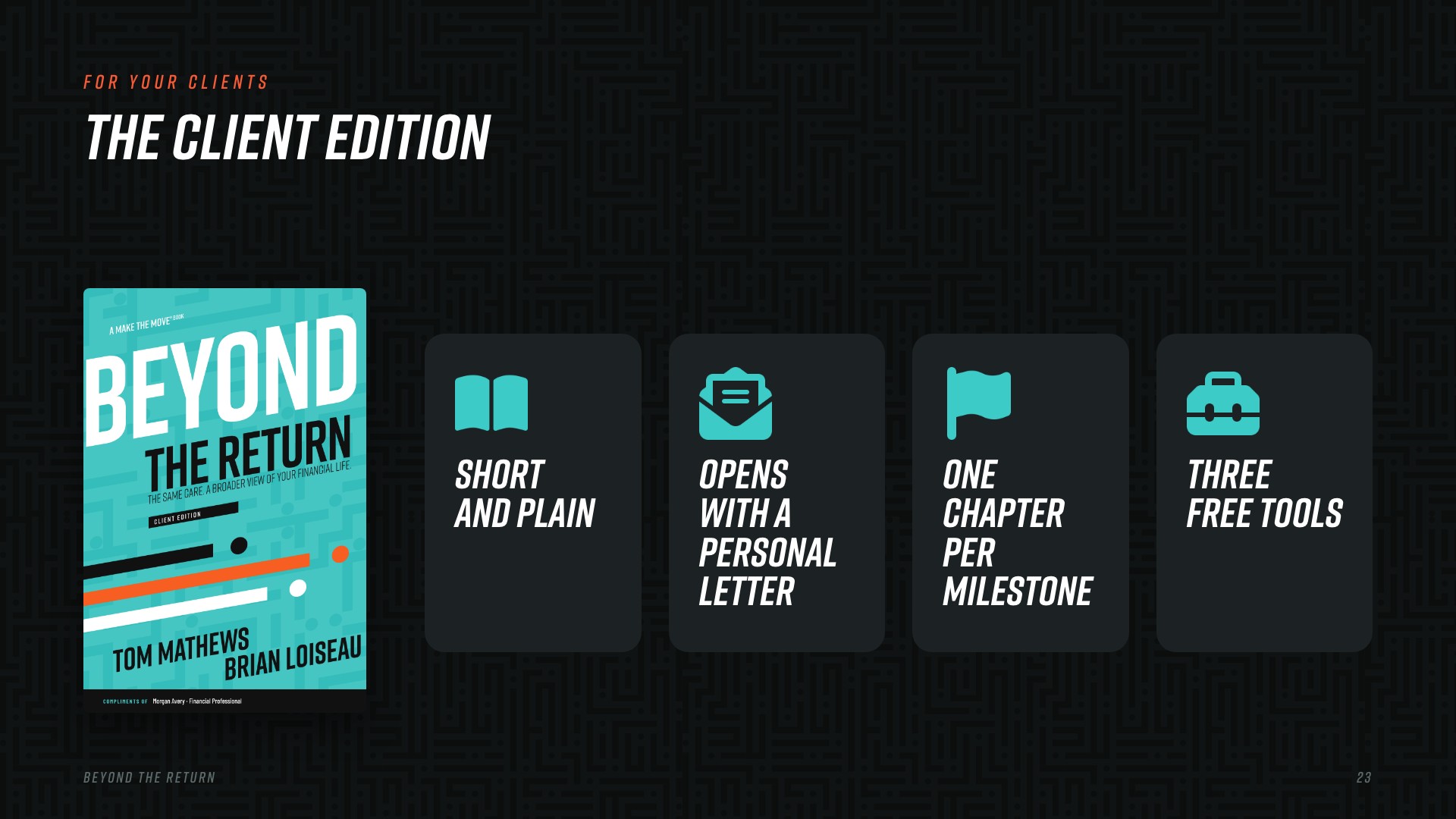
There's a companion book for clients: the Client Edition of Beyond the Return. It's short and written in plain language. It opens with a personal letter, walks through the seven Milestones one chapter at a time, and points clients to three free tools.
A licensed professional can personalize it and put it in a client's hands, so the client hears the same message the professional has just heard.
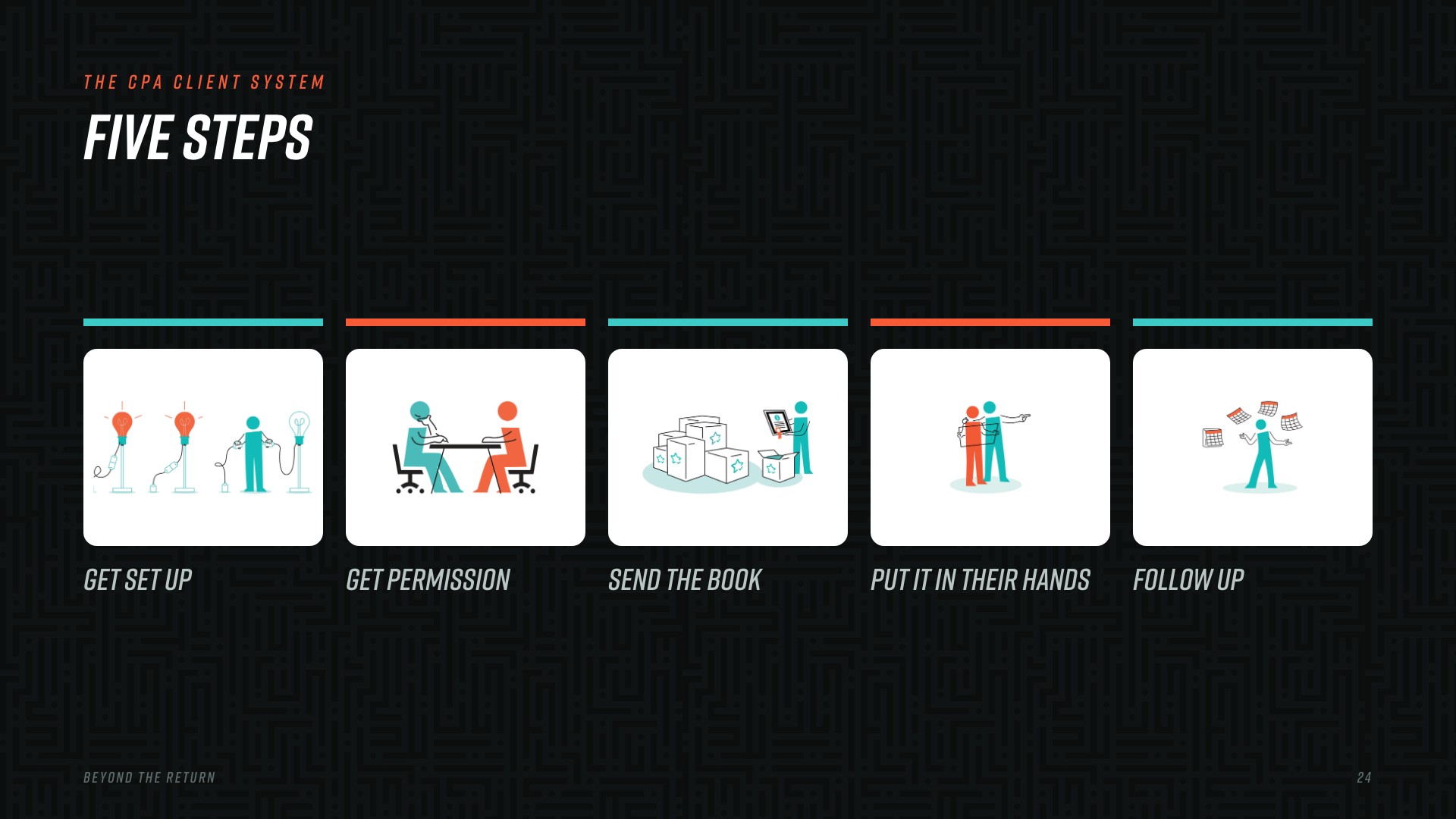
The system has five steps. Get set up. Get permission: each client's written consent, on its own signed page, usually sent with the engagement letter or organizer you already send. Send the book. Put it in their hands at the appointment. Follow up.
Every step is written out in the CPA Client System playbook, with the emails and the replies.
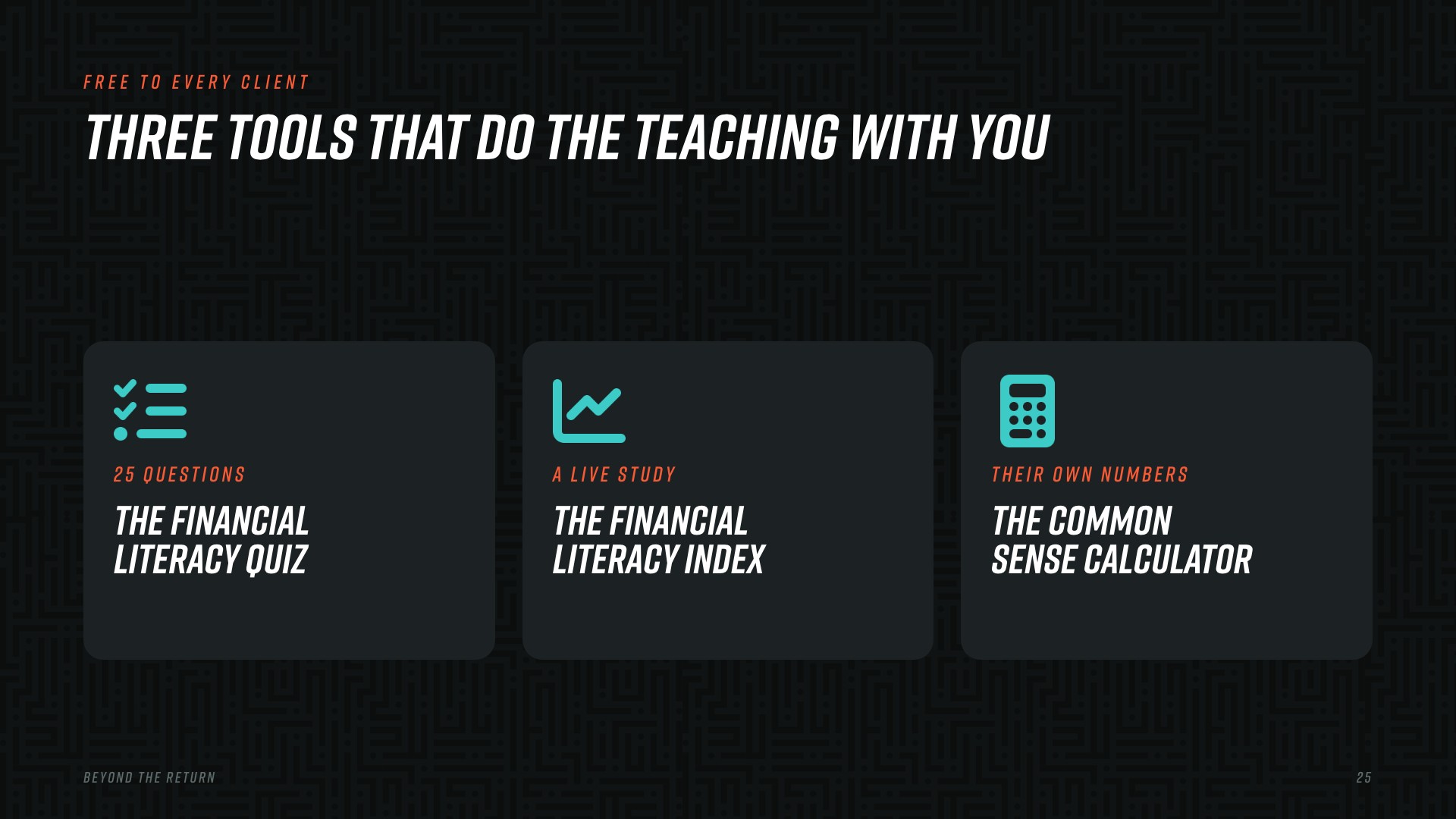
Three free tools come with the book.
The Financial Literacy Quiz: 25 questions, under 15 minutes, a score out of 100 and an explanation for every answer. The Financial Literacy Index: a continuing, anonymous national study the quiz feeds. And the Common Sense Calculator, where a client can run their own numbers.
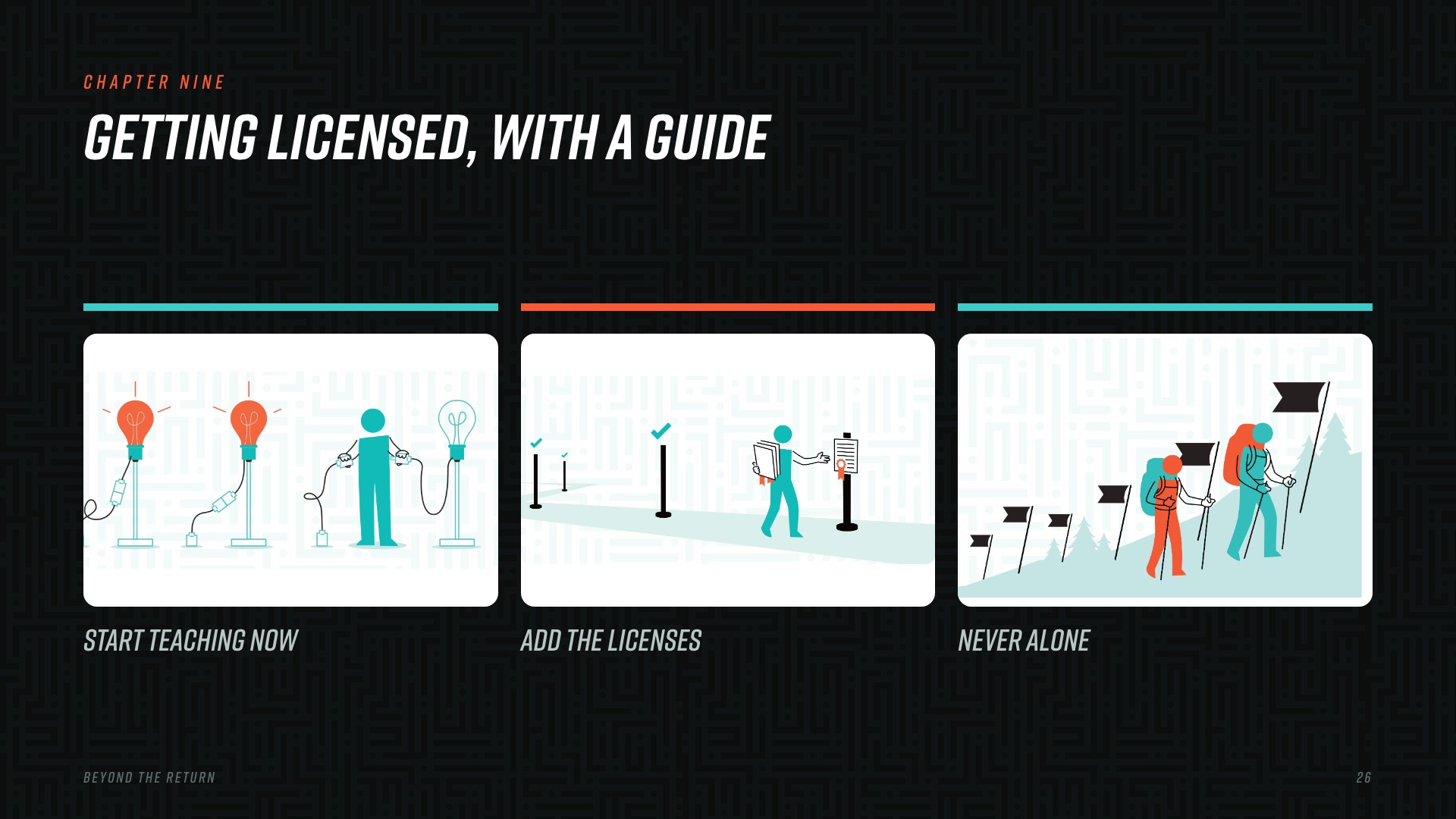
How do you get from here to there? First, you can start teaching now. Education needs no license. Second, you add the licenses that let you help a client act: an insurance license, and securities registration. WealthWave can show you the next steps to become registered with a broker-dealer. Third, you never do it alone. You have a guide and a team at every step.
This is the sentence the book hopes your clients will say. Why hasn't anyone ever talked to me about this before?
It's the sound of a client who finally understands how money works, from the one professional they already trust.
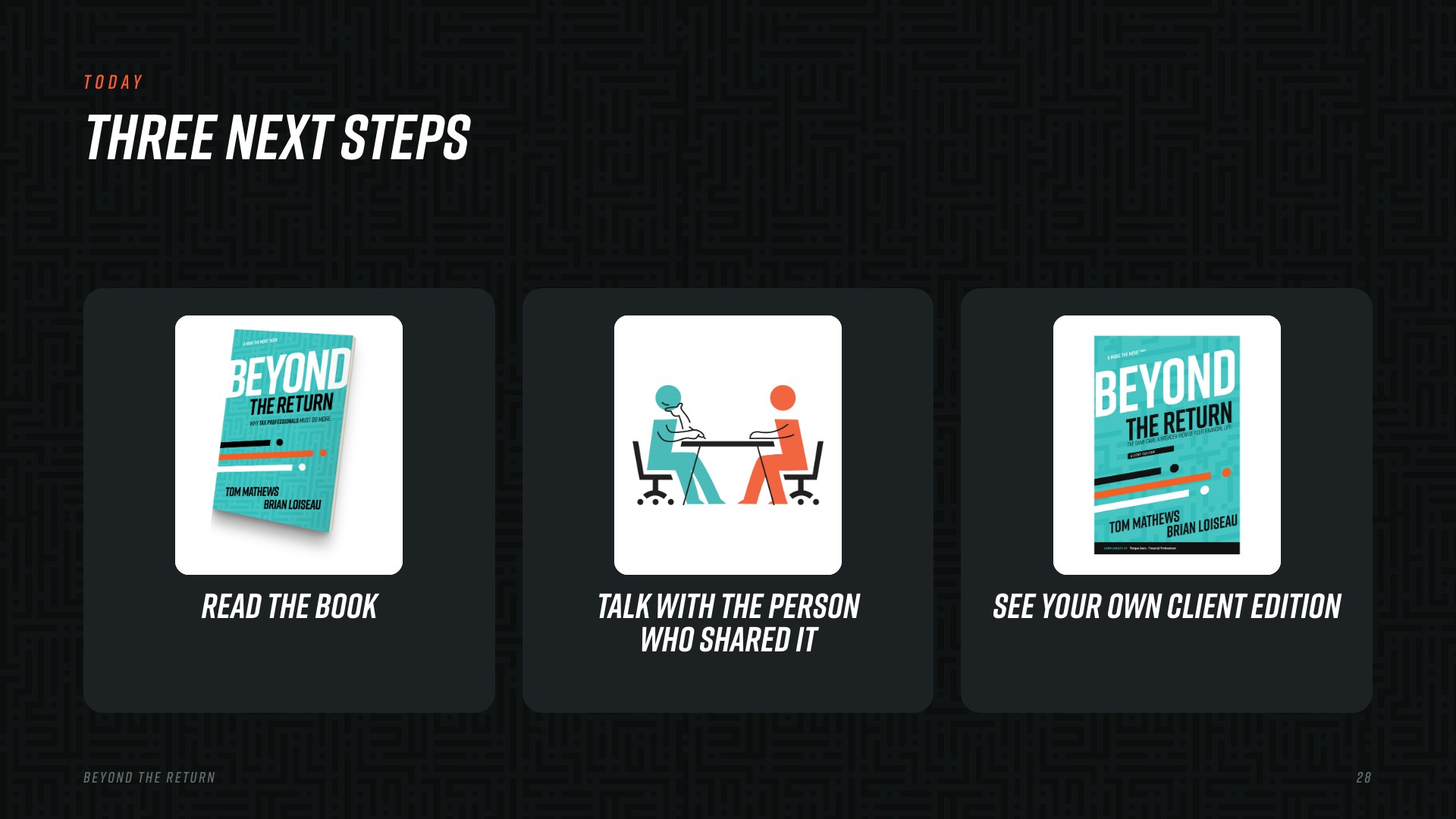
Three next steps. First, read the book. You can request your copy at wealthwave.com/beyond. Second, talk with me, the person who shared it with you. Third, see what your own Client Edition would look like with your name on it.
[Presenter: replace the link with your own personal link, wealthwave.com/your-name/beyond, so the request comes to you.]
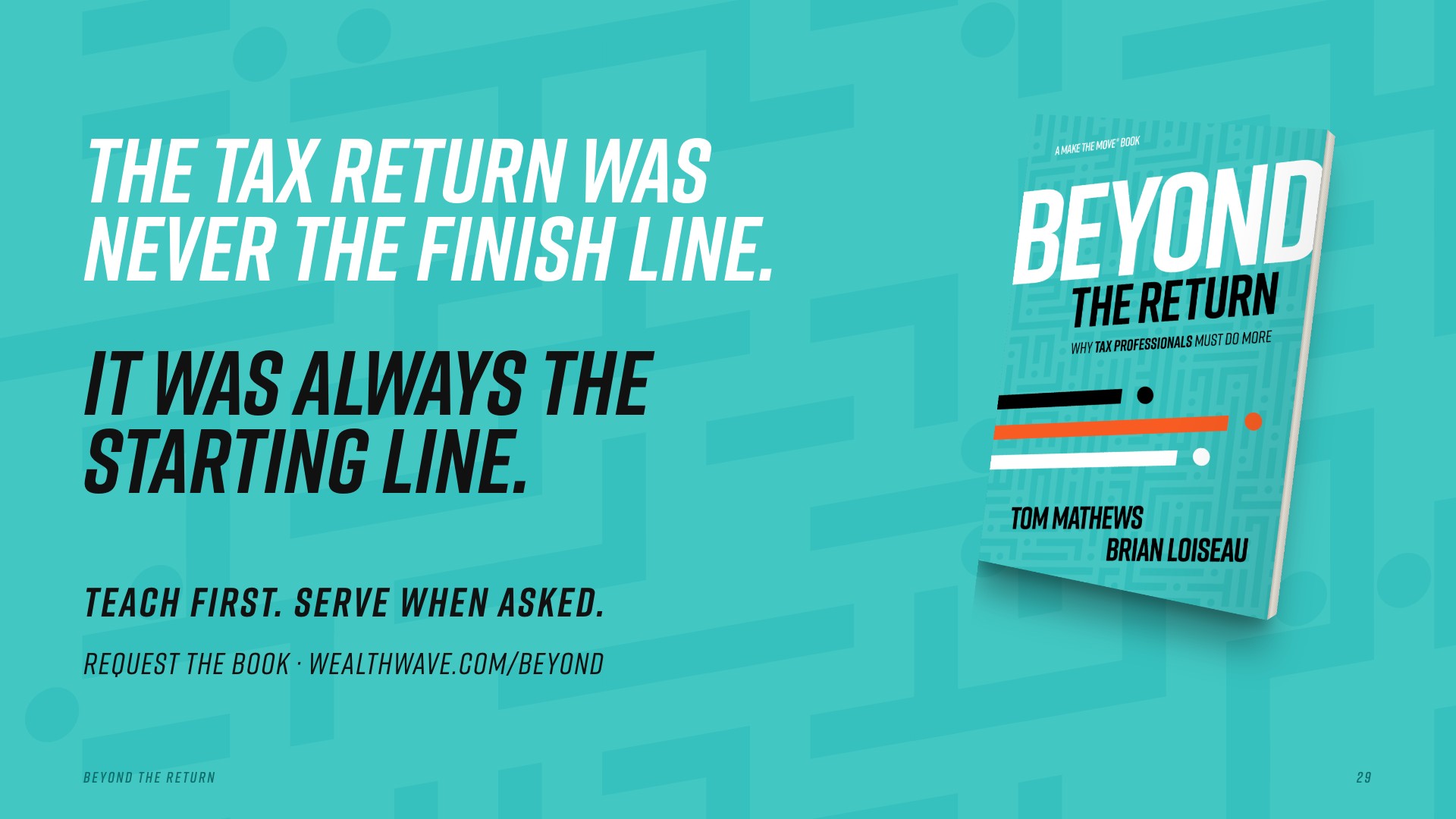
The book closes where we started. The tax return was never the finish line. It was always the starting line. And your clients have been waiting at the starting line for years.
Teach first. Serve when asked. Thank you. I'd love to hear your questions.