
Here's a personal question: how much money do you have? Here's one that's even more personal: do you have enough?
Will you and your family miss out because you won’t have enough money to live the life you’ve always wanted, give your children the future they deserve, or make the difference you’ve always imagined?
Be warned: It’s a price tag you may find shocking, or even disturbing. But before you decide that living your American Dream is impossible, make sure you read all the way to the end. Deal?
We’re going to add up, line by line, what it costs to live the American Dream in this country. Then we’re going to show you how families pay it.
What is The American Dream?

Here's a personal question: how much money do you have? Here's one that's even more personal: do you have enough?
Will you and your family miss out because you won’t have enough money to live the life you’ve always wanted, give your children the future they deserve, or make the difference you’ve always imagined?
Be warned: It’s a price tag you may find shocking, or even disturbing. But before you decide that living your American Dream is impossible, make sure you read all the way to the end. Deal?
We’re going to add up, line by line, what it costs to live the American Dream in this country. Then we’re going to show you how families pay it.
What is The American Dream?

Here's a personal question: how much money do you have? Here's one that's even more personal: do you have enough?
Will you and your family miss out because you won’t have enough money to live the life you’ve always wanted, give your children the future they deserve, or make the difference you’ve always imagined?
Be warned: It’s a price tag you may find shocking, or even disturbing. But before you decide that living your American Dream is impossible, make sure you read all the way to the end. Deal?
We’re going to add up, line by line, what it costs to live the American Dream in this country. Then we’re going to show you how families pay it.
What is The American Dream?
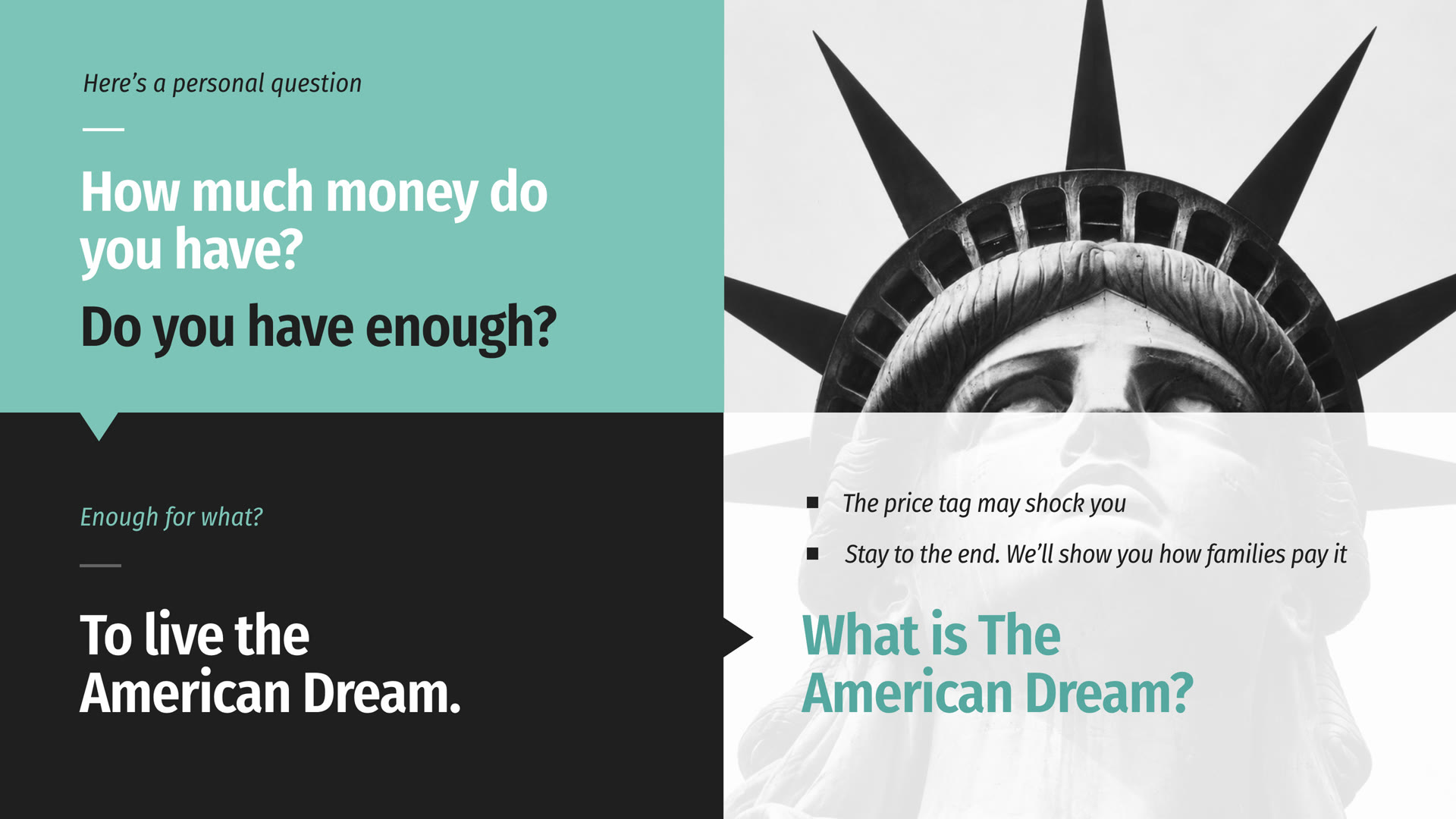
Here's a personal question: how much money do you have? Here's one that's even more personal: do you have enough?
Will you and your family miss out because you won’t have enough money to live the life you’ve always wanted, give your children the future they deserve, or make the difference you’ve always imagined?
Be warned: It’s a price tag you may find shocking, or even disturbing. But before you decide that living your American Dream is impossible, make sure you read all the way to the end. Deal?
We’re going to add up, line by line, what it costs to live the American Dream in this country. Then we’re going to show you how families pay it.
What is The American Dream?
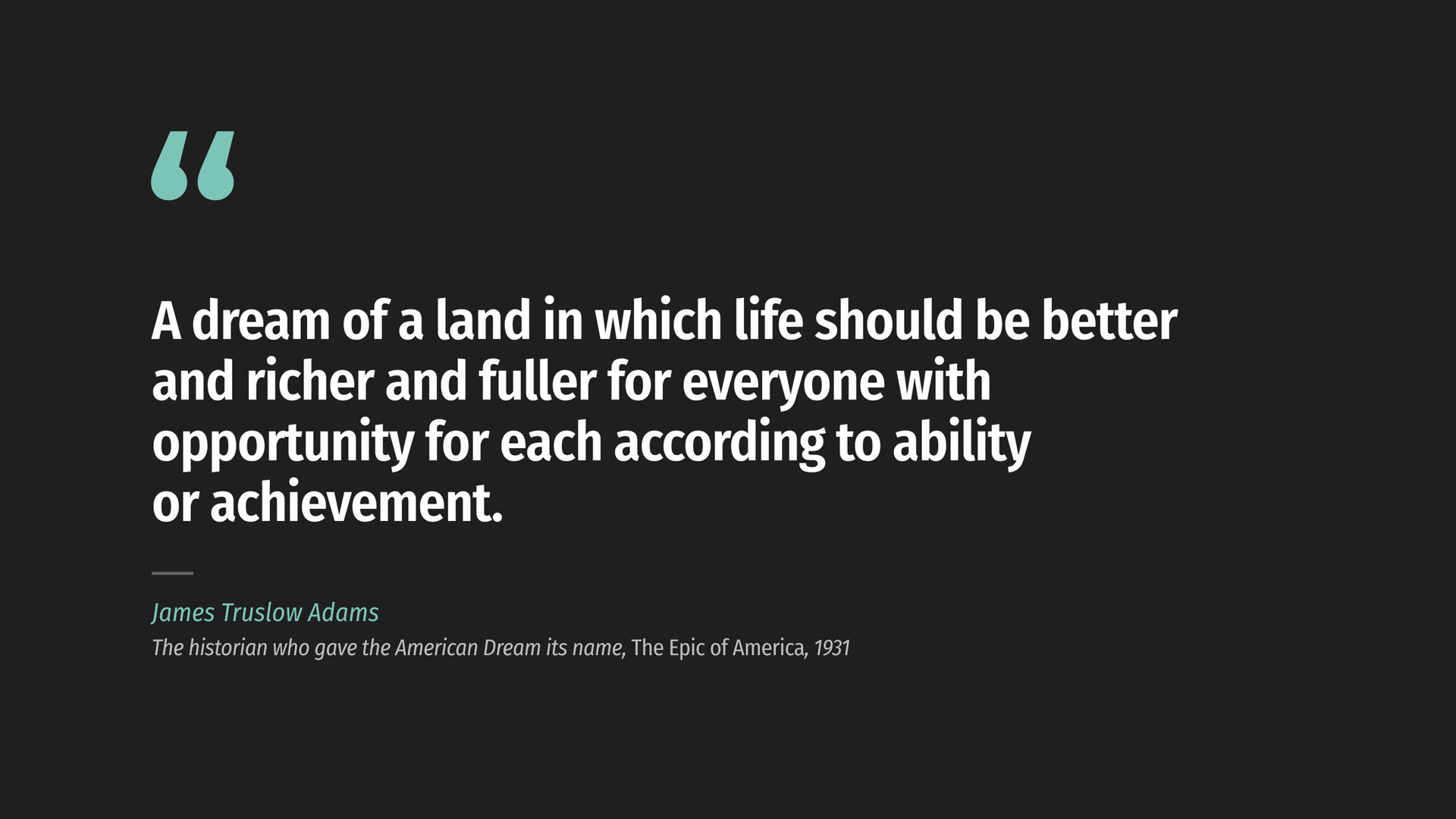
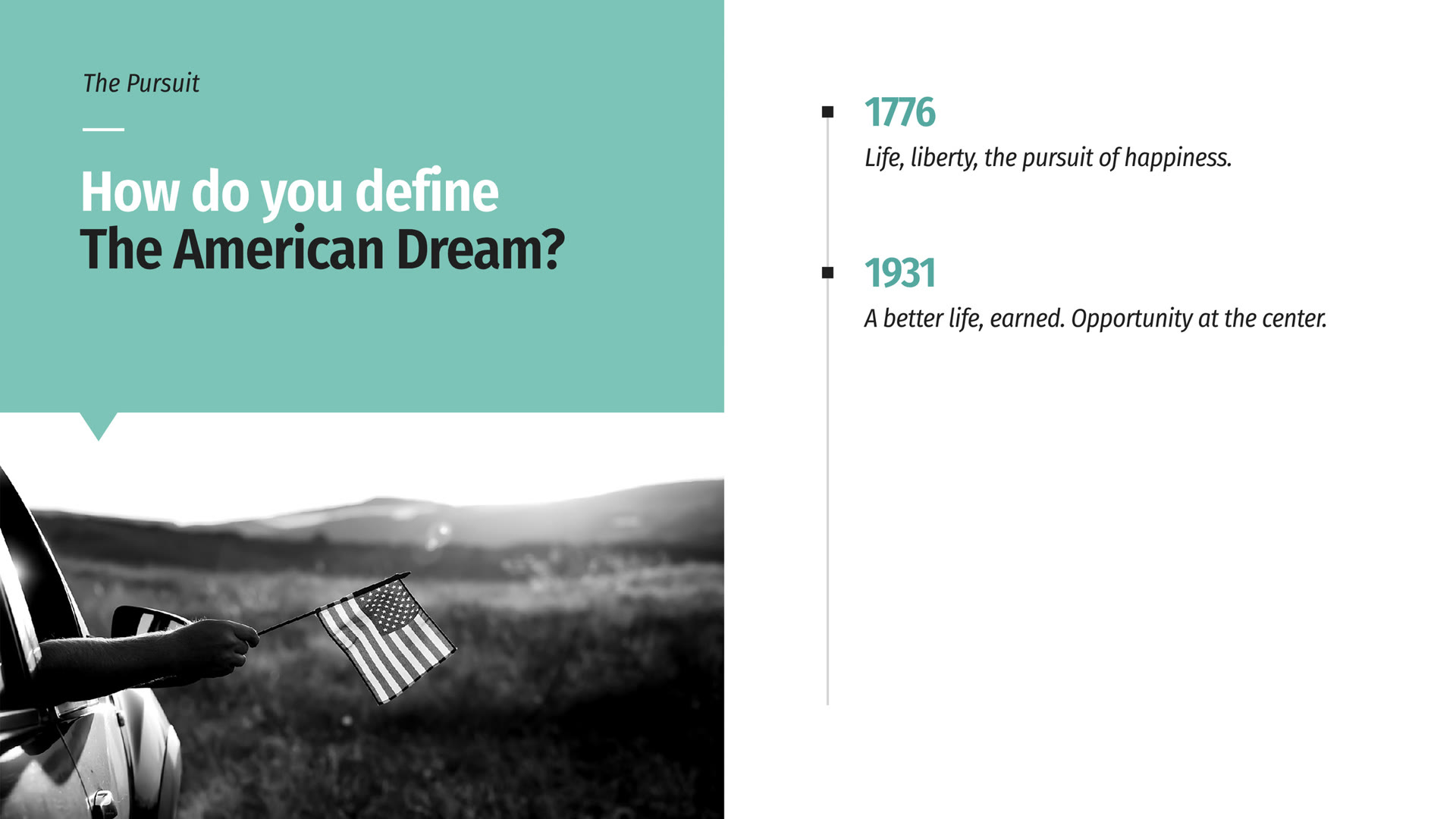
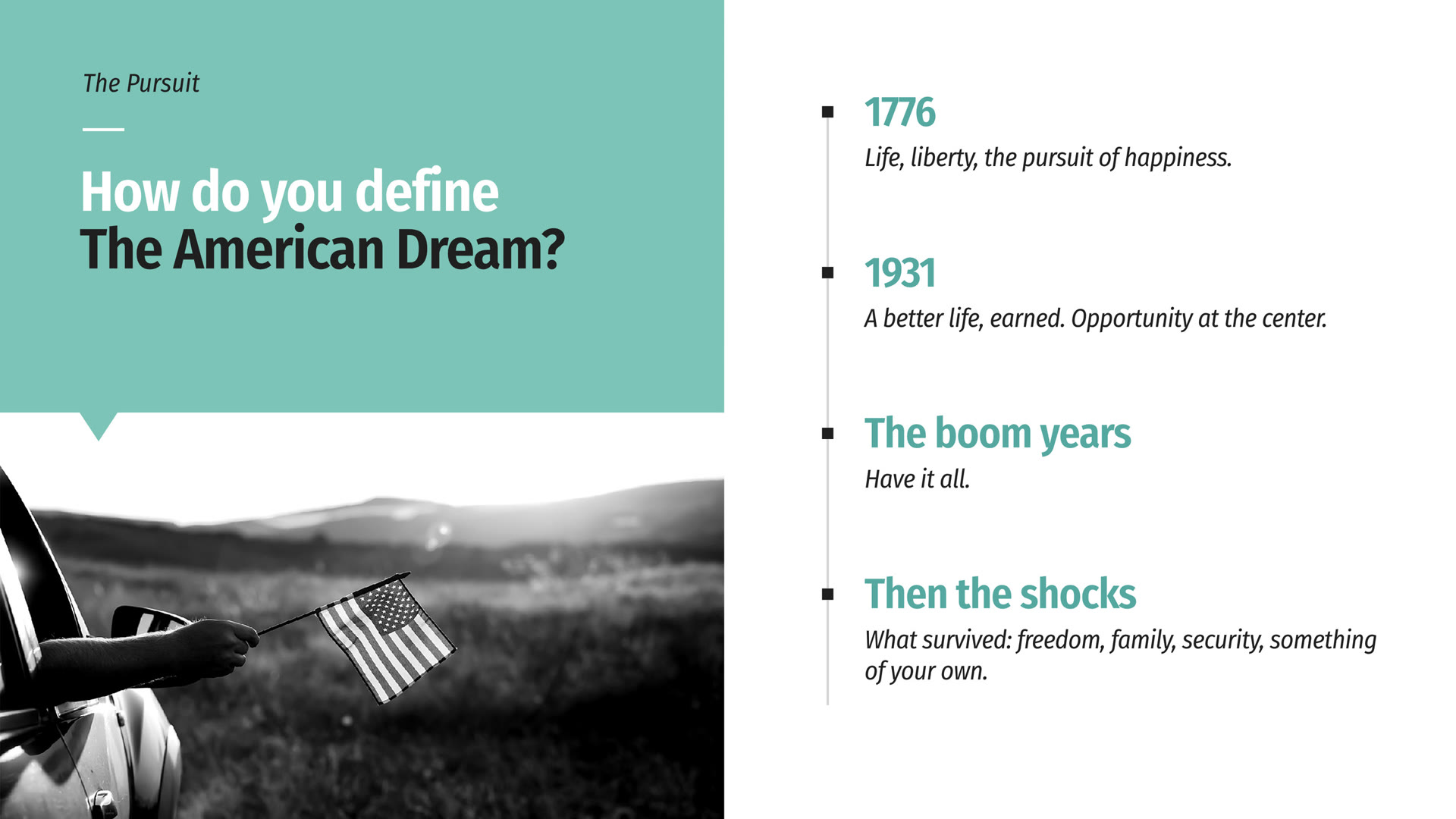
The Declaration of Independence is a good starting point: “Life, Liberty, and the pursuit of happiness.” The American Dream was originally and simply stated as the freedom to live our lives as we wish, independent from the control of others. In 1931, the historian James Truslow Adams gave it a name. Notice what he put at the center. Opportunity. A better life, earned.
During the boom years of the last century, that idea grew into something bigger and shinier: graduate from the right school, marry the right person, land the right job, and you could have it all. Then came the shocks. Terror attacks. A great recession. A pandemic. The fastest run-up in prices most families have ever lived through. What survived is a dream that’s more pragmatic, and one that looks a lot like the original. Freedom. Family. Security. The chance to pursue something of your own.
The Declaration of Independence is a good starting point: “Life, Liberty, and the pursuit of happiness.” The American Dream was originally and simply stated as the freedom to live our lives as we wish, independent from the control of others. In 1931, the historian James Truslow Adams gave it a name. Notice what he put at the center. Opportunity. A better life, earned.
During the boom years of the last century, that idea grew into something bigger and shinier: graduate from the right school, marry the right person, land the right job, and you could have it all. Then came the shocks. Terror attacks. A great recession. A pandemic. The fastest run-up in prices most families have ever lived through. What survived is a dream that’s more pragmatic, and one that looks a lot like the original. Freedom. Family. Security. The chance to pursue something of your own.
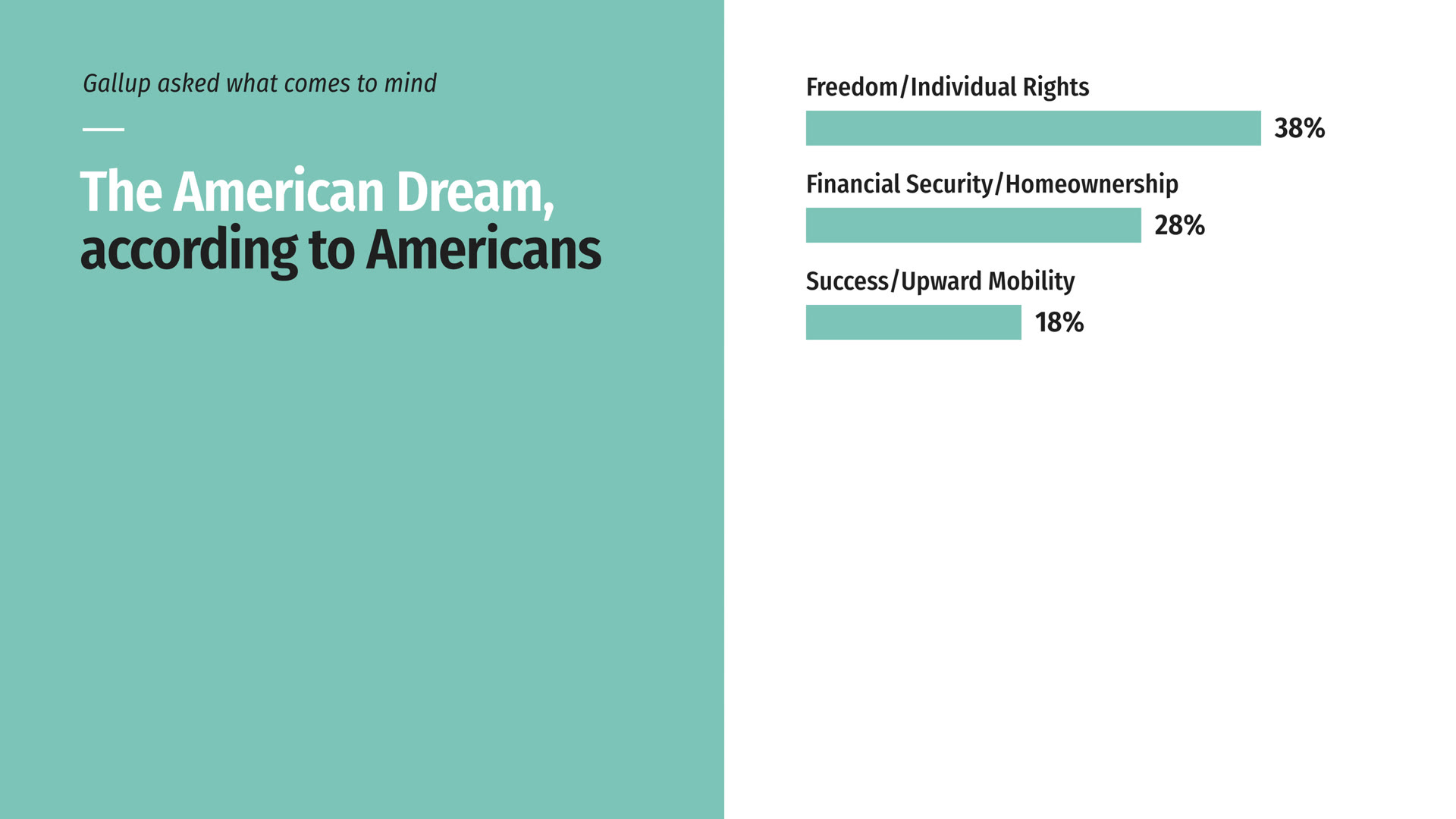
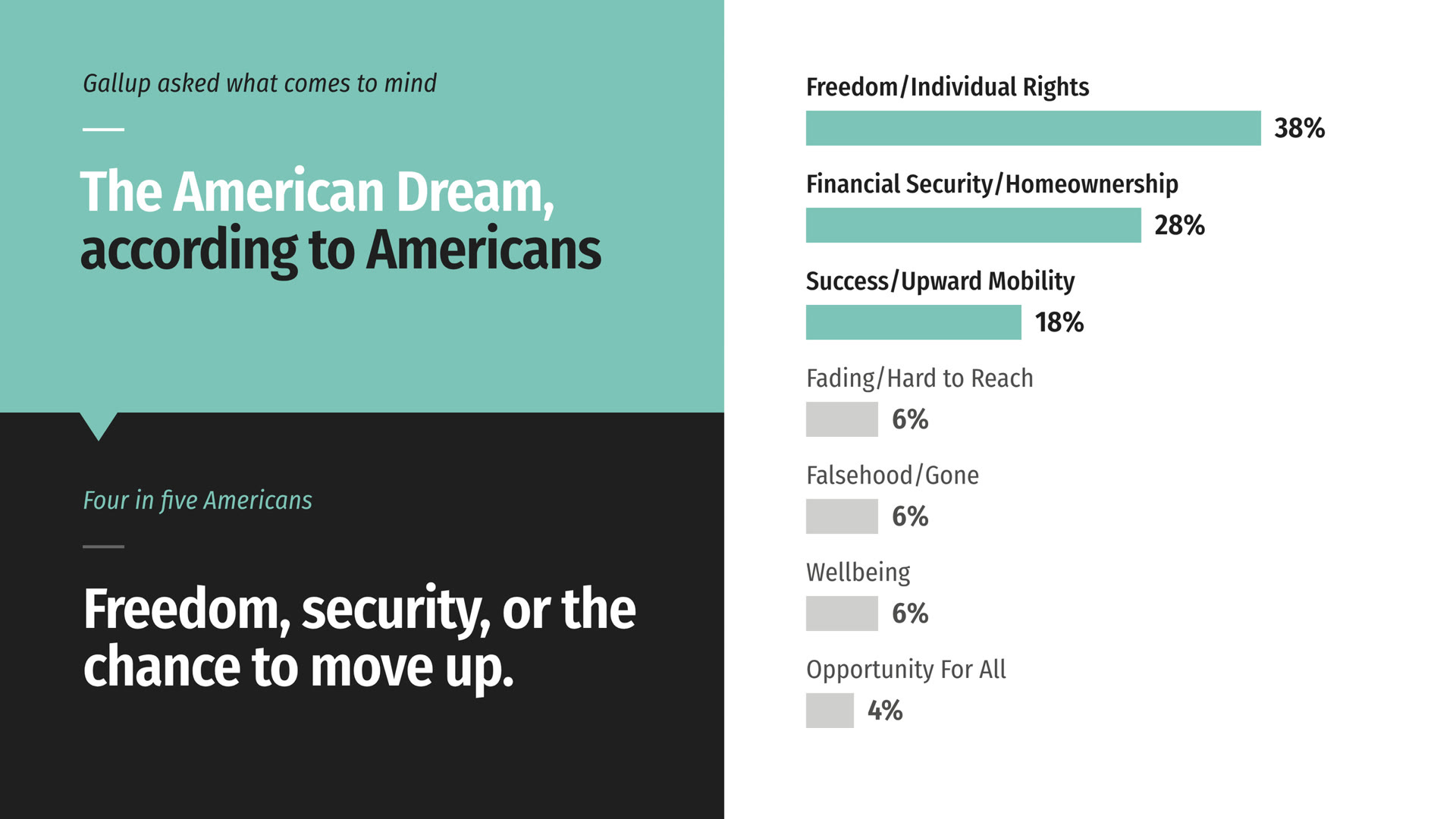
When Gallup asked Americans what comes to mind when they think of the American Dream, the answers came back in three big themes.
Four out of five Americans define the Dream by freedom, security, or the chance to move up. Fewer than one in eight describe it as fading or gone.
When Gallup asked Americans what comes to mind when they think of the American Dream, the answers came back in three big themes.
Four out of five Americans define the Dream by freedom, security, or the chance to move up. Fewer than one in eight describe it as fading or gone.
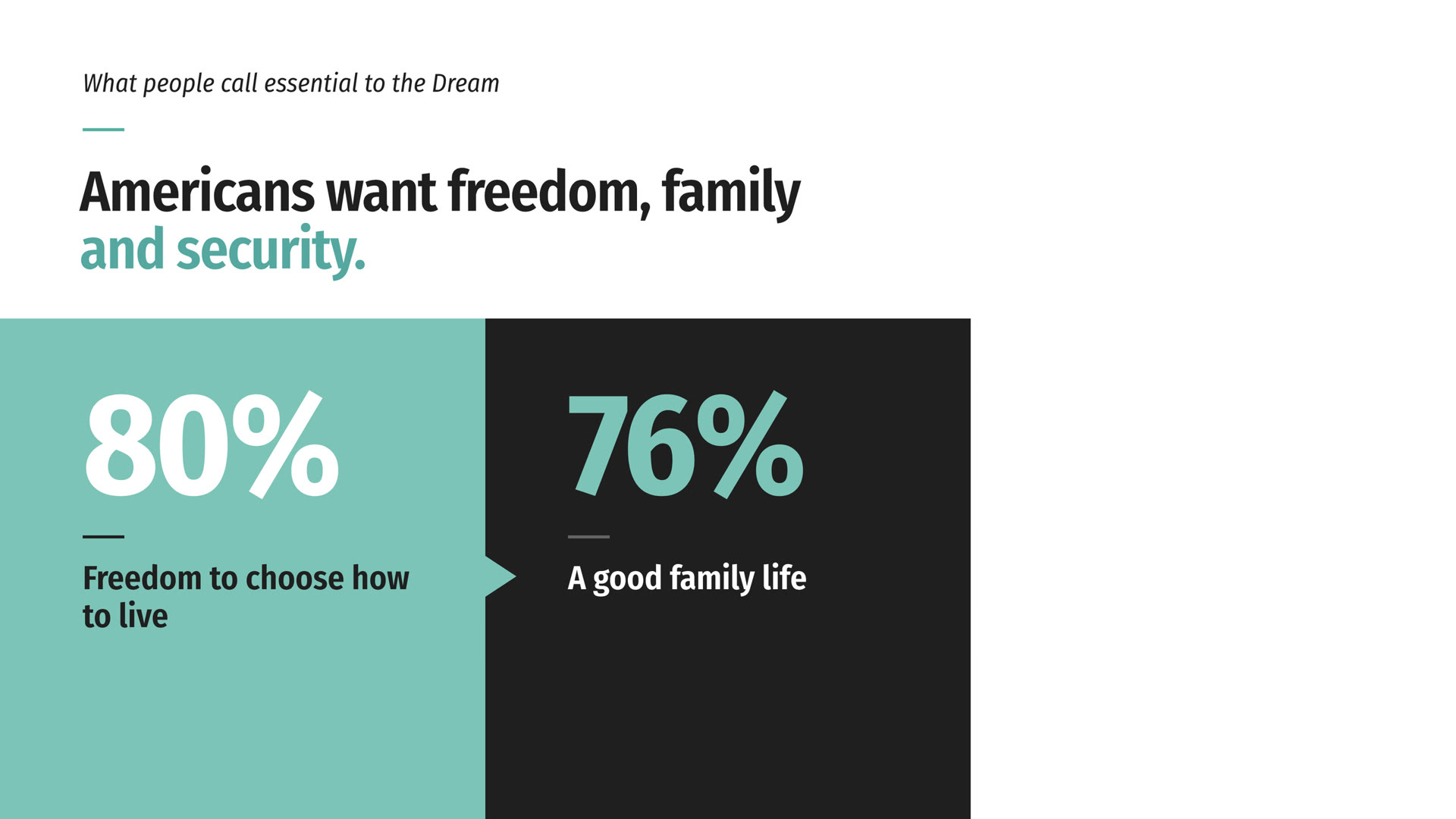
A second national survey found the two things people call essential to the Dream:
Read that again. All they ask is the chance to earn it for themselves and protect it for the people they love. Hundreds of millions of people can’t get it wrong. You can’t fool 300 million people.
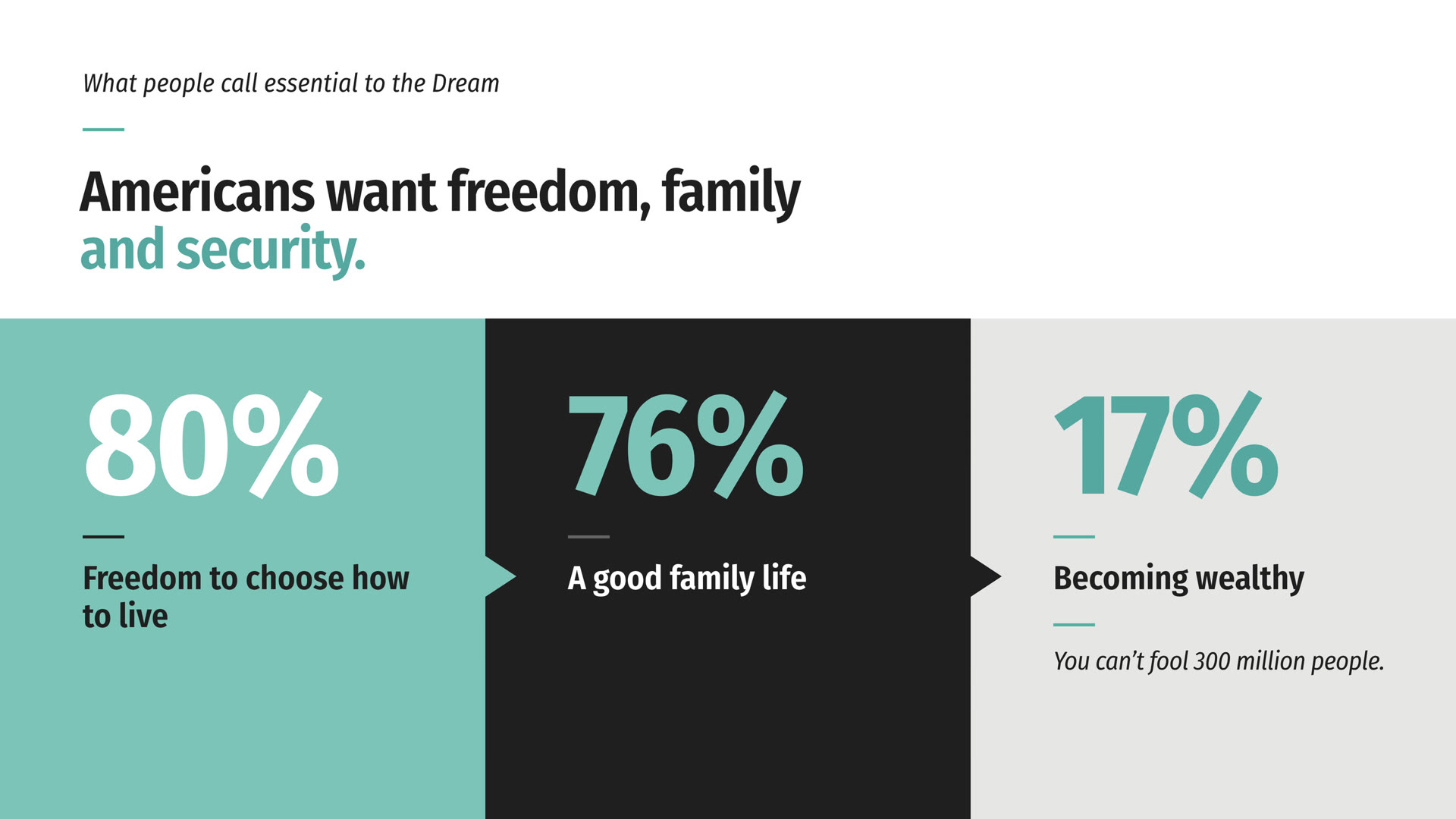
A second national survey found the two things people call essential to the Dream:
Read that again. All they ask is the chance to earn it for themselves and protect it for the people they love. Hundreds of millions of people can’t get it wrong. You can’t fool 300 million people.
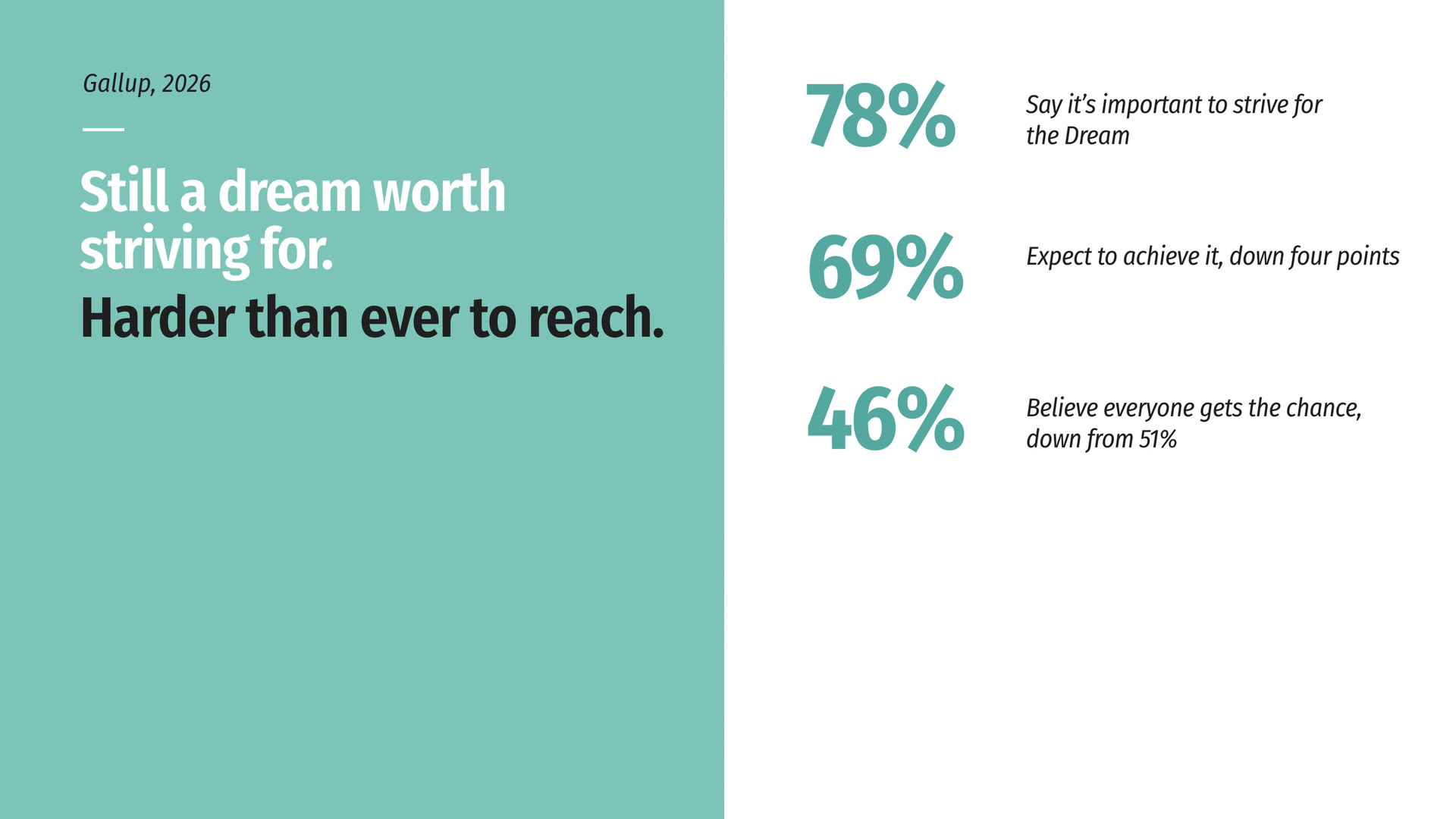
Nearly 8 in 10 Americans say the Dream is worth striving for. Fewer than half believe everyone gets a shot at it, and a third are now convinced the door is closed. The gap between those two numbers is the gap this presentation is about.
Asked whether the American Dream has succeeded, has failed, or is unfinished, most Americans chose the same word, and they chose it across every political party: unfinished.
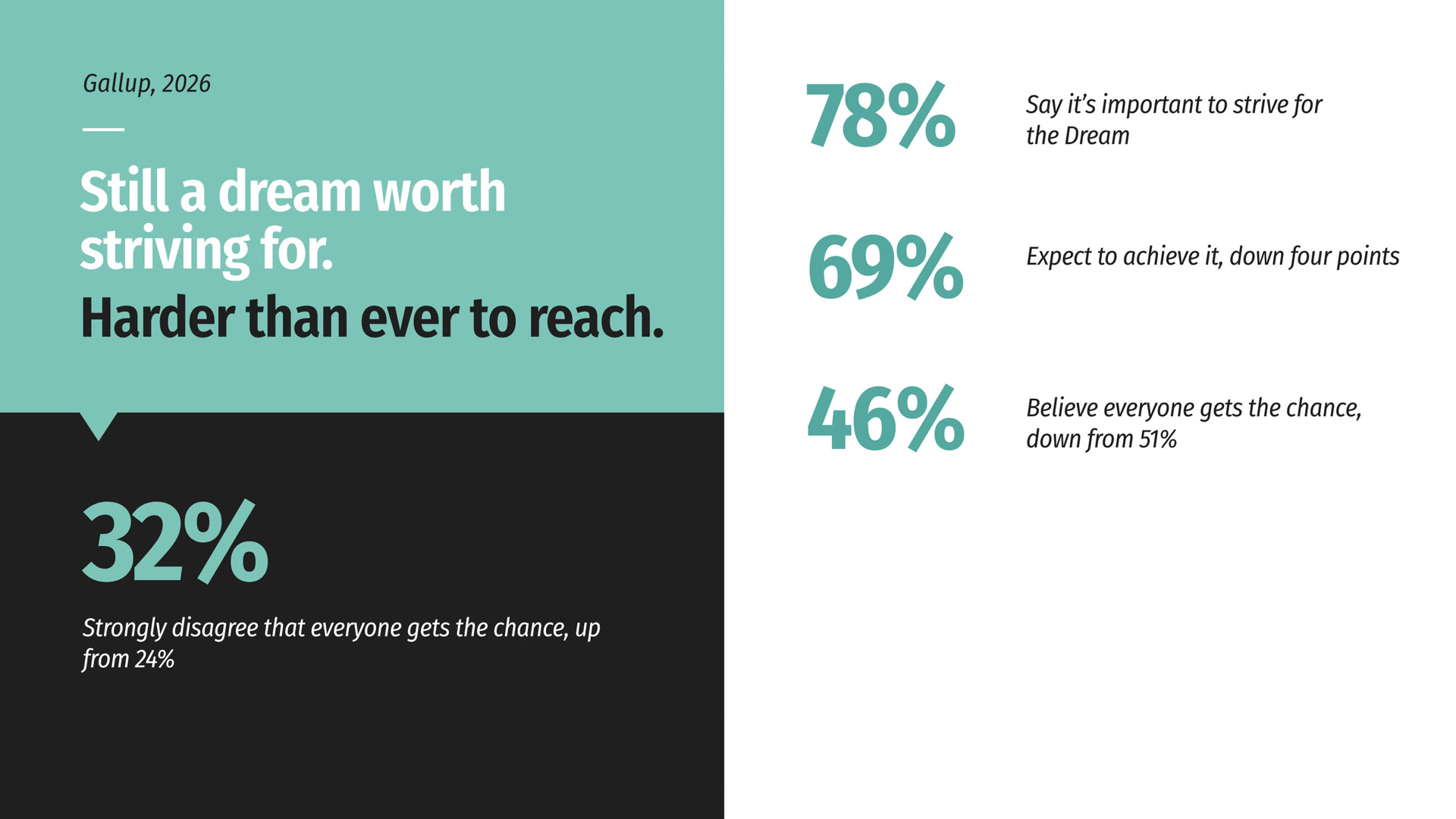
Nearly 8 in 10 Americans say the Dream is worth striving for. Fewer than half believe everyone gets a shot at it, and a third are now convinced the door is closed. The gap between those two numbers is the gap this presentation is about.
Asked whether the American Dream has succeeded, has failed, or is unfinished, most Americans chose the same word, and they chose it across every political party: unfinished.
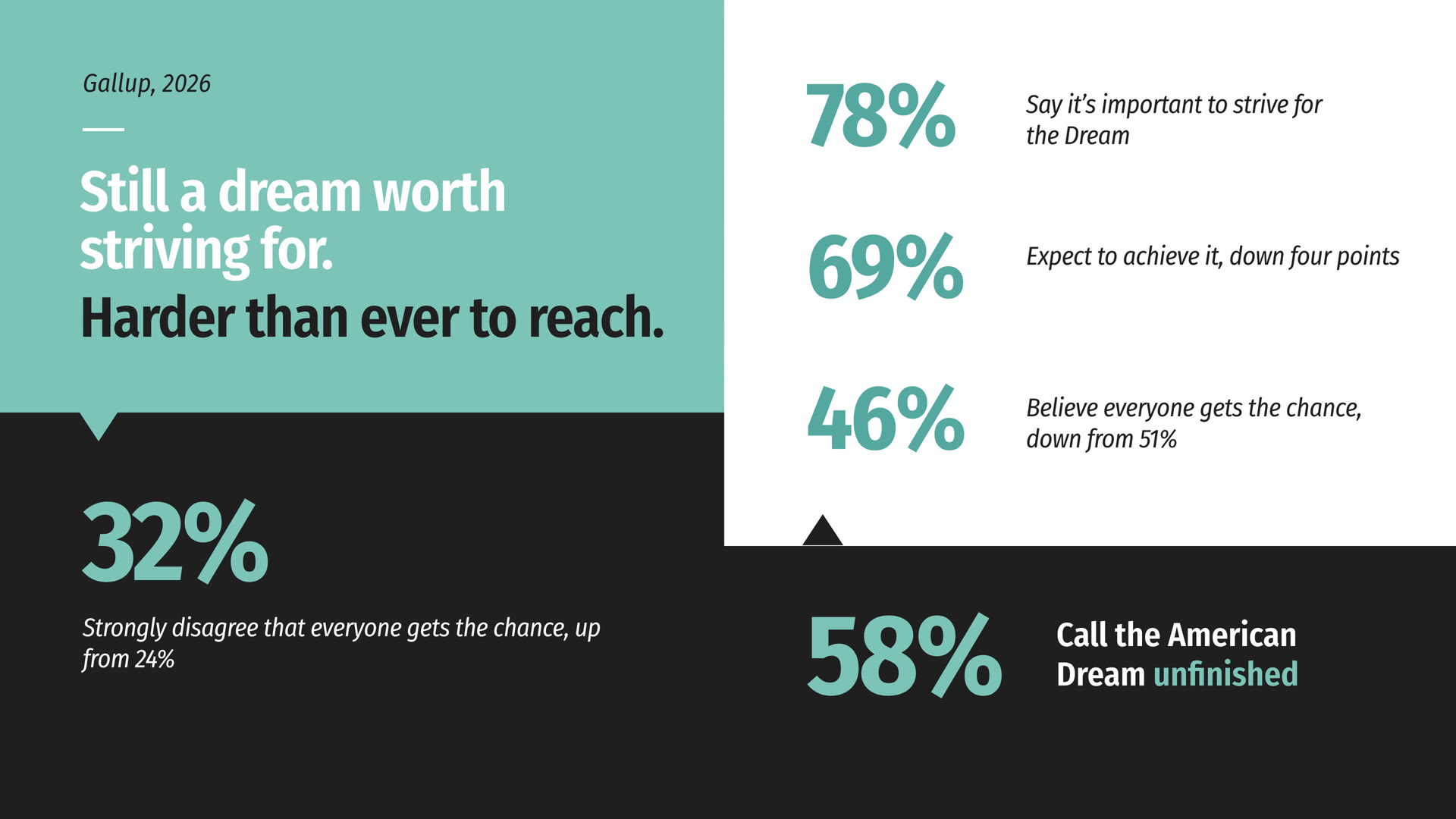
Nearly 8 in 10 Americans say the Dream is worth striving for. Fewer than half believe everyone gets a shot at it, and a third are now convinced the door is closed. The gap between those two numbers is the gap this presentation is about.
Asked whether the American Dream has succeeded, has failed, or is unfinished, most Americans chose the same word, and they chose it across every political party: unfinished.

Nearly 8 in 10 Americans say the Dream is worth striving for. Fewer than half believe everyone gets a shot at it, and a third are now convinced the door is closed. The gap between those two numbers is the gap this presentation is about.
Asked whether the American Dream has succeeded, has failed, or is unfinished, most Americans chose the same word, and they chose it across every political party: unfinished.
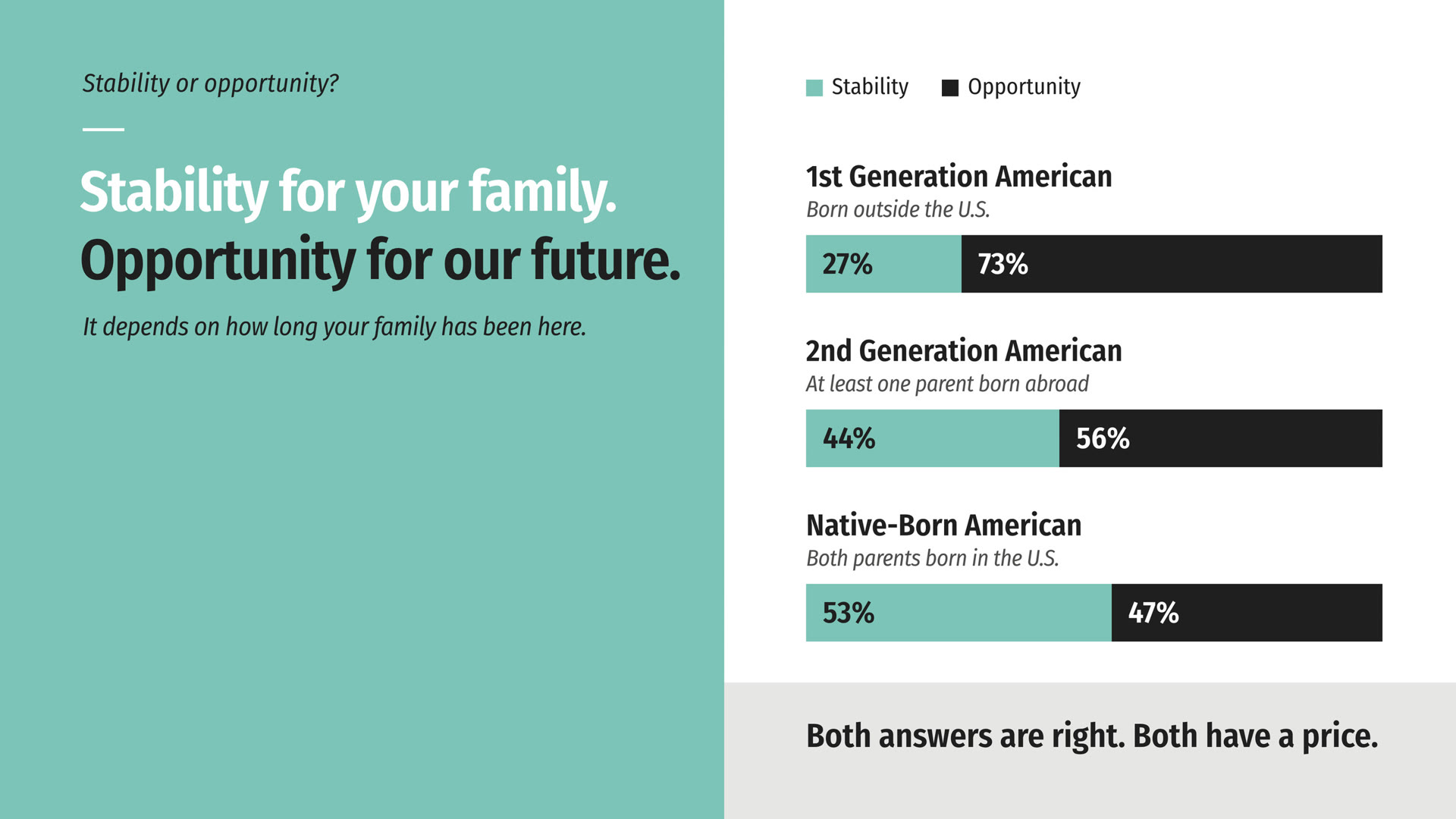
Ask a family what the Dream is really about and you’ll hear one of two answers. Stability: being able to support your family with a job and a safe place to live. Opportunity: being able to improve the quality of life for you and your family through education, better work and other resources. Gallup asked, and the answer depends on how long your family has been here.
First-generation Americans choose opportunity almost three to one. Families who have been here for generations lean toward stability. Both answers are right, and both have a price.
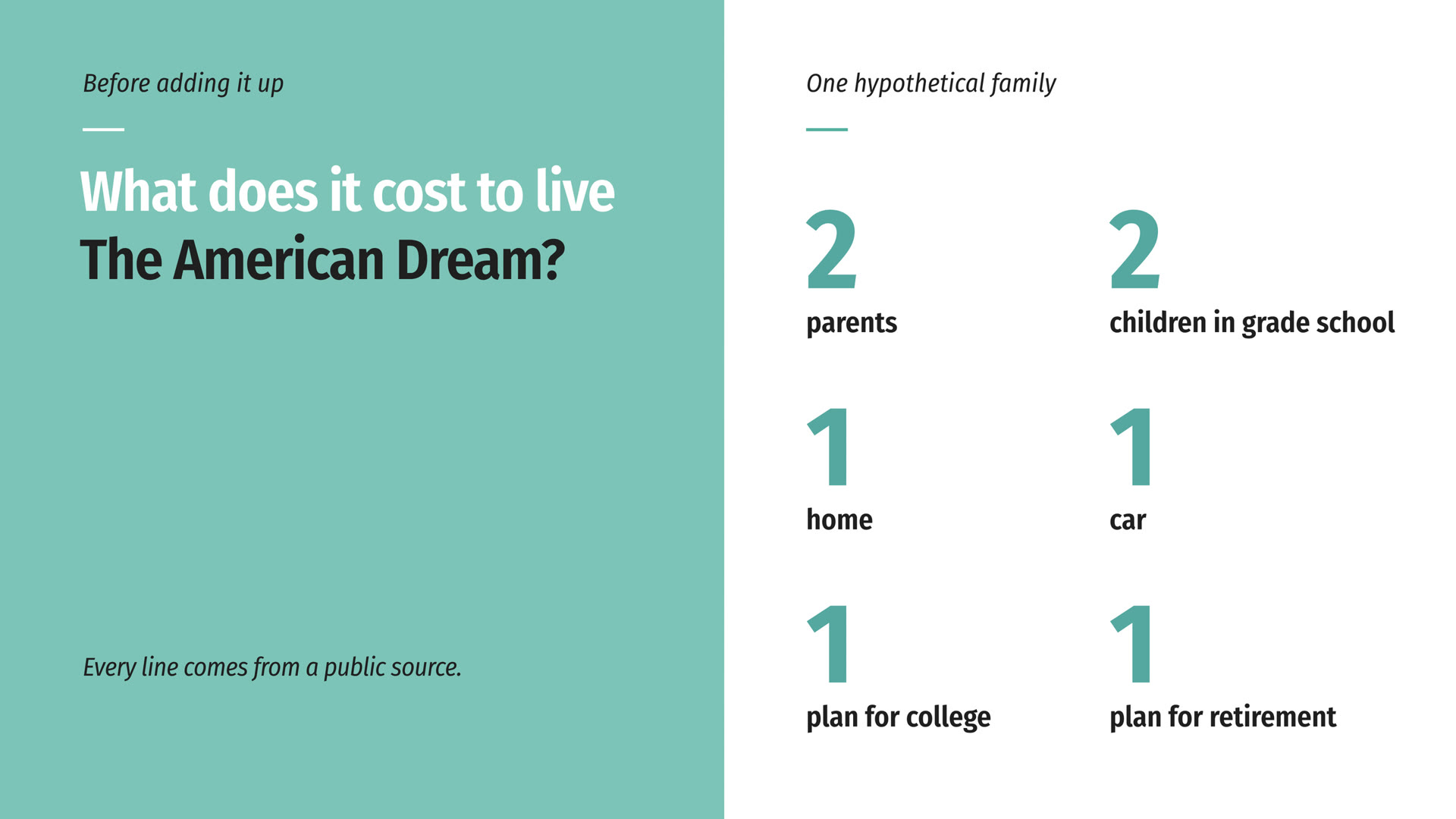
To find out, we built a hypothetical family:
Every line on their receipt comes from a public source, listed at the end.
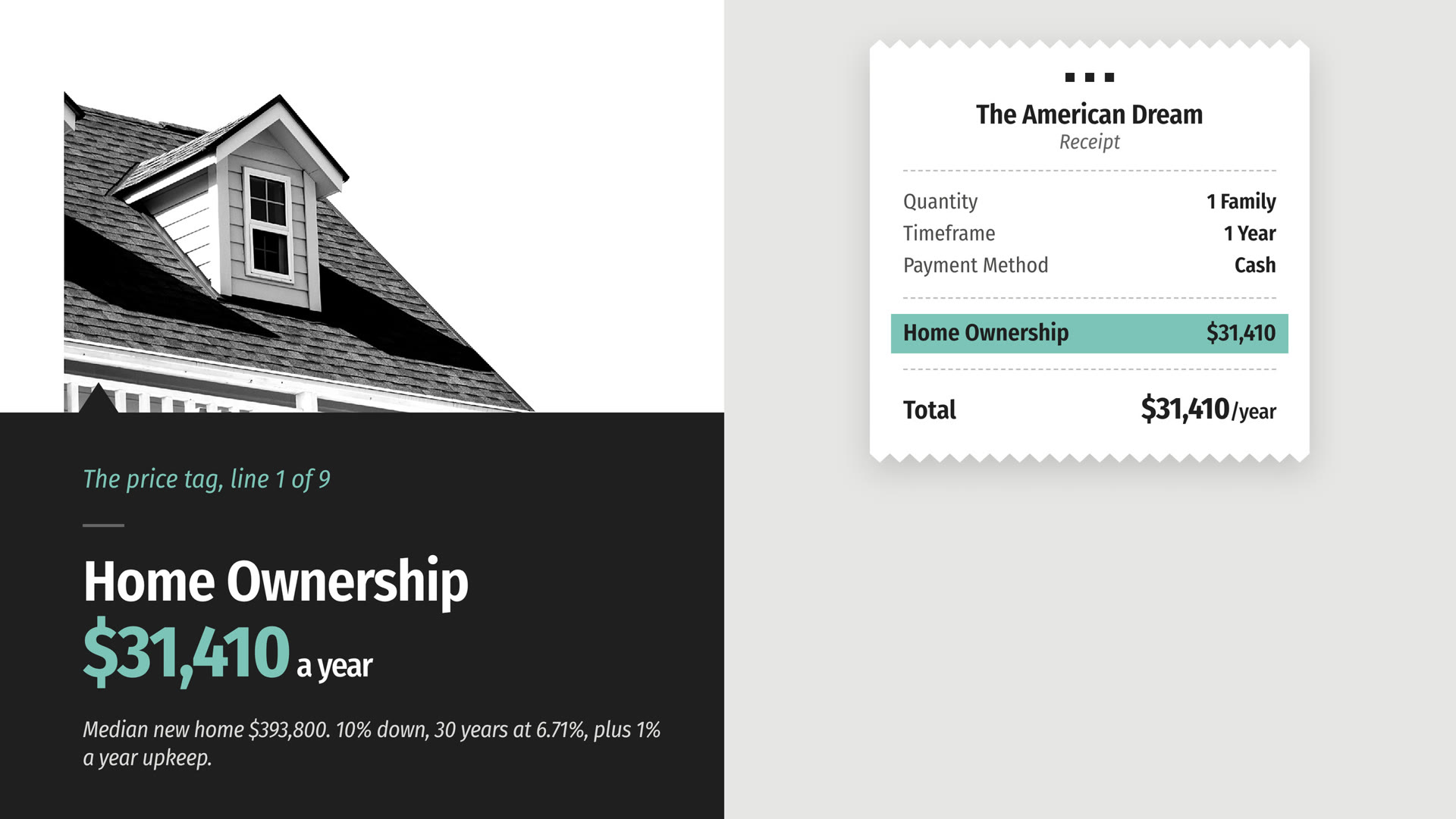
It’s at the heart of the American Dream. Start with the median price of a new house in America at $393,800. Put 10% down and finance the rest with a 30-year mortgage at 6.71%, the going rate when this price tag was updated. Add yearly maintenance at 1% of the purchase price. Before property taxes, which we count later, and before homeowners insurance.
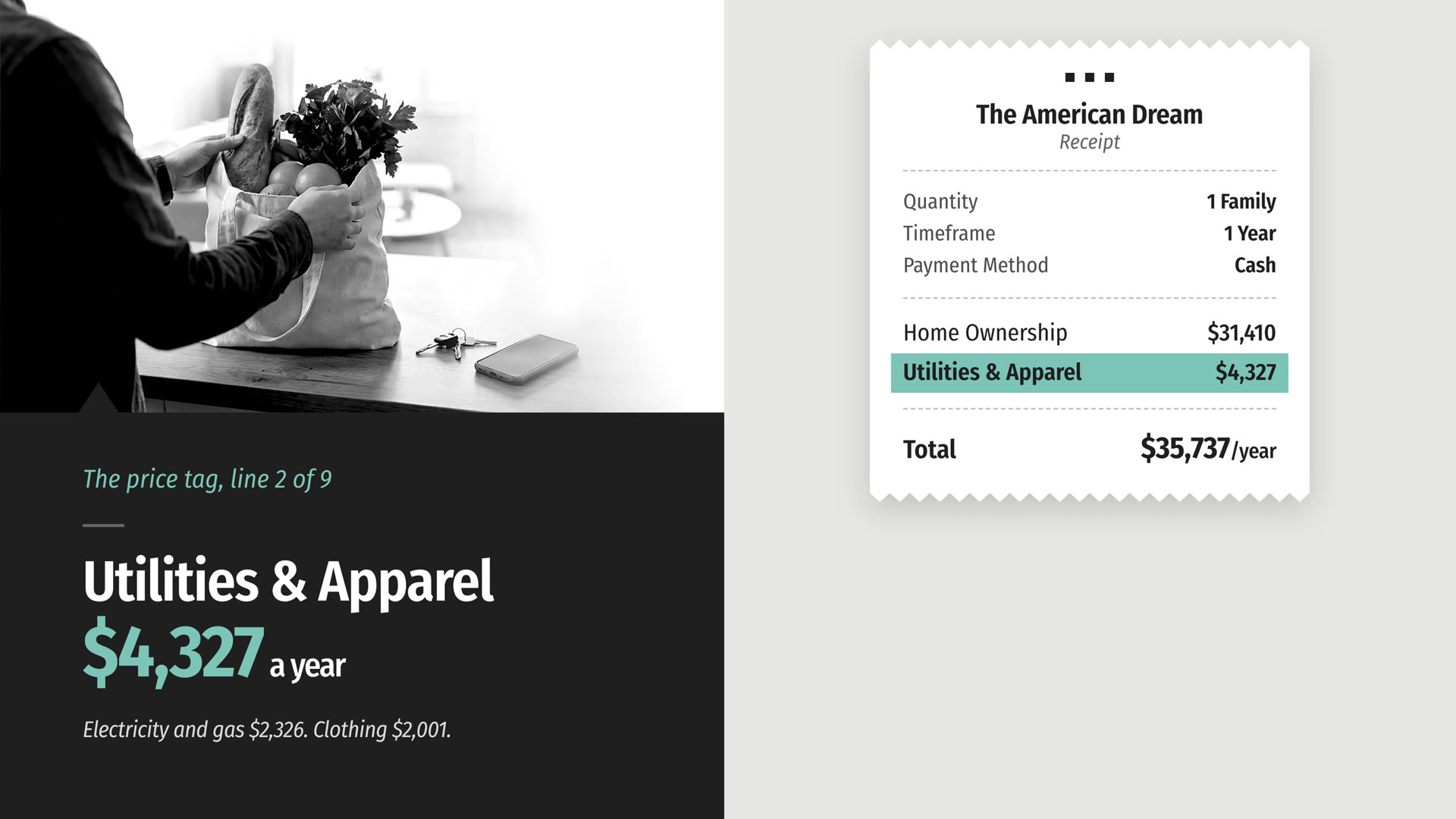
The federal government tracks what American households actually spend. Electricity and natural gas come to $2,326 a year, and clothing for the family adds $2,001.
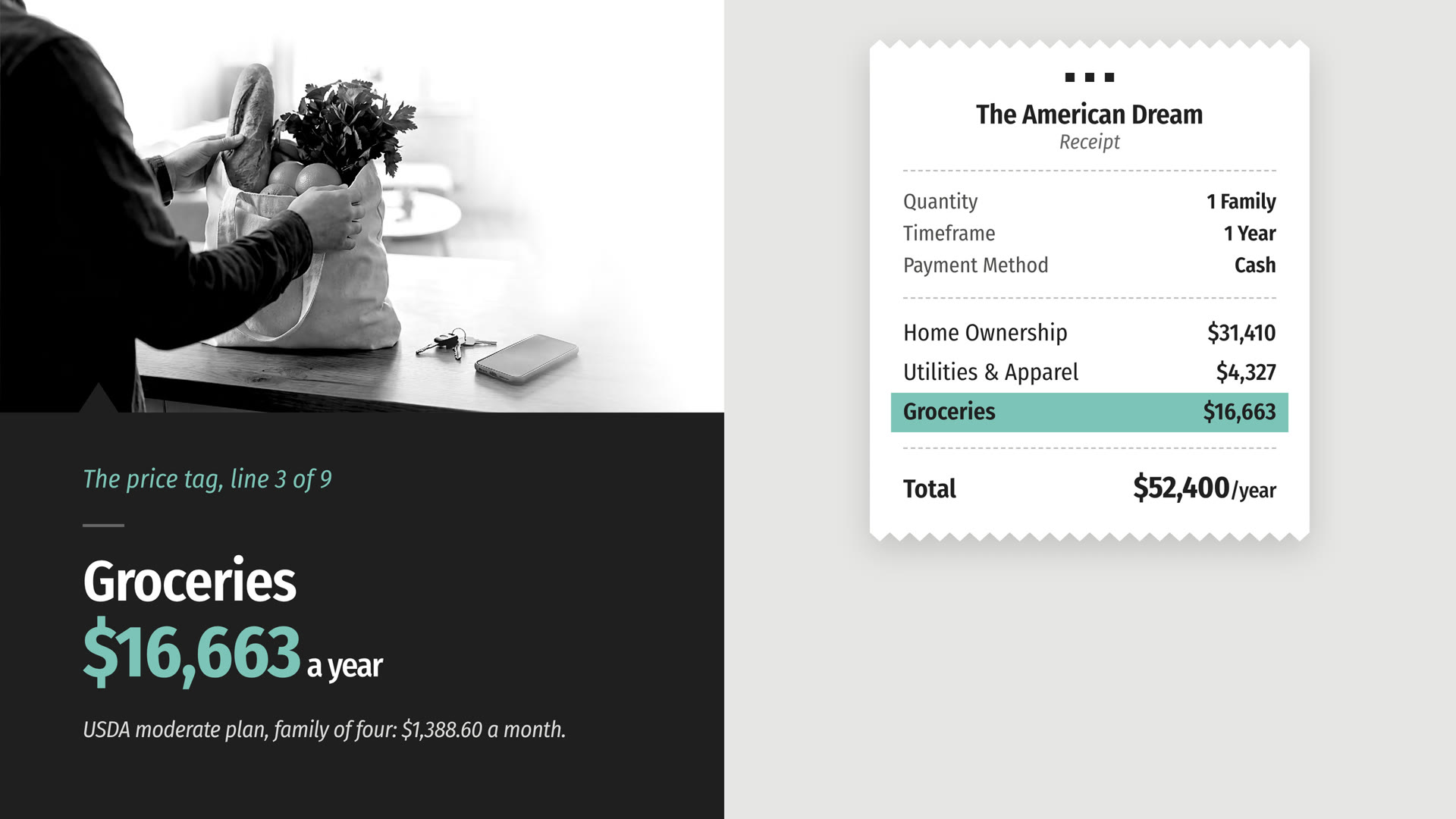
The U.S. Department of Agriculture’s moderate-cost food plan for a family of four with two grade-school children: $1,388.60 a month. That’s food at home. Eating out comes later.
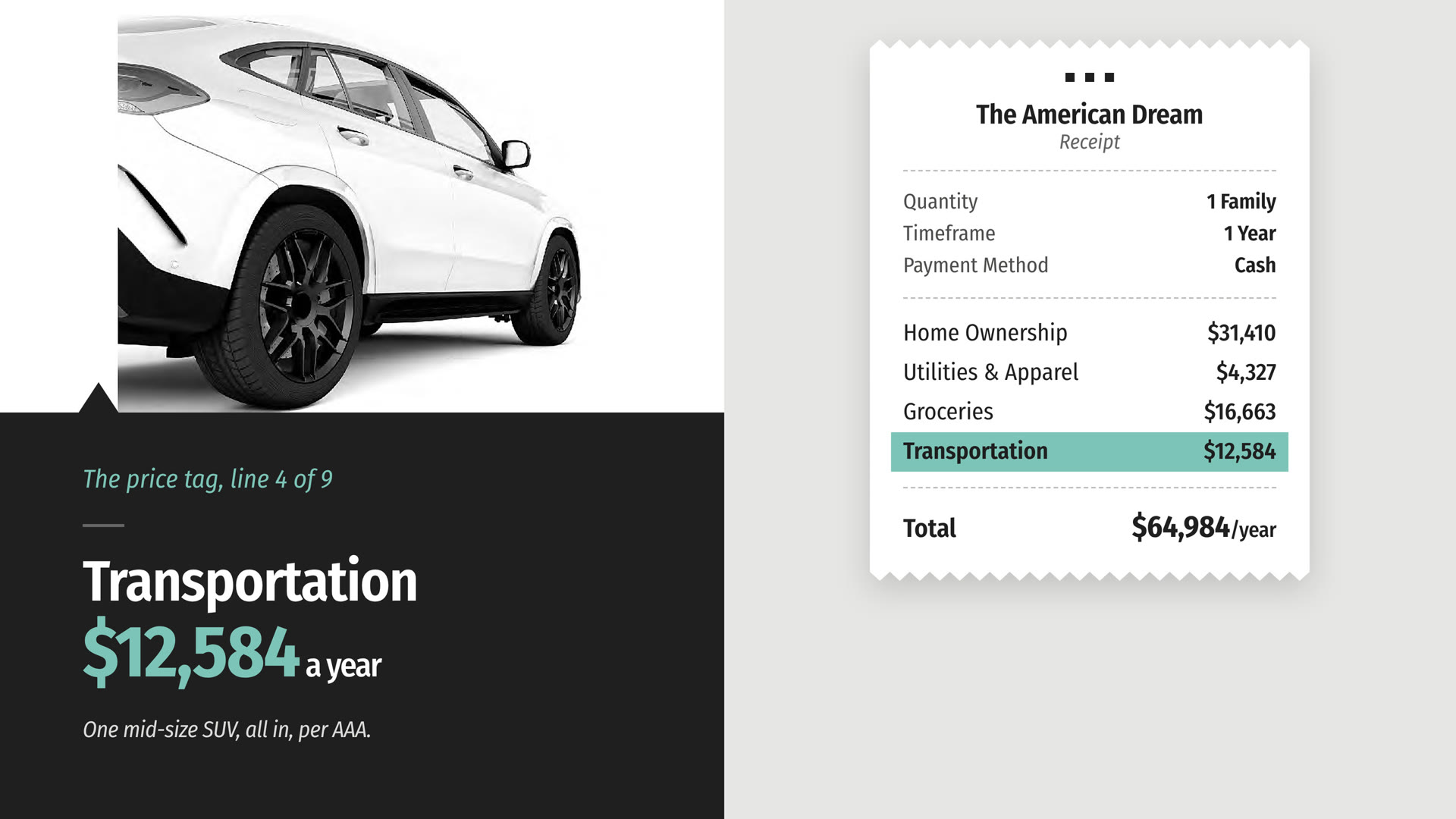
Owning a mid-size SUV that comfortably fits a family of four, according to AAA. Depreciation, fuel, insurance, maintenance, finance charges and registration, all in.
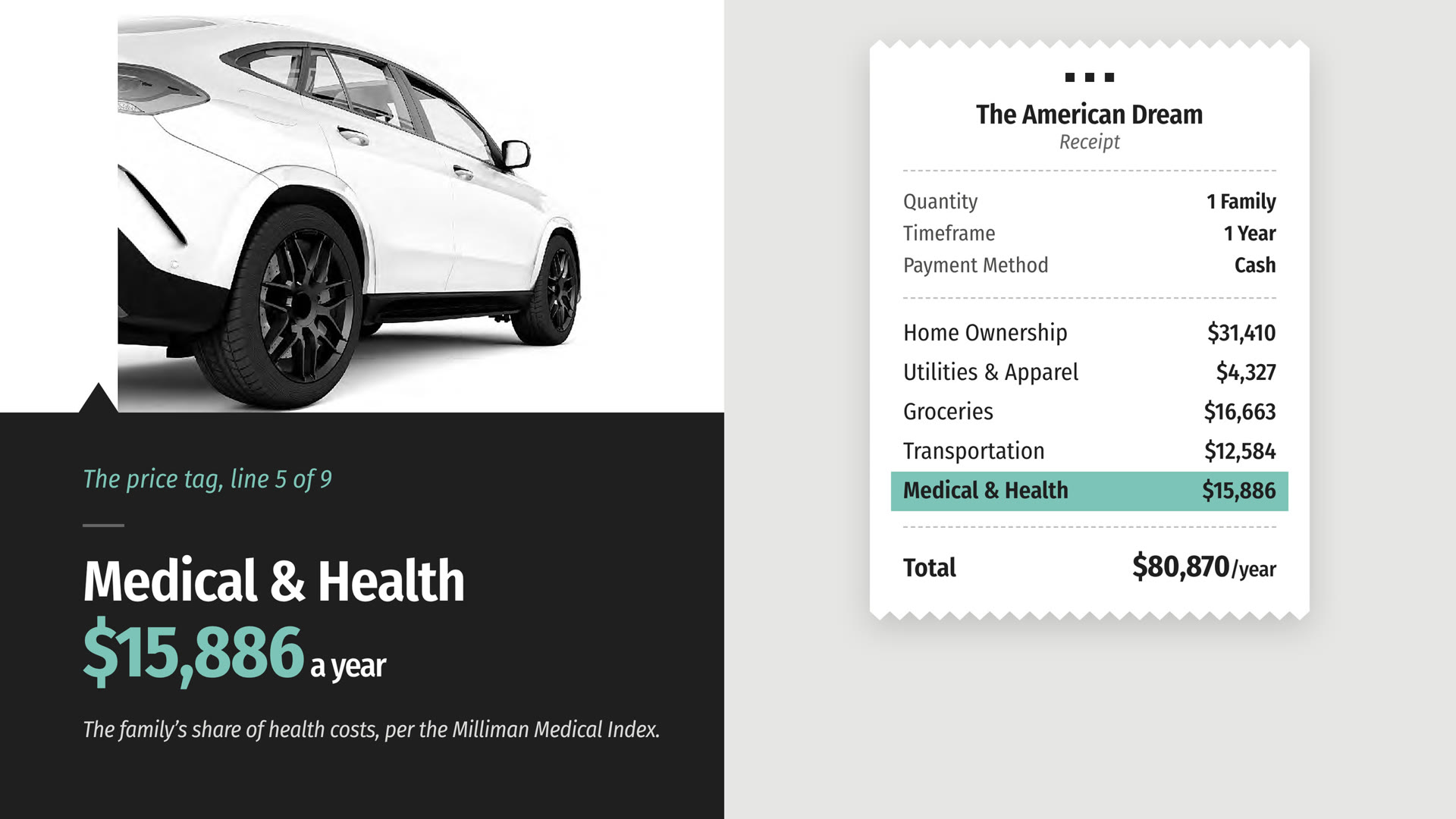
Employer coverage pays most of the bill for a family’s health care. The family’s own share, payroll deductions plus out-of-pocket costs, based on the Milliman Medical Index for a family of four.
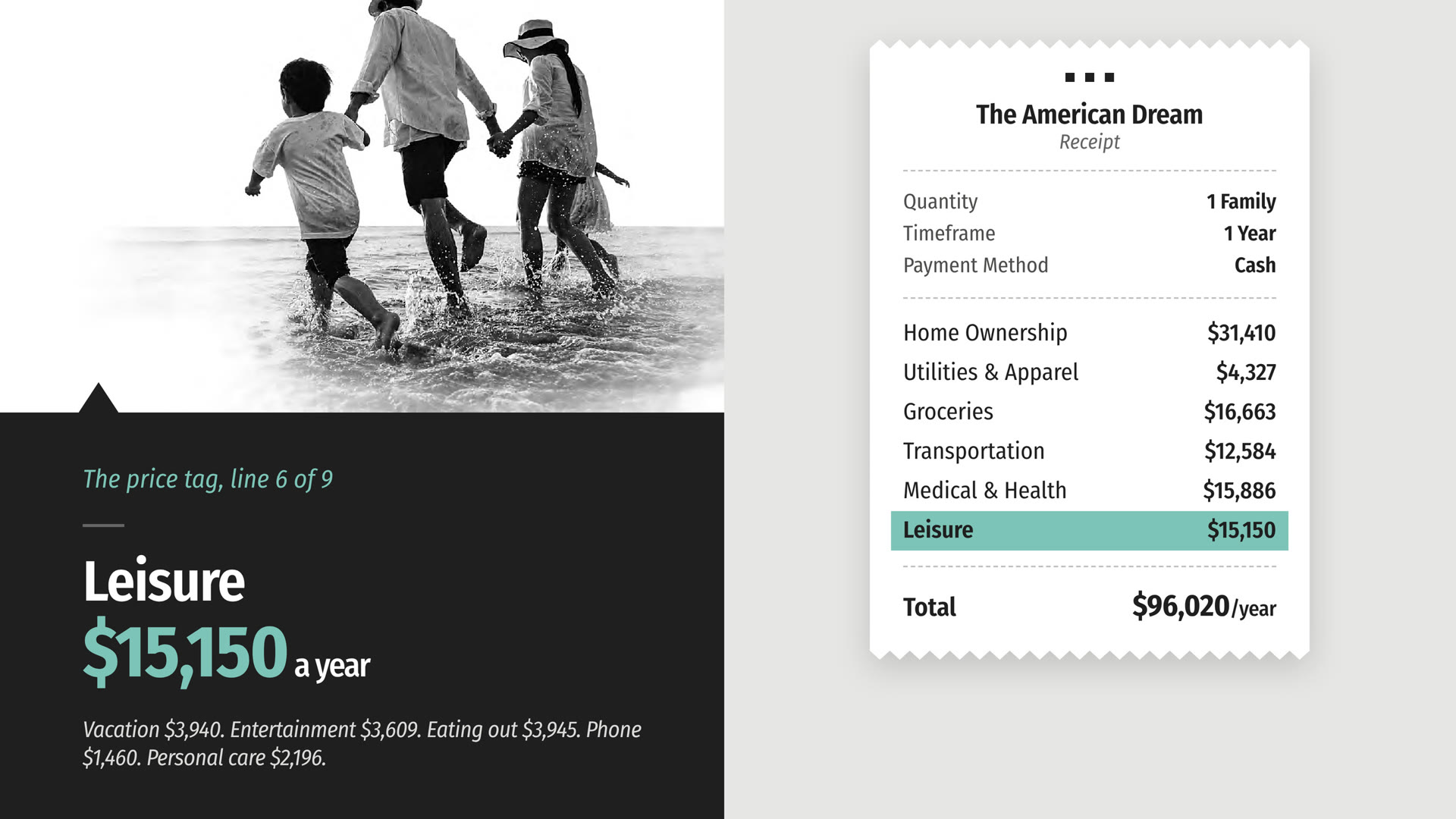
If you don’t make time for a little rest and relaxation, you certainly aren’t living the American Dream. A family vacation runs $3,940. Entertainment adds $3,609, eating out $3,945, phone service $1,460, and personal care and miscellaneous expenses $2,196.
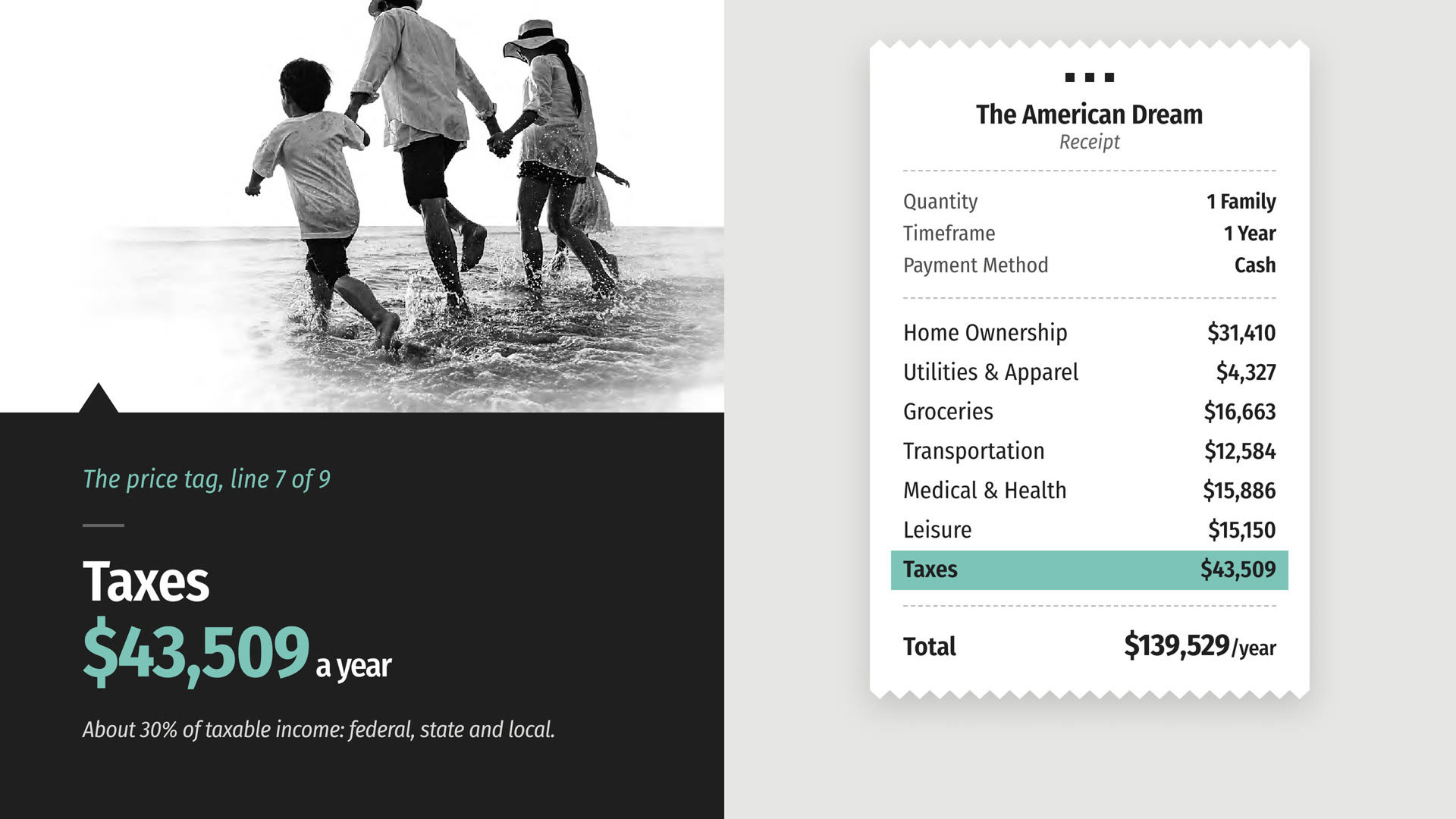
Every dollar above is spent after the government takes its share. A household at this earning level can expect to pay about 30% of its taxable income in federal, state and local taxes. Income, property, sales and payroll taxes are all in that number. The biggest single line on the receipt.
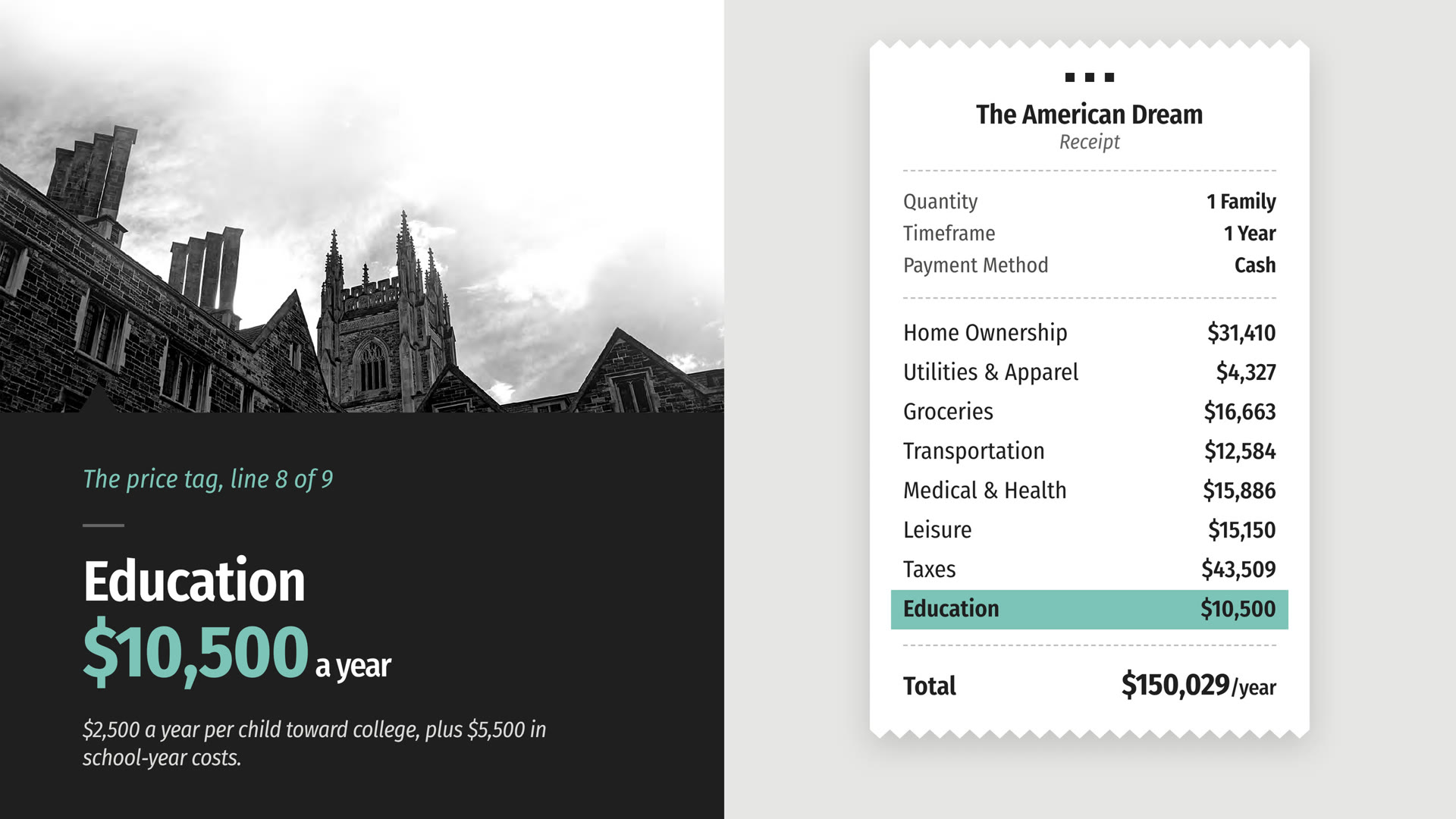
Four years of tuition and fees at a public university now runs about $48,000 per child, before housing and food. Saving toward it takes $2,500 a year per child, set aside before taxes. Add $5,500 a year in school-year expenses for two children.
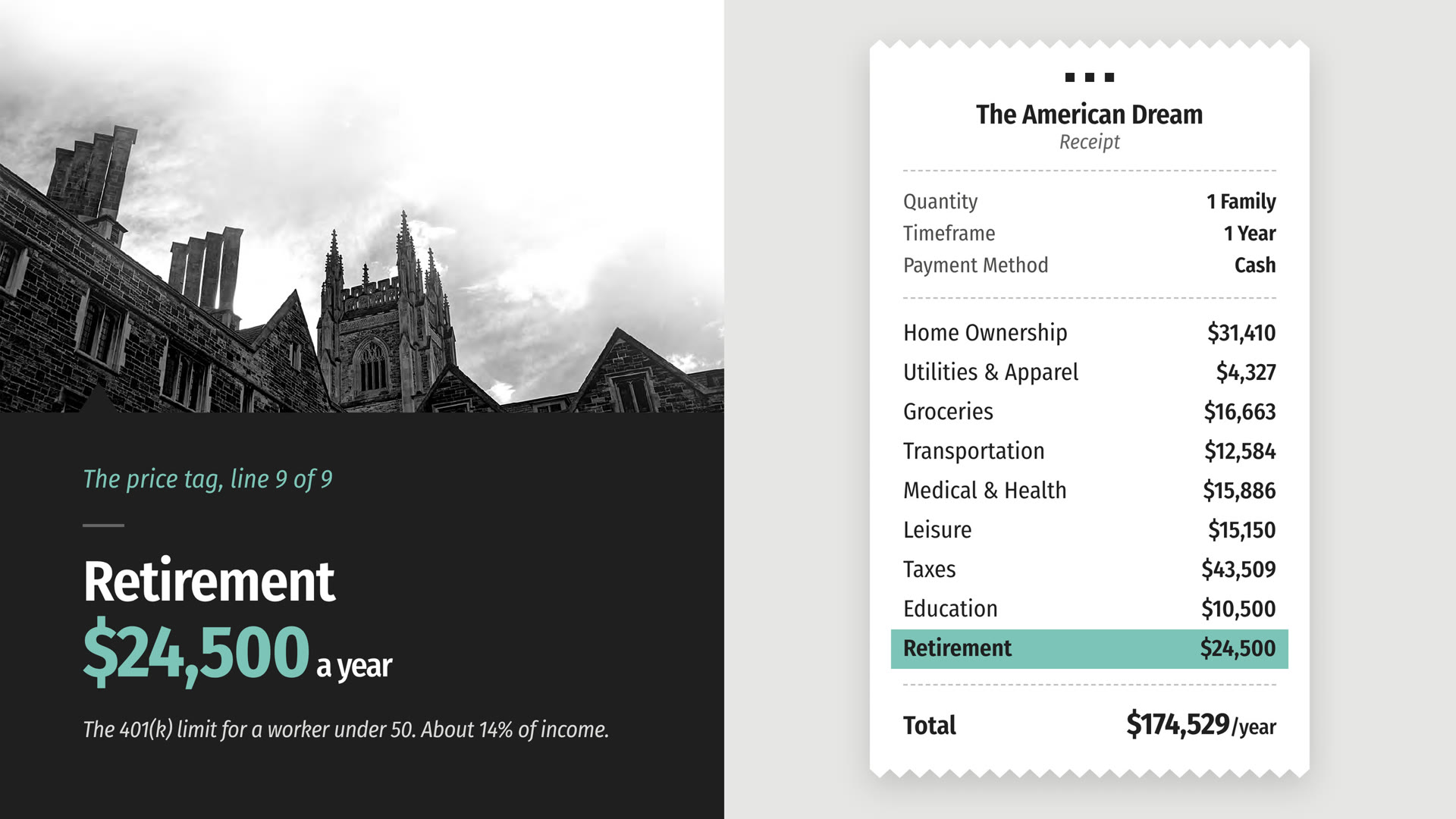
Knowing that one day you may not want to, or be able to, hold a job, it’s critical to save for retirement. A worker under 50 can put up to $24,500 a year into a 401(k) before taxes. That’s about 14% of this family’s income, right at the level many financial professionals recommend.
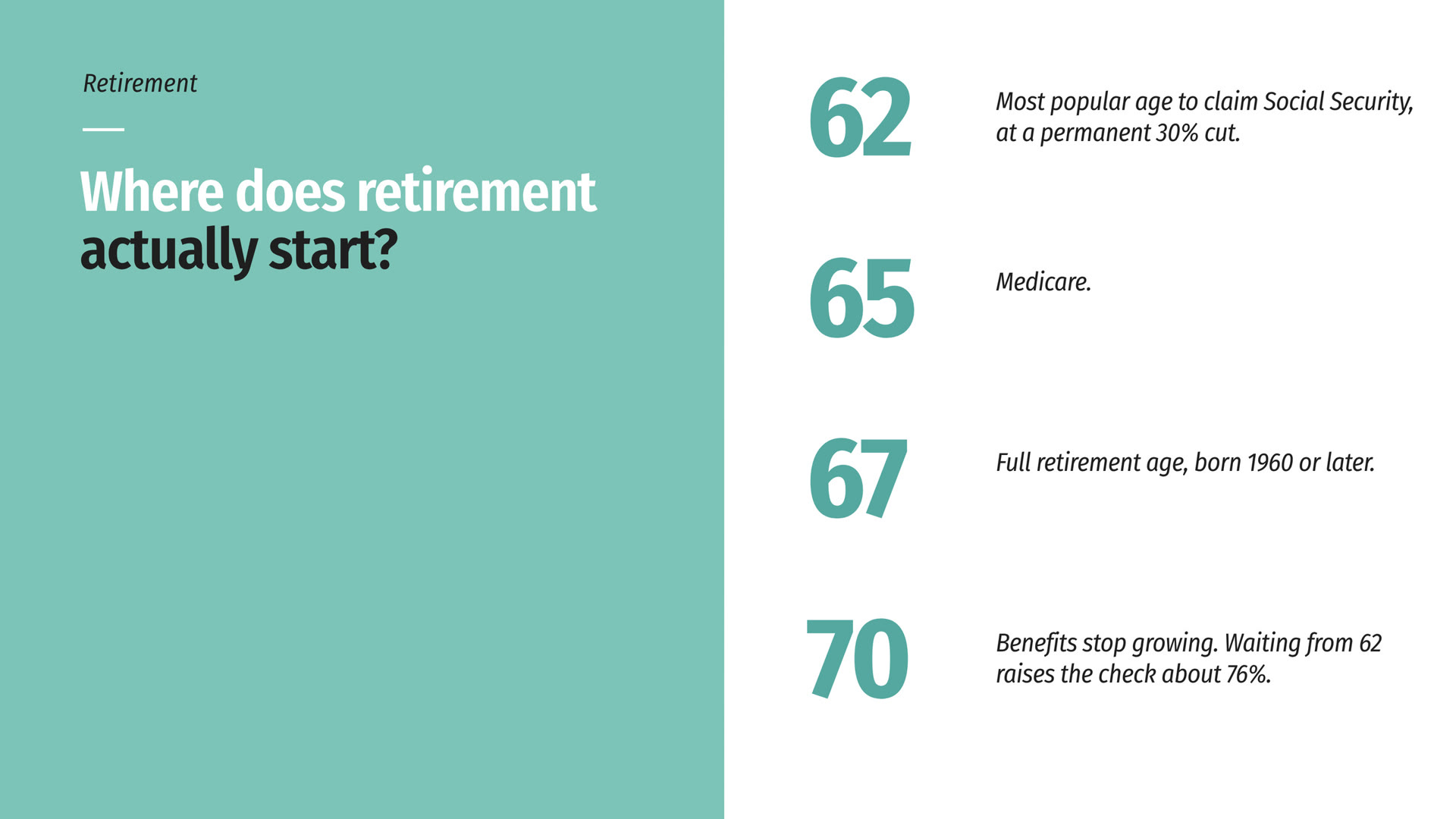
Company pensions are mostly gone. The Social Security retirement trust fund is projected to run short in 2032, after which incoming taxes cover about 78% of scheduled benefits. Of the three legs of the old retirement stool, the one you build yourself is the one still standing.
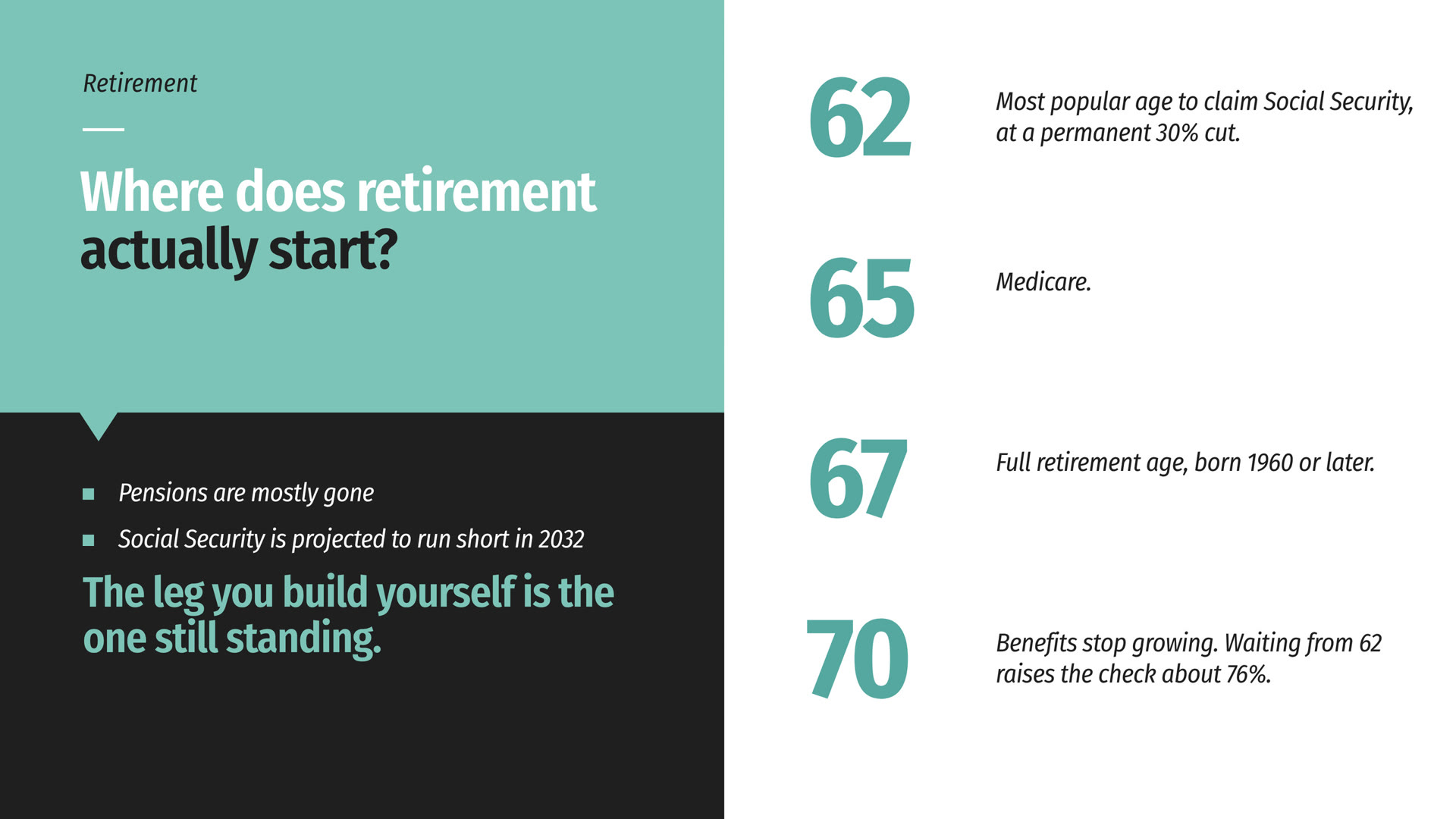
Company pensions are mostly gone. The Social Security retirement trust fund is projected to run short in 2032, after which incoming taxes cover about 78% of scheduled benefits. Of the three legs of the old retirement stool, the one you build yourself is the one still standing.
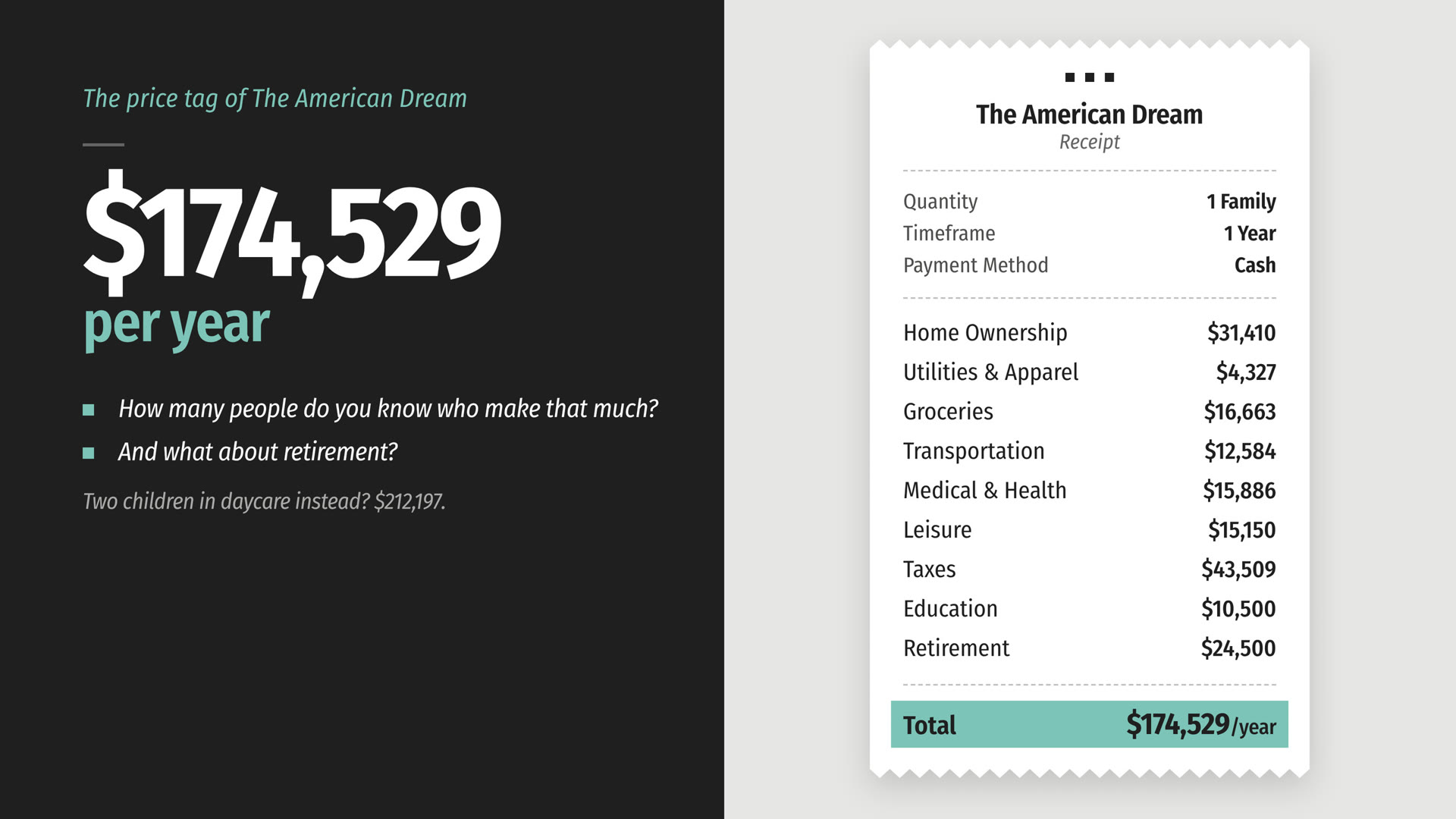
That’s the cost to live the American Dream as defined by Americans themselves, added up line by line from public data. How many people do you know who make that much in a year?
Of course, the American Dream is subjective. Some might be content with far less. Others may need far more. But to offer a good life and financial security to your family, and to have the freedom to pursue the opportunities that matter to you, you must come up with enough money to fund your dreams.
Two children in daycare instead of grade school? Add $26,368 a year for child care, and the price tag passes $212,197.
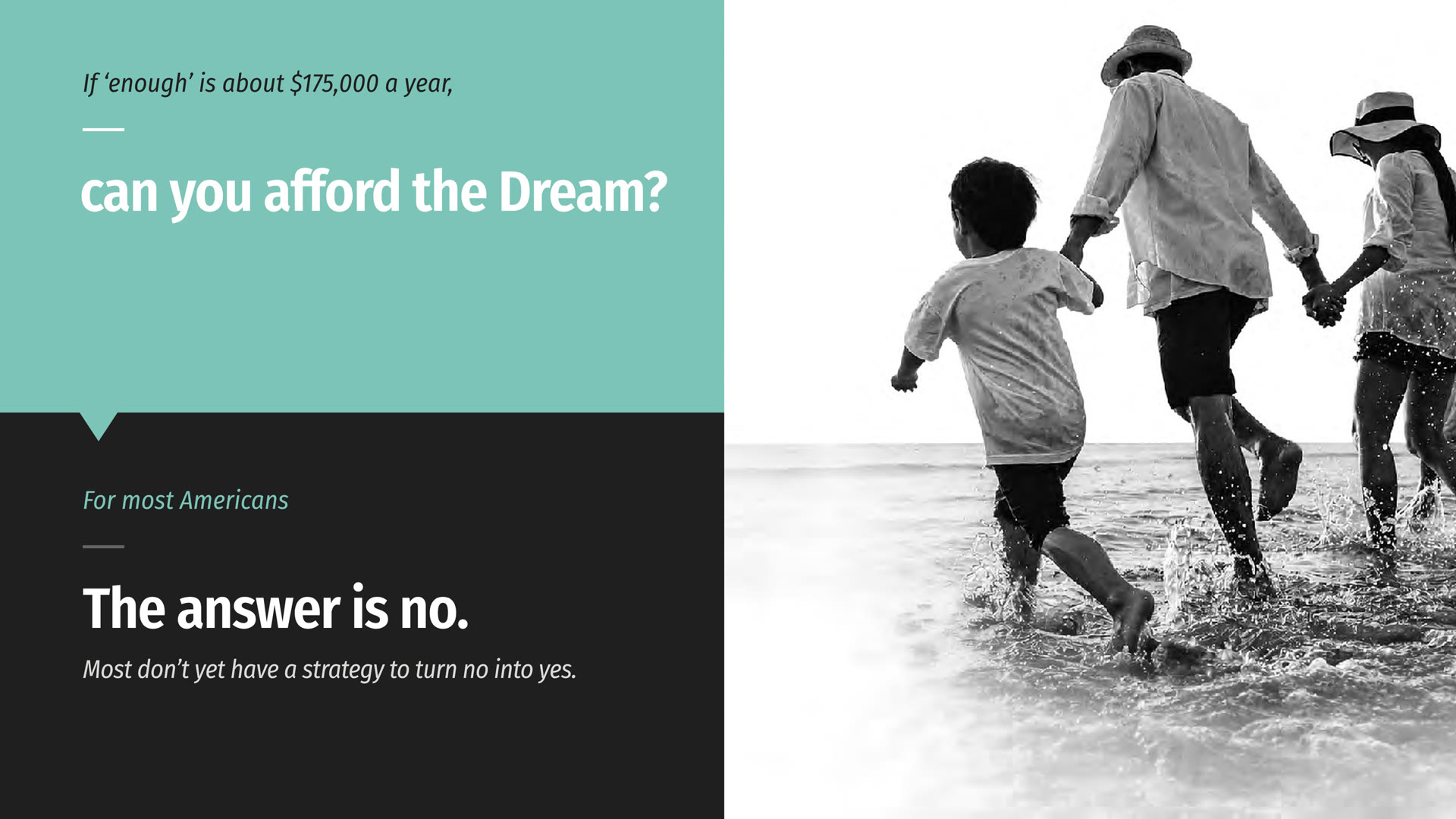
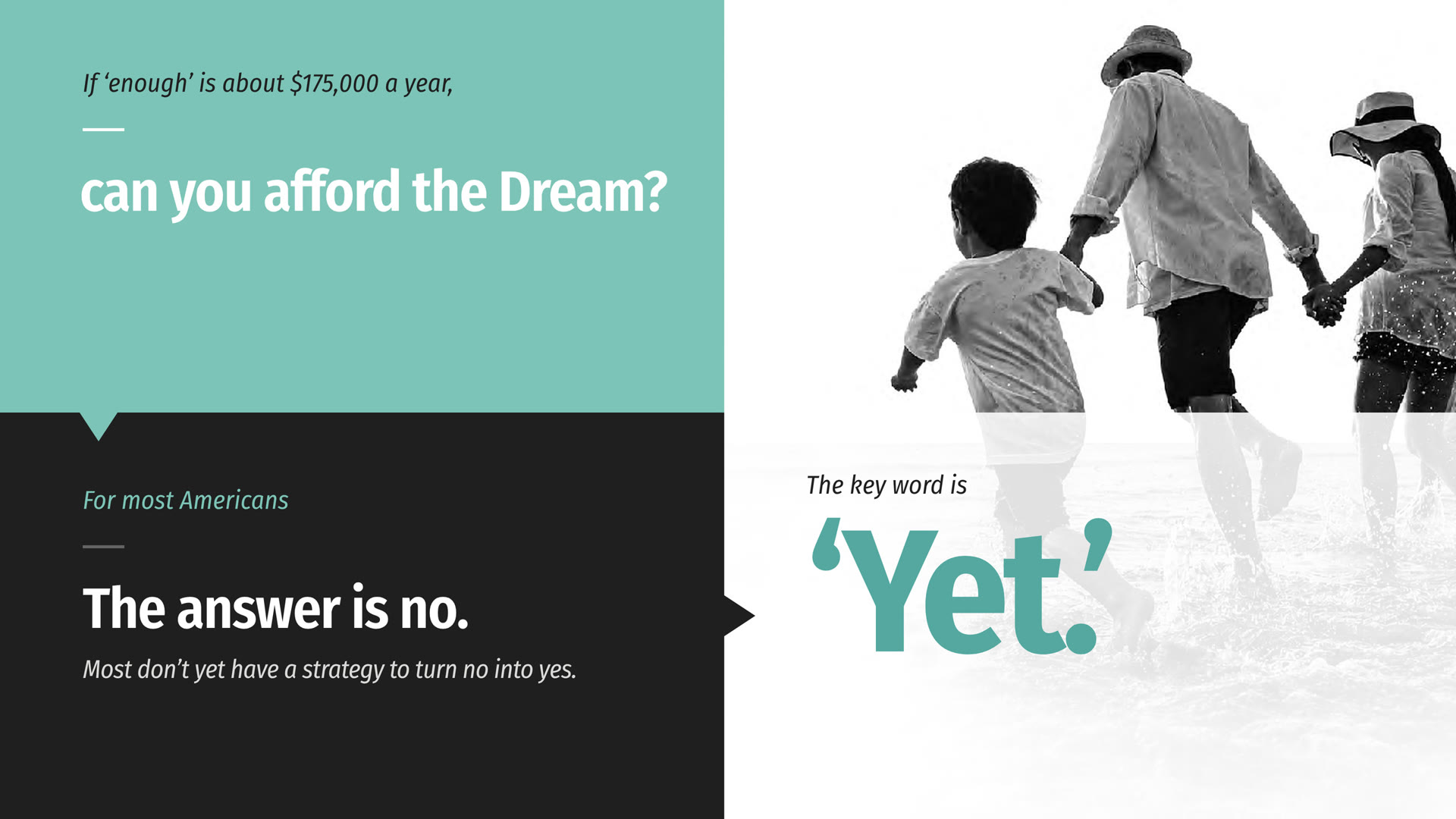
Even if you can now, what about in retirement? Are you on track with your savings so that if you quit working at 65 you’ll have $175,000 to live on every year for 20 or 30 more years?
If you’re like most Americans, your answer to these challenging questions would be ‘no.’ You don’t make enough. You aren’t saving enough. And the fact is, if you’re like most Americans, you don’t yet have a strategy to turn your ‘no’ into a ‘yes.’
Even if you can now, what about in retirement? Are you on track with your savings so that if you quit working at 65 you’ll have $175,000 to live on every year for 20 or 30 more years?
If you’re like most Americans, your answer to these challenging questions would be ‘no.’ You don’t make enough. You aren’t saving enough. And the fact is, if you’re like most Americans, you don’t yet have a strategy to turn your ‘no’ into a ‘yes.’
Even if you can now, what about in retirement? Are you on track with your savings so that if you quit working at 65 you’ll have $175,000 to live on every year for 20 or 30 more years?
If you’re like most Americans, your answer to these challenging questions would be ‘no.’ You don’t make enough. You aren’t saving enough. And the fact is, if you’re like most Americans, you don’t yet have a strategy to turn your ‘no’ into a ‘yes.’
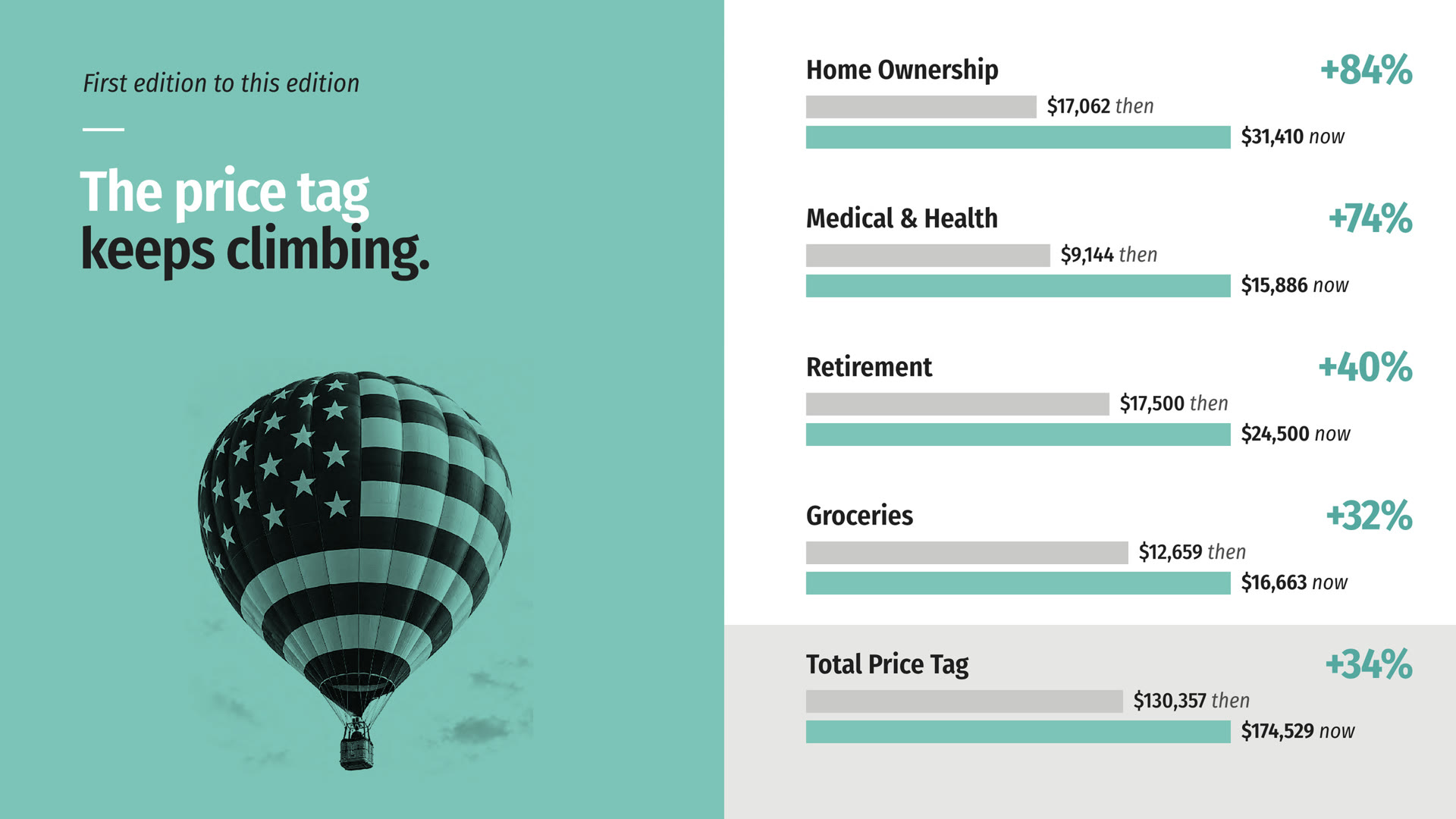
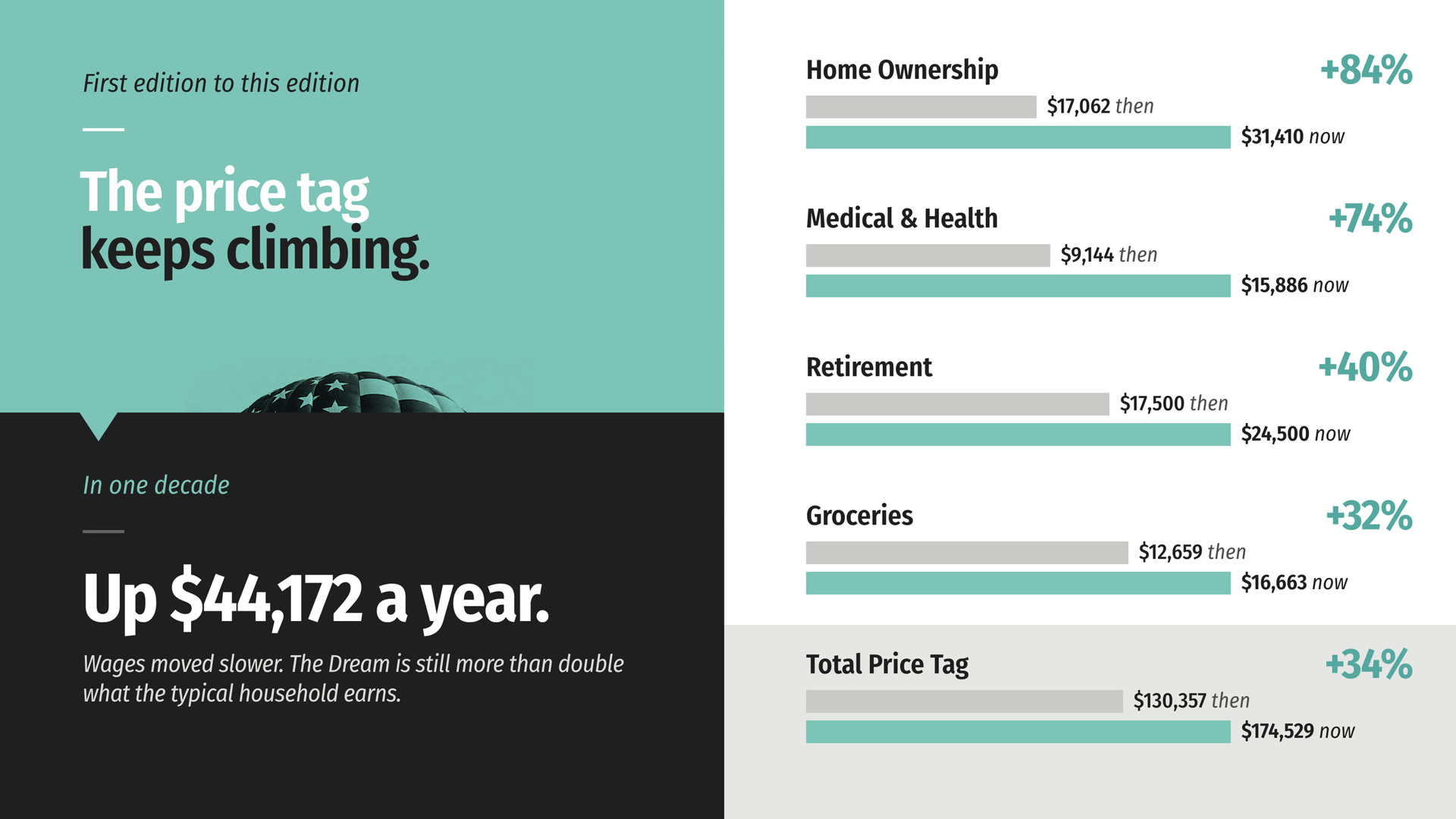
When the first edition of this book added up the Dream, the receipt came to $130,357 a year. This edition: $174,529. Four lines did most of the climbing, and two of them, a home and health care, did almost all of it.
Every line on this receipt is a public number that moves: the price of a house, the interest rate on the mortgage, the cost of a doctor’s visit, the limit on a 401(k). The receipt carries a date because prices move. Everything else stays true.
One more thing the numbers say. Wages moved too, and they moved slower than the two lines that matter most. When the first edition was published, the price tag was about two and a half times what the typical household earned. It is still more than double. The Dream stayed roughly as far away as it was, and the families chasing it have been running the whole time.
When the first edition of this book added up the Dream, the receipt came to $130,357 a year. This edition: $174,529. Four lines did most of the climbing, and two of them, a home and health care, did almost all of it.
Every line on this receipt is a public number that moves: the price of a house, the interest rate on the mortgage, the cost of a doctor’s visit, the limit on a 401(k). The receipt carries a date because prices move. Everything else stays true.
One more thing the numbers say. Wages moved too, and they moved slower than the two lines that matter most. When the first edition was published, the price tag was about two and a half times what the typical household earned. It is still more than double. The Dream stayed roughly as far away as it was, and the families chasing it have been running the whole time.
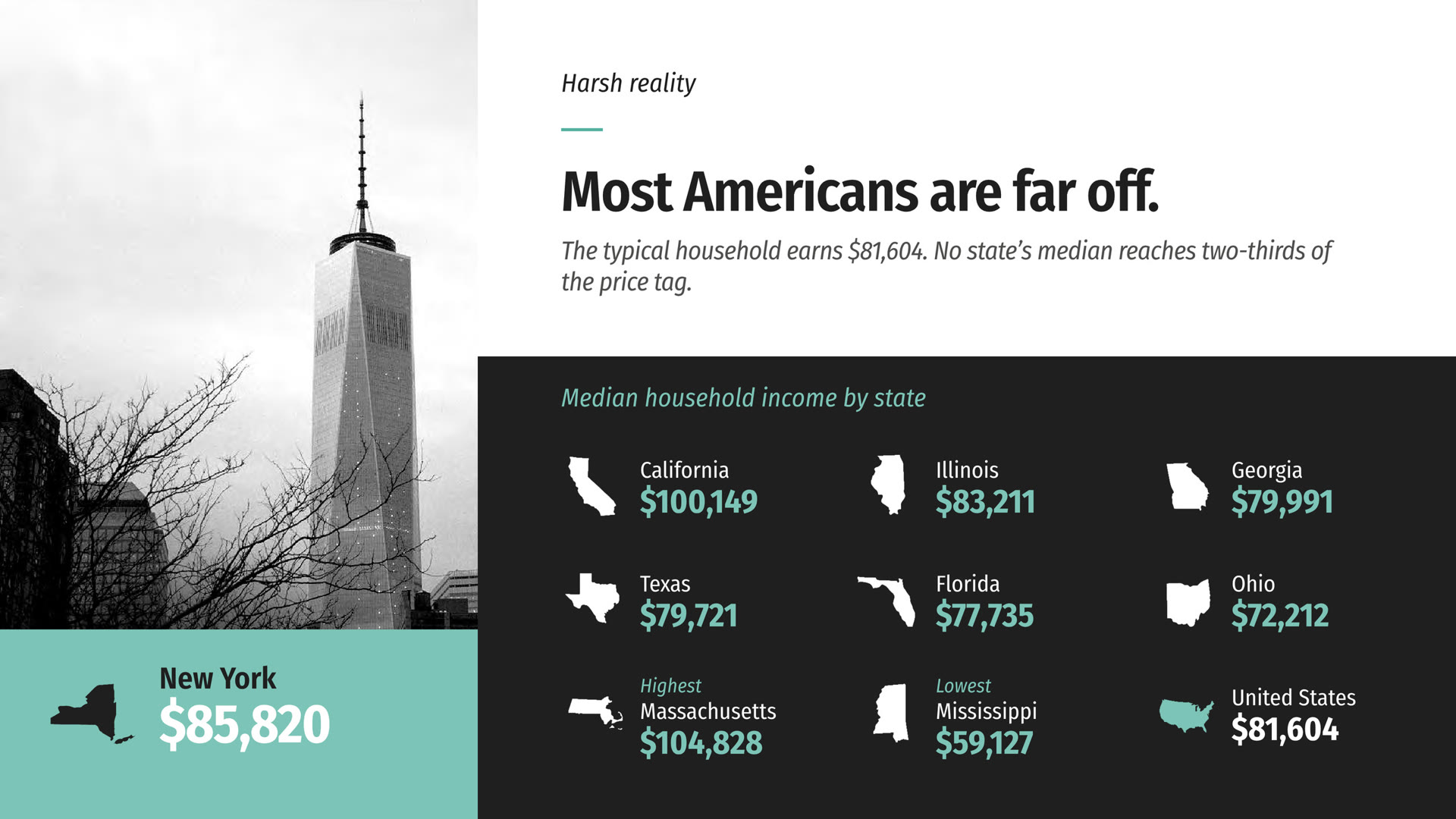
Regardless of how big and beautiful their dreams may be, most U.S. families fall painfully shy of $175,000 in annual income. The typical American household earns $81,604 a year.
There’s not a single state in the country where the median household earns even two-thirds of the price tag.
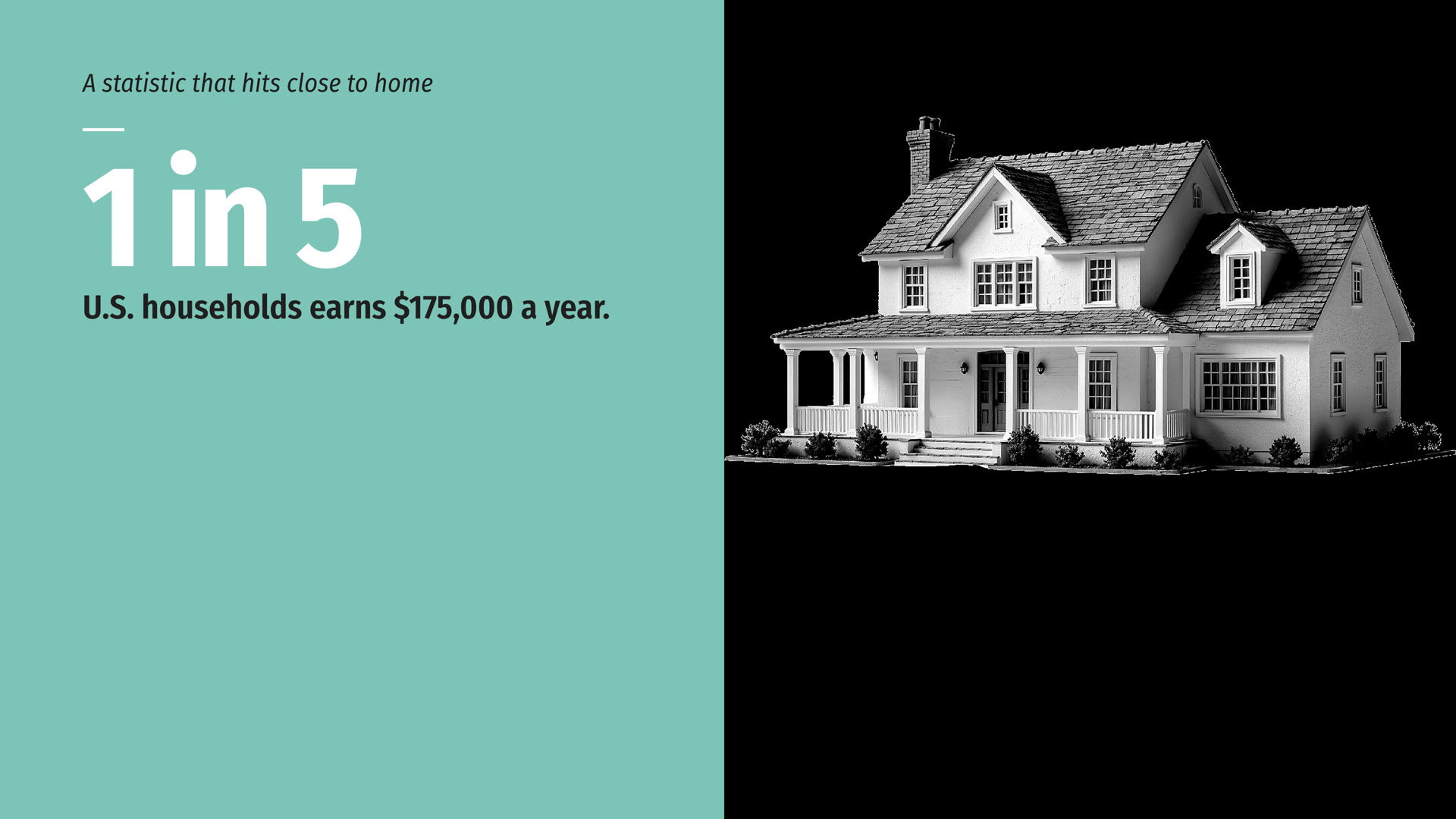
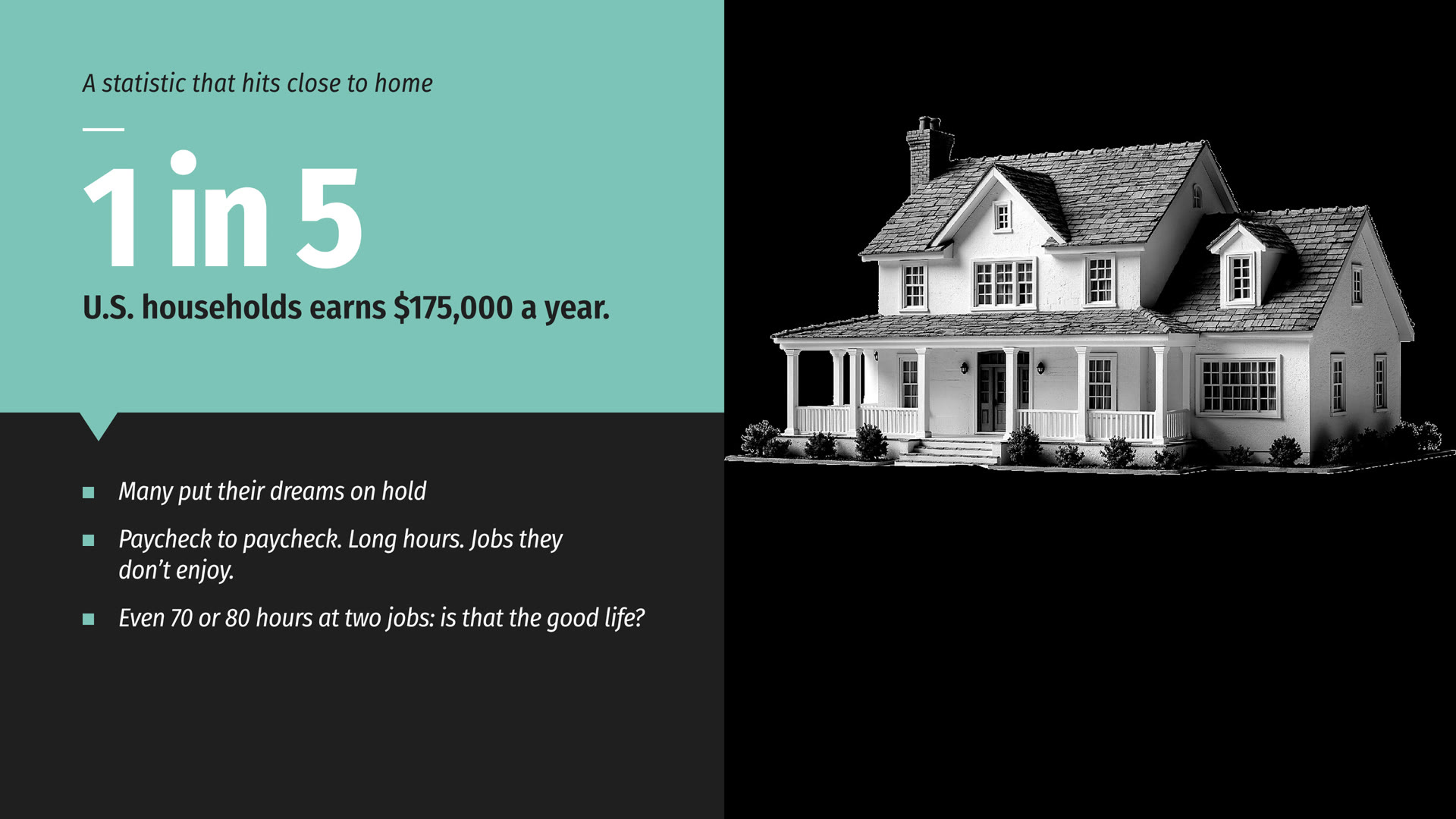
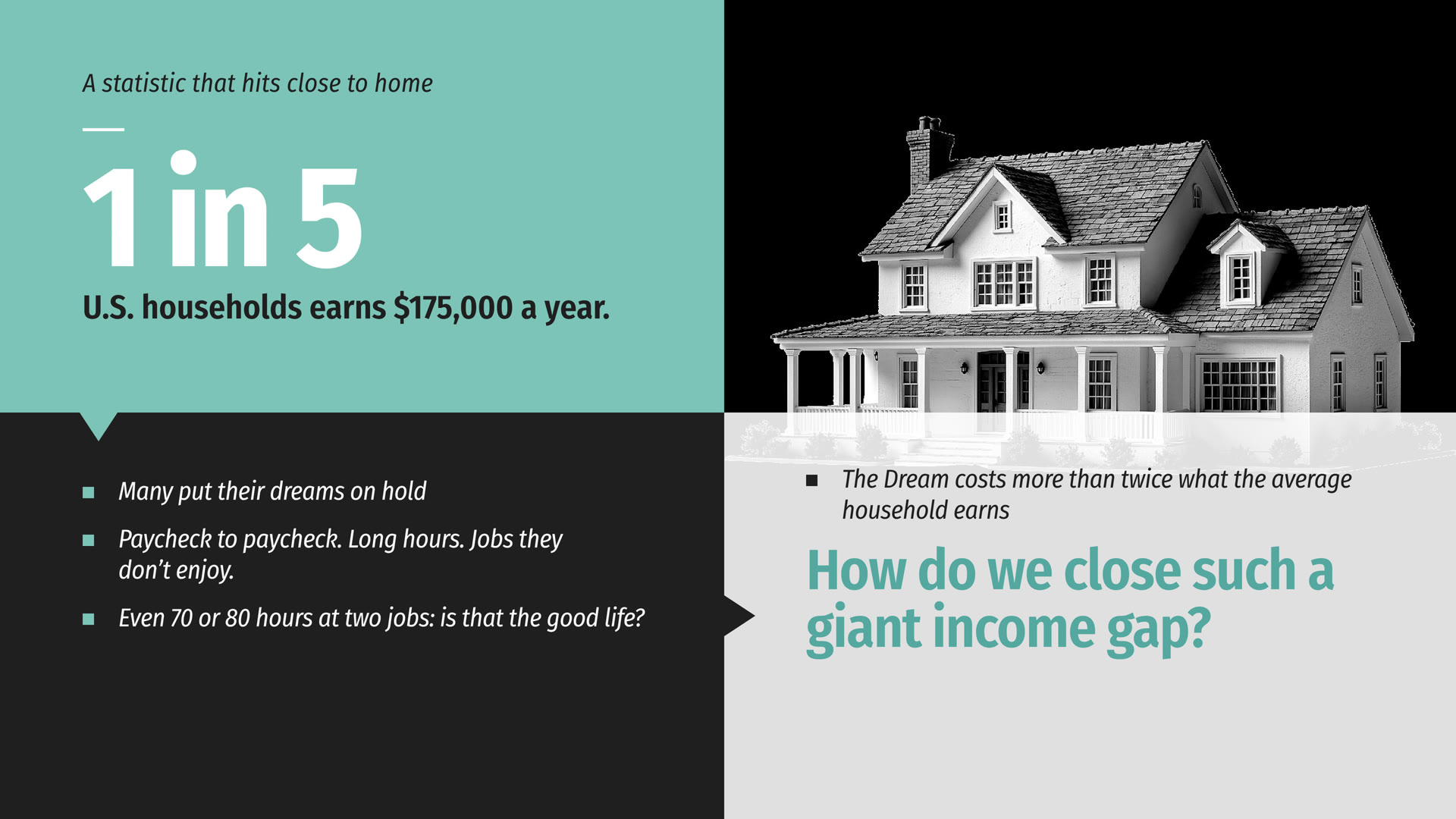
If $175,000 a year is required to live the American Dream, but the typical American household earns $81,604, what’s the real-world outcome?
A lot of people have had to put their dreams on hold or forget them altogether. We now have an explanation for why so many families are struggling financially, surviving paycheck to paycheck, and working long hours at jobs they don’t enjoy. When you’re barely getting by, the American Dream can feel like a big, fat lie.
Aside from hitting the lottery, how will the average American close the gap between the $70,000s or $80,000s and $175,000? And even if they pulled it off by clocking 70 or 80 hours at multiple jobs, is that living the good life?
If $175,000 a year is required to live the American Dream, but the typical American household earns $81,604, what’s the real-world outcome?
A lot of people have had to put their dreams on hold or forget them altogether. We now have an explanation for why so many families are struggling financially, surviving paycheck to paycheck, and working long hours at jobs they don’t enjoy. When you’re barely getting by, the American Dream can feel like a big, fat lie.
Aside from hitting the lottery, how will the average American close the gap between the $70,000s or $80,000s and $175,000? And even if they pulled it off by clocking 70 or 80 hours at multiple jobs, is that living the good life?
If $175,000 a year is required to live the American Dream, but the typical American household earns $81,604, what’s the real-world outcome?
A lot of people have had to put their dreams on hold or forget them altogether. We now have an explanation for why so many families are struggling financially, surviving paycheck to paycheck, and working long hours at jobs they don’t enjoy. When you’re barely getting by, the American Dream can feel like a big, fat lie.
Aside from hitting the lottery, how will the average American close the gap between the $70,000s or $80,000s and $175,000? And even if they pulled it off by clocking 70 or 80 hours at multiple jobs, is that living the good life?
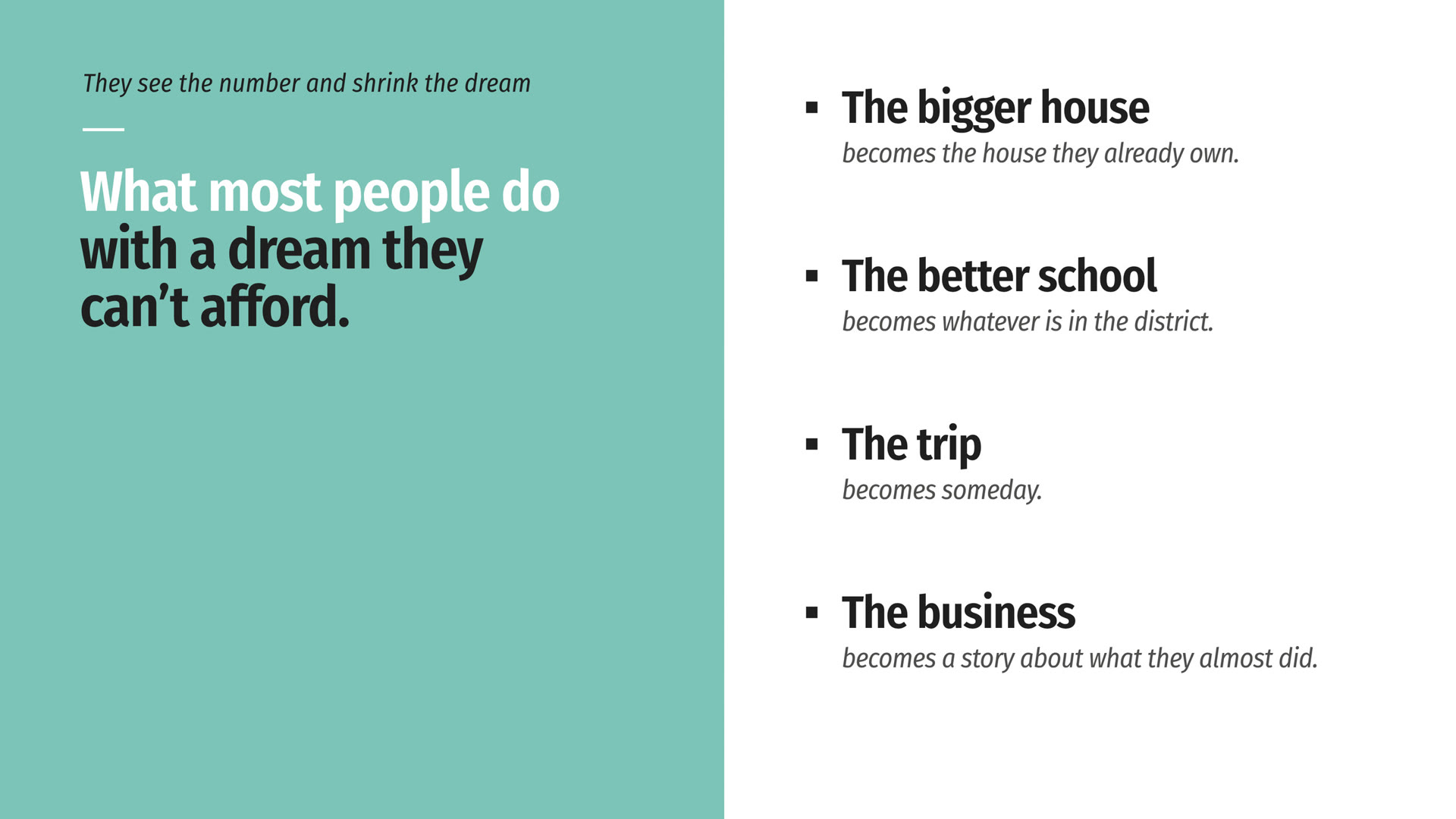
Here’s what happens to most people when they see this number. They shrink the dream. Quietly, over the years, they trim it until it fits the size of their paycheck, or the size of the opportunity they believe they have.
No one admits or announces it. The dream is shrunk to fit.
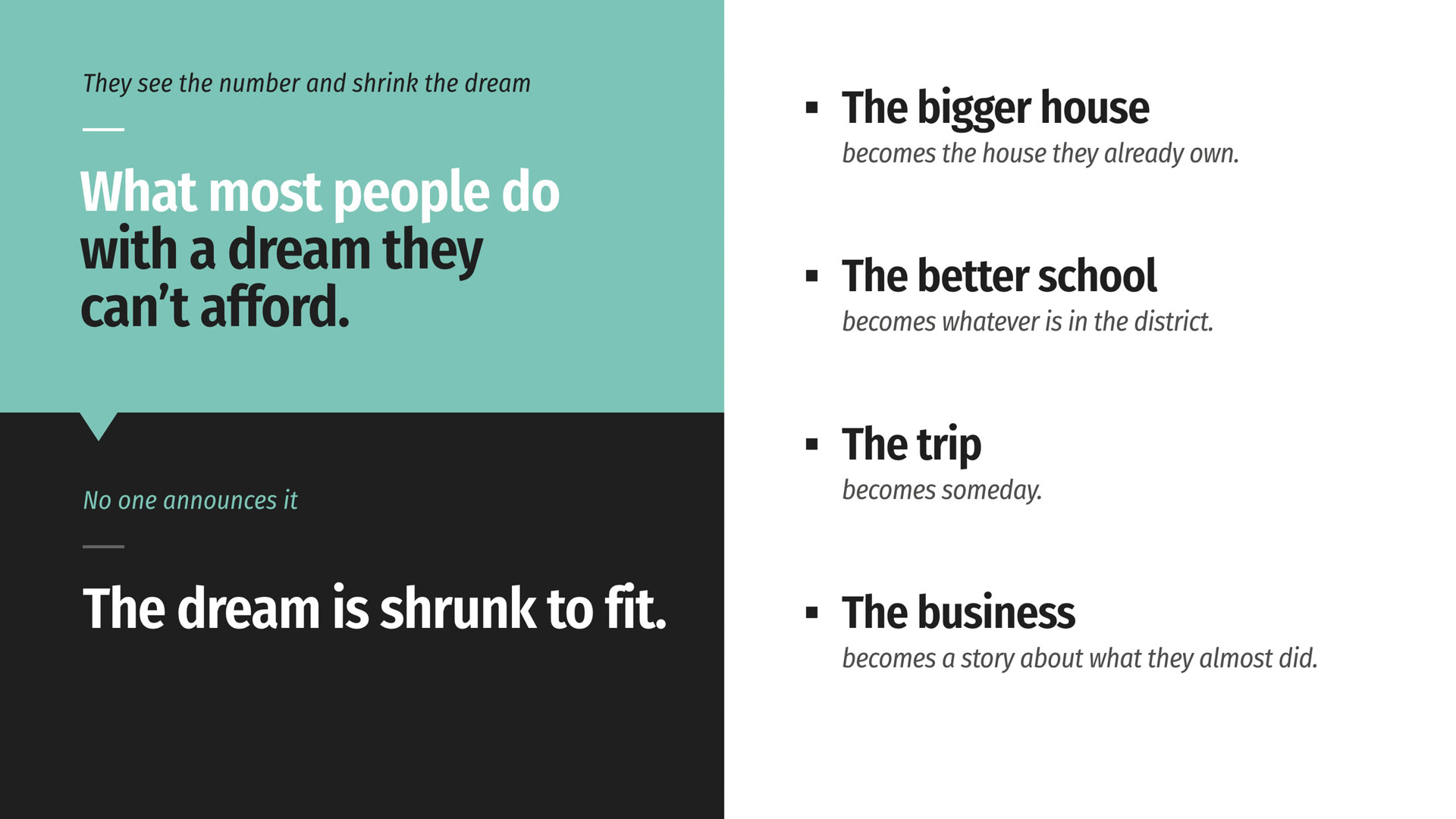
Here’s what happens to most people when they see this number. They shrink the dream. Quietly, over the years, they trim it until it fits the size of their paycheck, or the size of the opportunity they believe they have.
No one admits or announces it. The dream is shrunk to fit.
There’s another response, and it’s the way this country was built. Think about how your family pays for almost every big thing it will ever own. Nobody writes one check for the entire house. Few people pay cash for four years of college or a new car. Big goals require a plan, a vehicle, and money committed over time.
Now look back at the receipt. The payment method says CASH. That’s why the Dream looks impossible. Nobody pays cash for the American Dream. You build a plan to afford it. Your dreams can stay their full size. They need a way to be paid for…
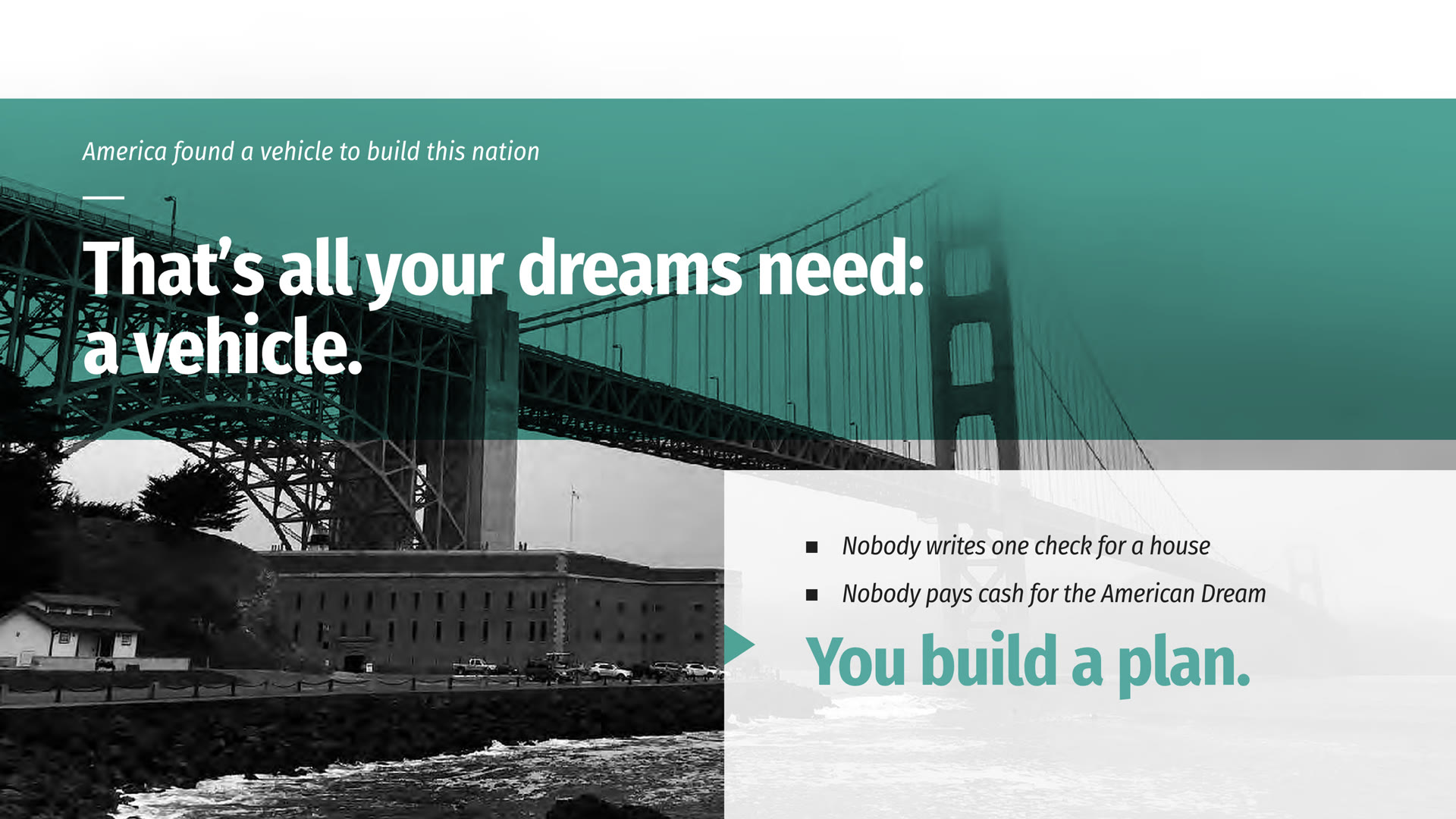
There’s another response, and it’s the way this country was built. Think about how your family pays for almost every big thing it will ever own. Nobody writes one check for the entire house. Few people pay cash for four years of college or a new car. Big goals require a plan, a vehicle, and money committed over time.
Now look back at the receipt. The payment method says CASH. That’s why the Dream looks impossible. Nobody pays cash for the American Dream. You build a plan to afford it. Your dreams can stay their full size. They need a way to be paid for…
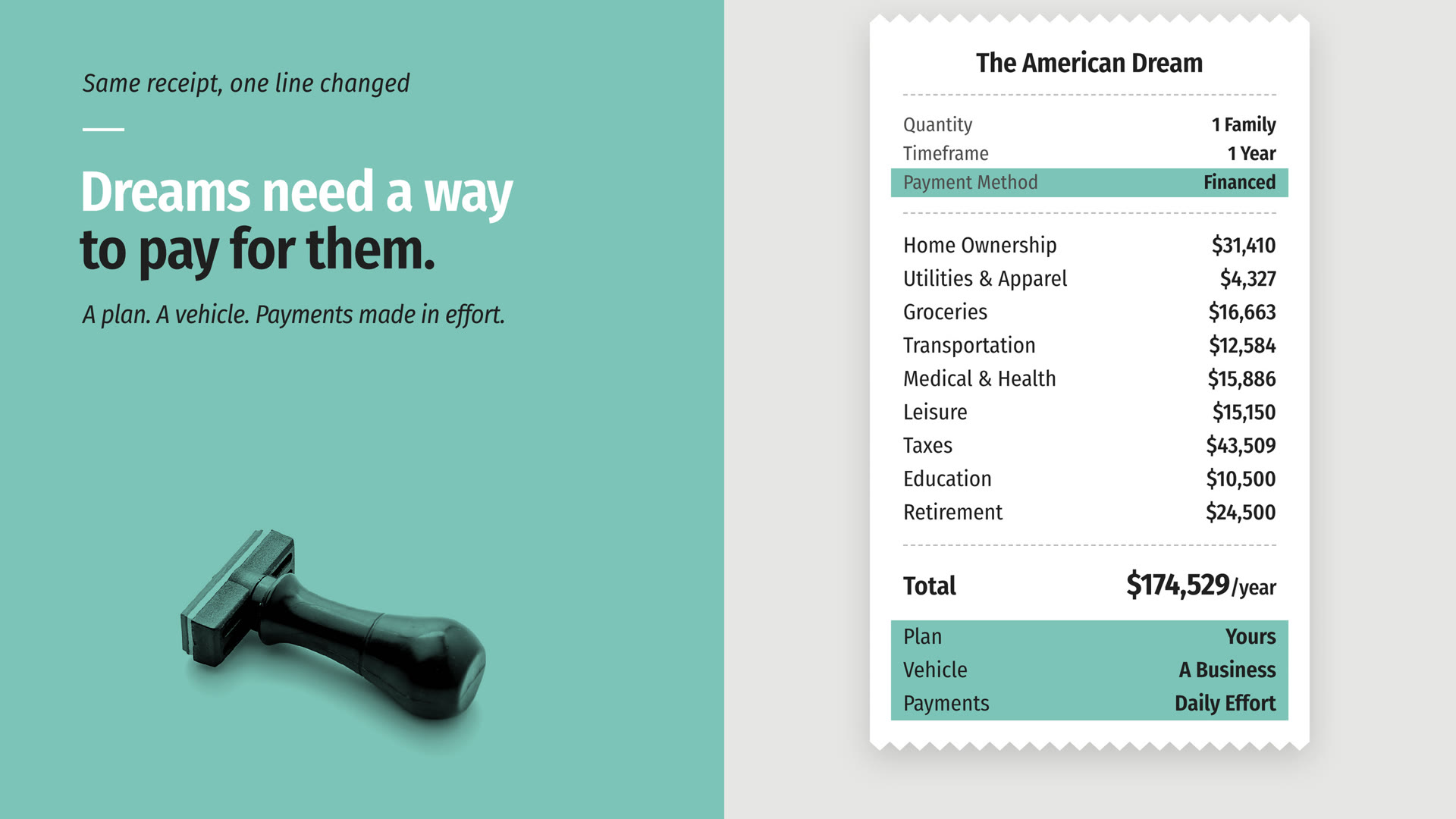
Here is the same receipt, reprinted with one line changed.
Financing a dream means a plan, a vehicle, and payments made in effort, with no loan anywhere in the picture. The plan is the decision to go after the number. The vehicle is a business that can grow past a salary. The payments are the daily work of building it.
The rest of this presentation is about the vehicle.
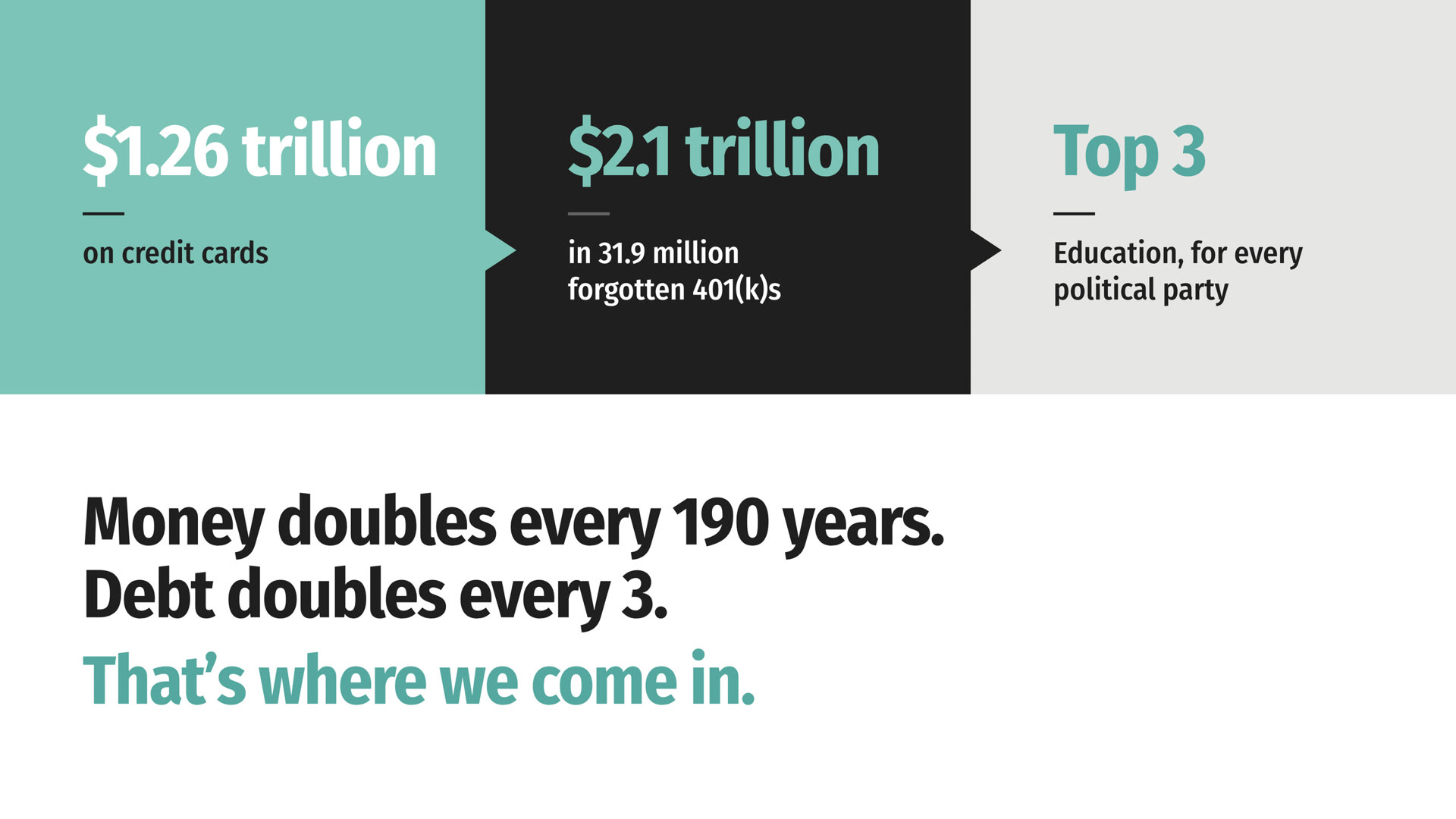
One thing to know about it first. The problem this country has with money is bigger than most people realize, it is still taught in almost no school, and it grows every year.
Solving problems is what entrepreneurs do. The families in every neighborhood in America who are losing to their own bank accounts and credit cards are the opportunity.
Before we get to the vehicle, though, any good coach would tell you to start with the fundamentals.
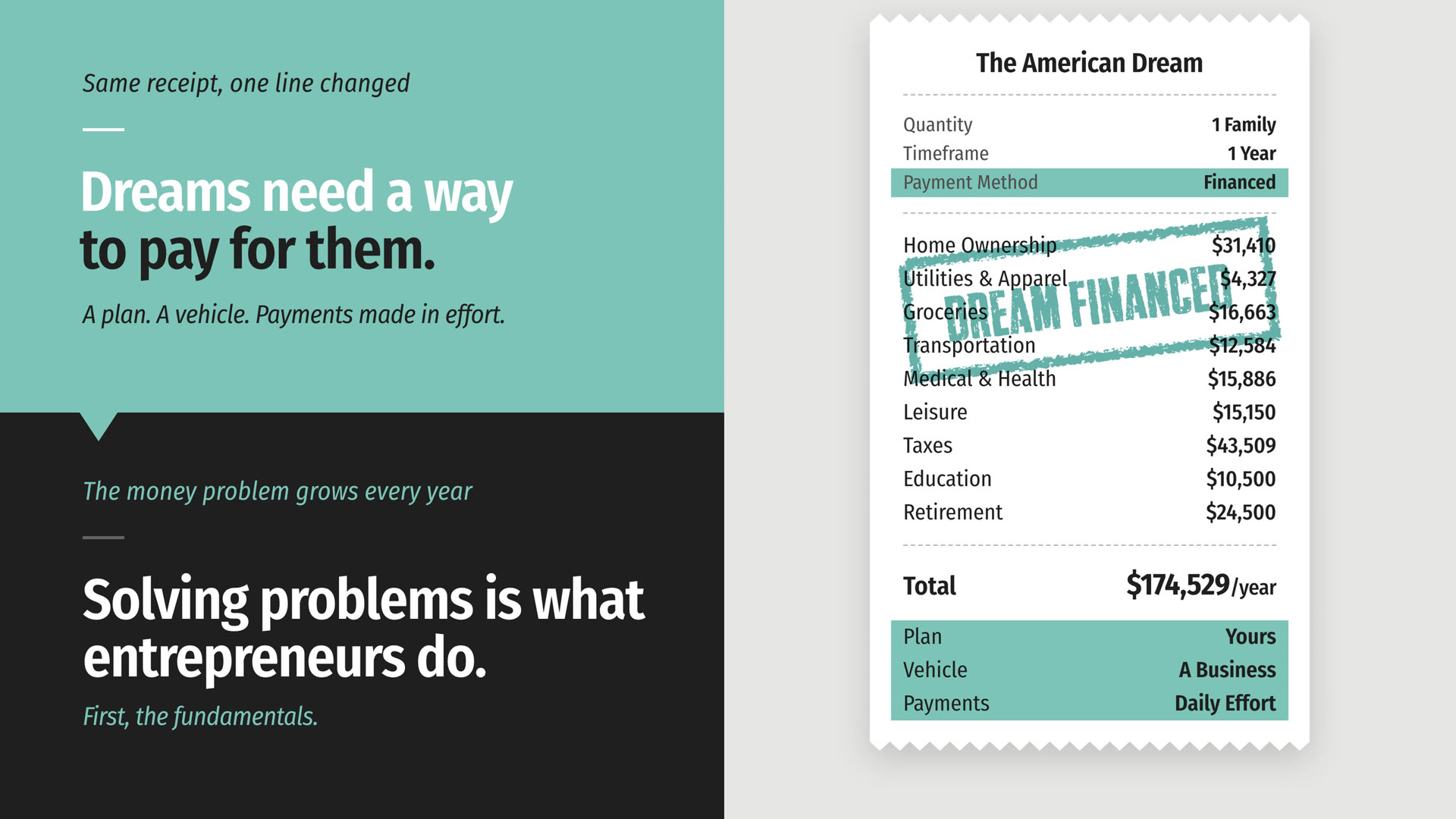
Here is the same receipt, reprinted with one line changed.
Financing a dream means a plan, a vehicle, and payments made in effort, with no loan anywhere in the picture. The plan is the decision to go after the number. The vehicle is a business that can grow past a salary. The payments are the daily work of building it.
The rest of this presentation is about the vehicle.
One thing to know about it first. The problem this country has with money is bigger than most people realize, it is still taught in almost no school, and it grows every year.
Solving problems is what entrepreneurs do. The families in every neighborhood in America who are losing to their own bank accounts and credit cards are the opportunity.
Before we get to the vehicle, though, any good coach would tell you to start with the fundamentals.
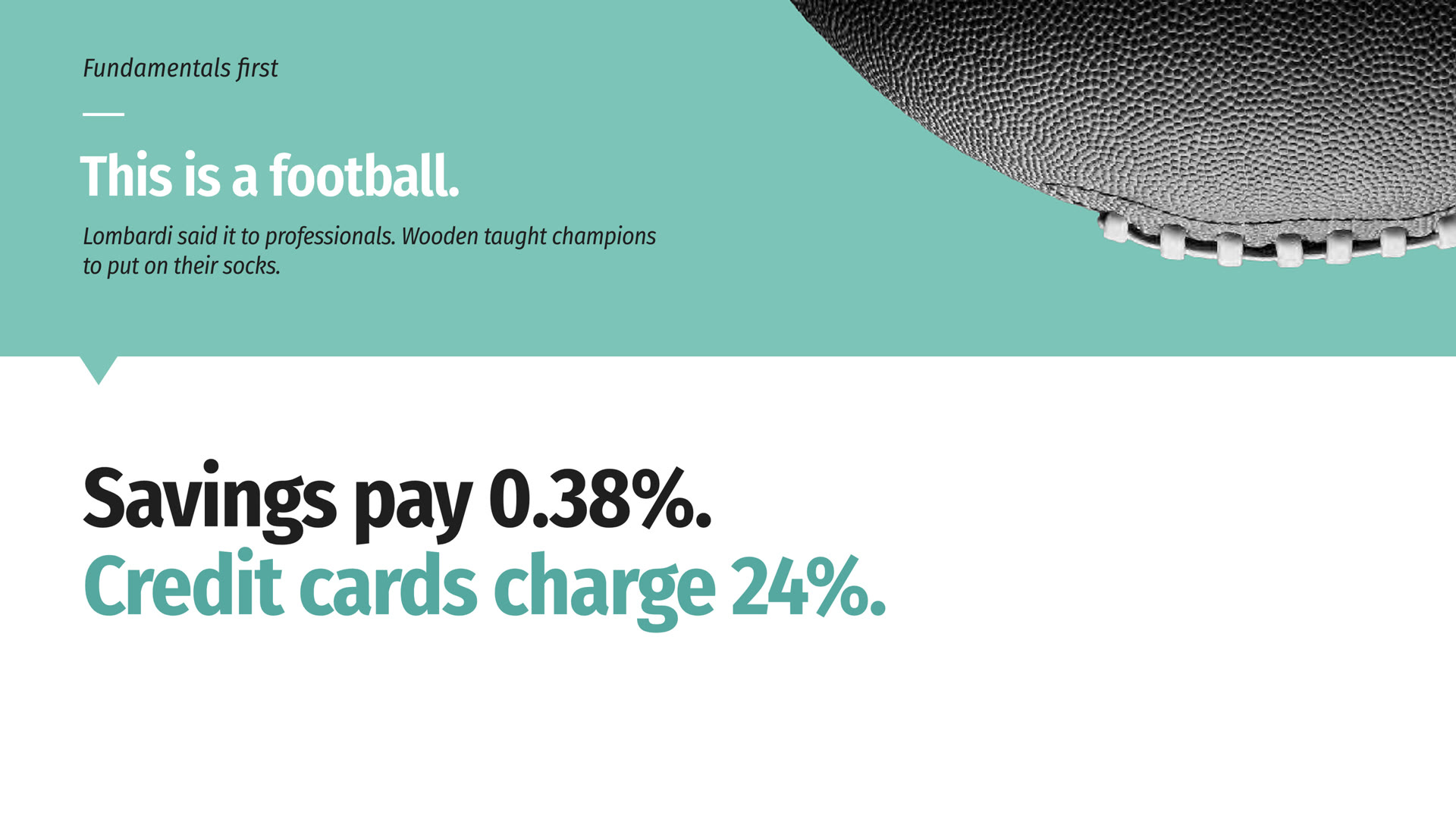
Vince Lombardi opened training camp every year by holding up a ball in front of professional players and saying, “Gentlemen, this is a football.” John Wooden began every season at UCLA, national champions included, by teaching his players how to put on their socks. Fundamentals first.
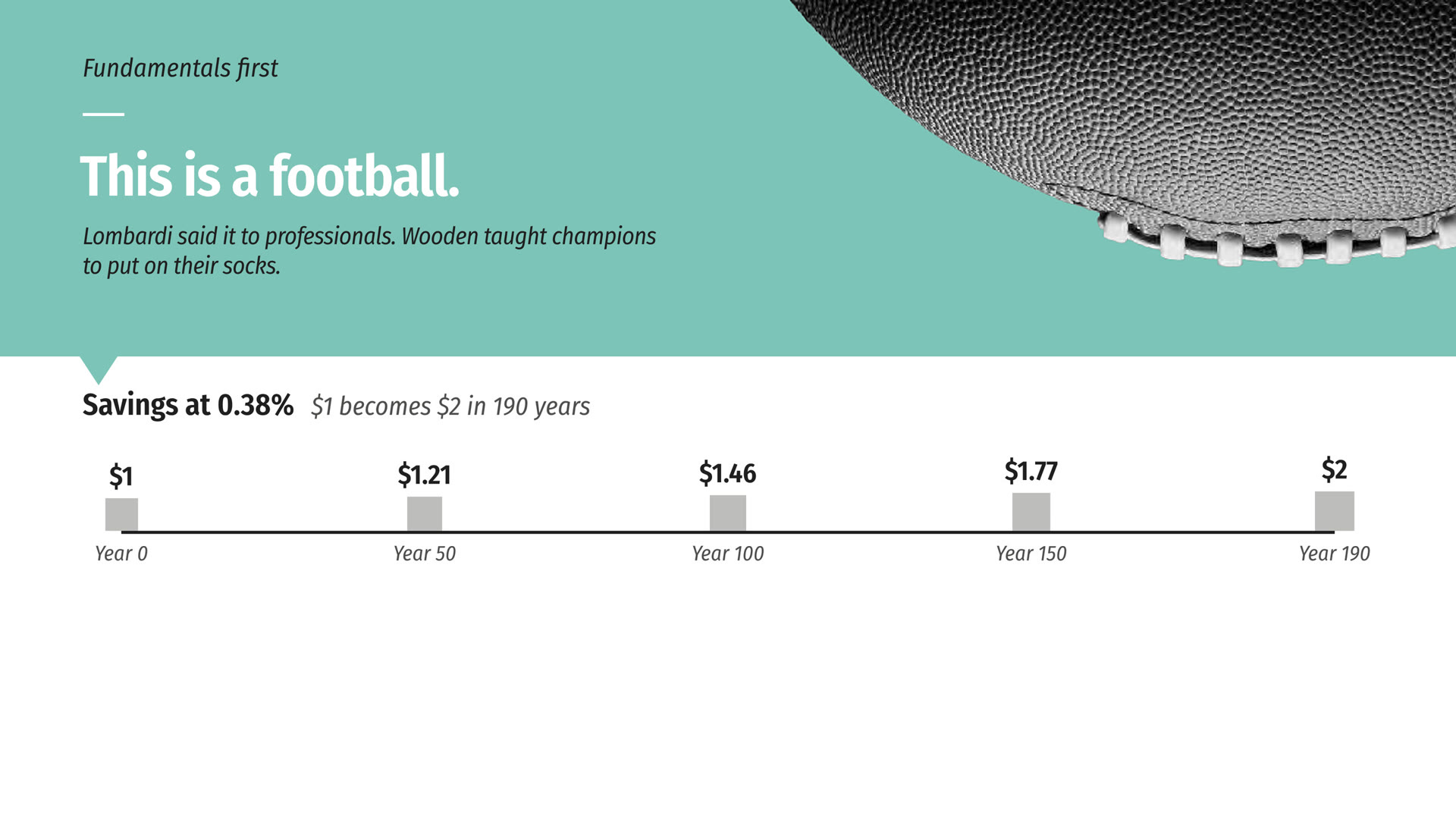
Vince Lombardi opened training camp every year by holding up a ball in front of professional players and saying, “Gentlemen, this is a football.” John Wooden began every season at UCLA, national champions included, by teaching his players how to put on their socks. Fundamentals first.
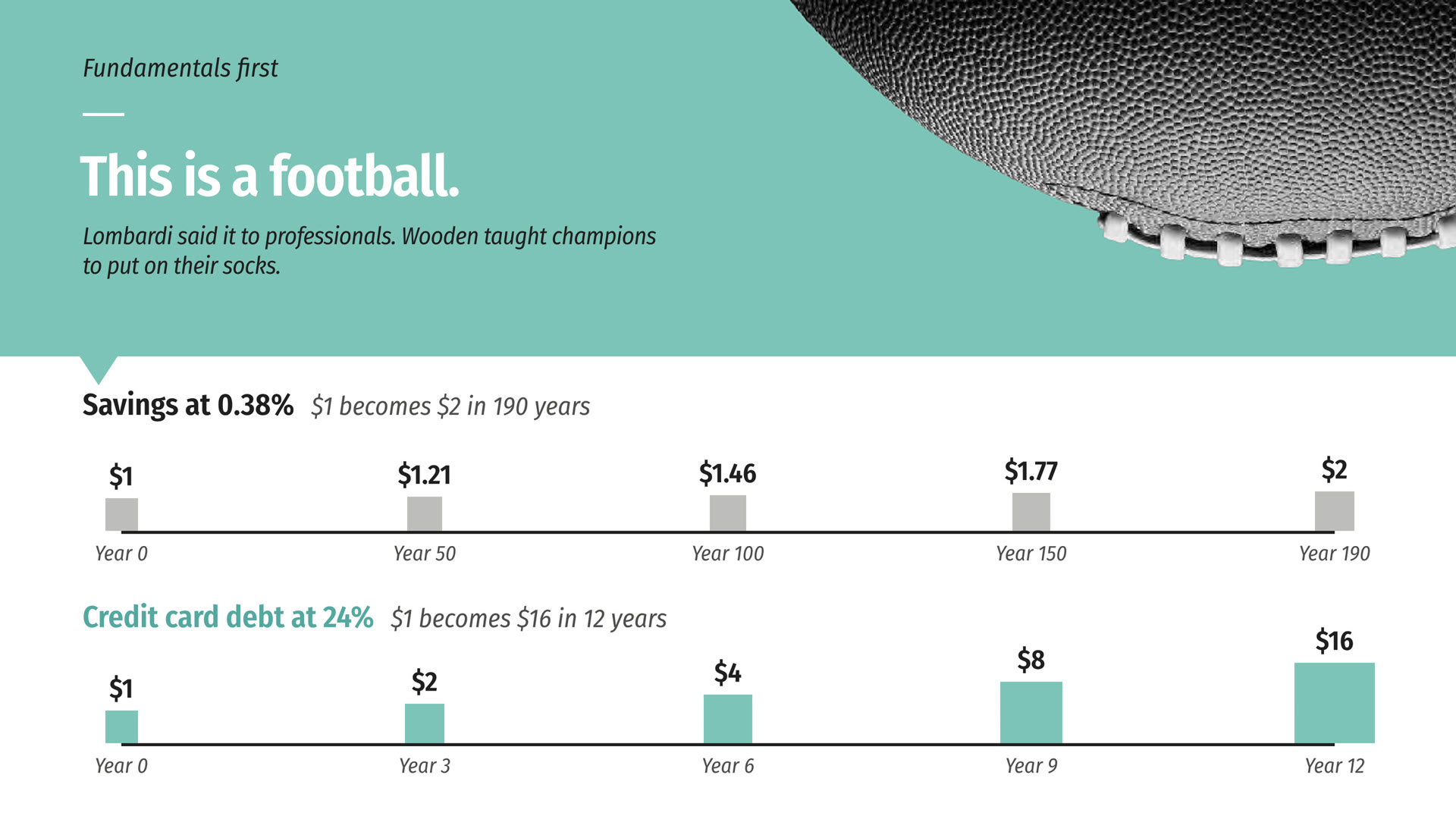
Vince Lombardi opened training camp every year by holding up a ball in front of professional players and saying, “Gentlemen, this is a football.” John Wooden began every season at UCLA, national champions included, by teaching his players how to put on their socks. Fundamentals first.
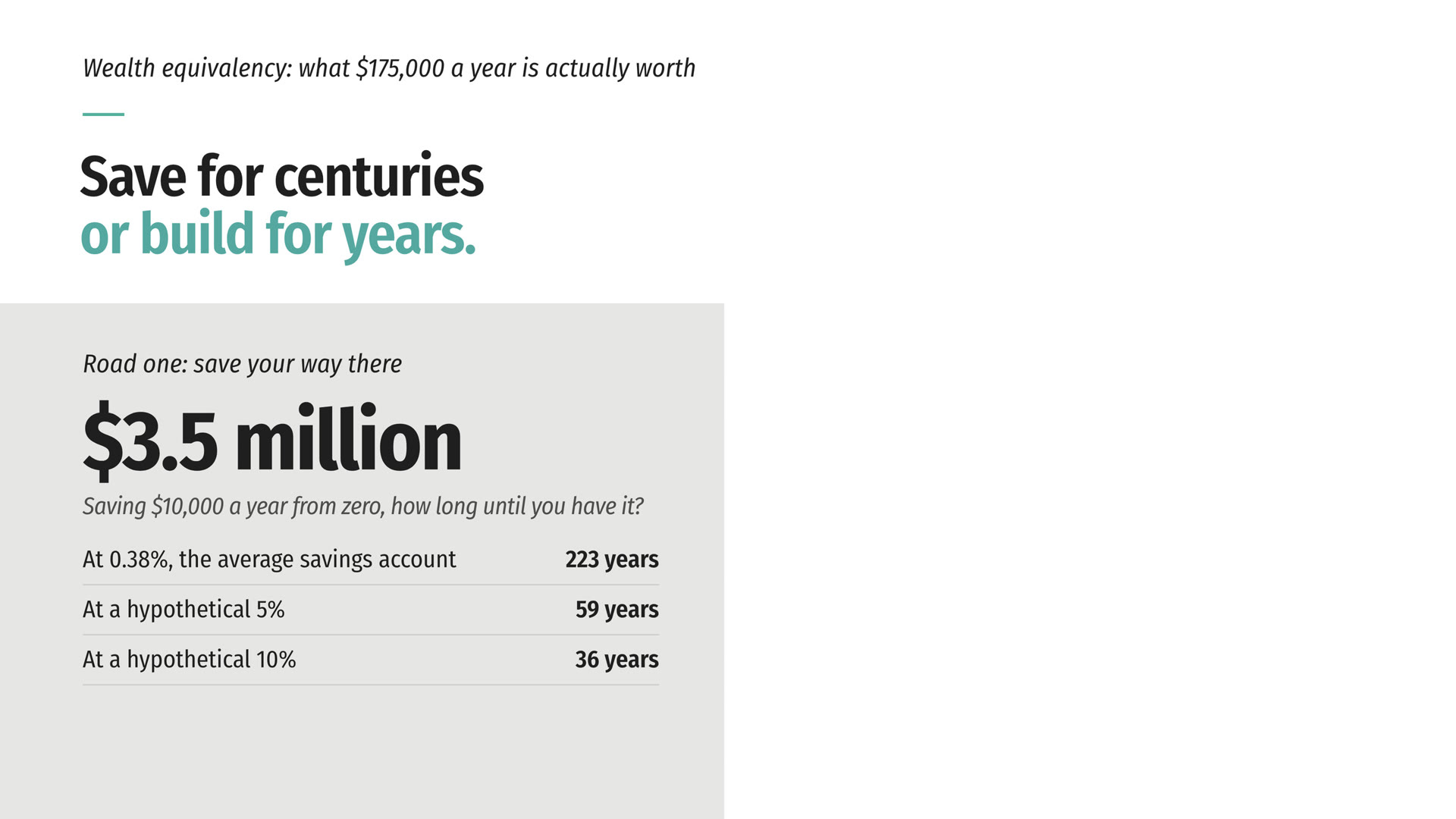
If you read the $175,000/year receipt and realize your paycheck can’t close the gap, you have two options: save your way there or build your way there. The first takes millions in savings. The second takes entrepreneurship: find a problem people need solved and build a profitable business around the solution.
The American Dream income gap is a massive problem. The need is the problem. Teaching people how money works, and showing them how to take action, is the business.
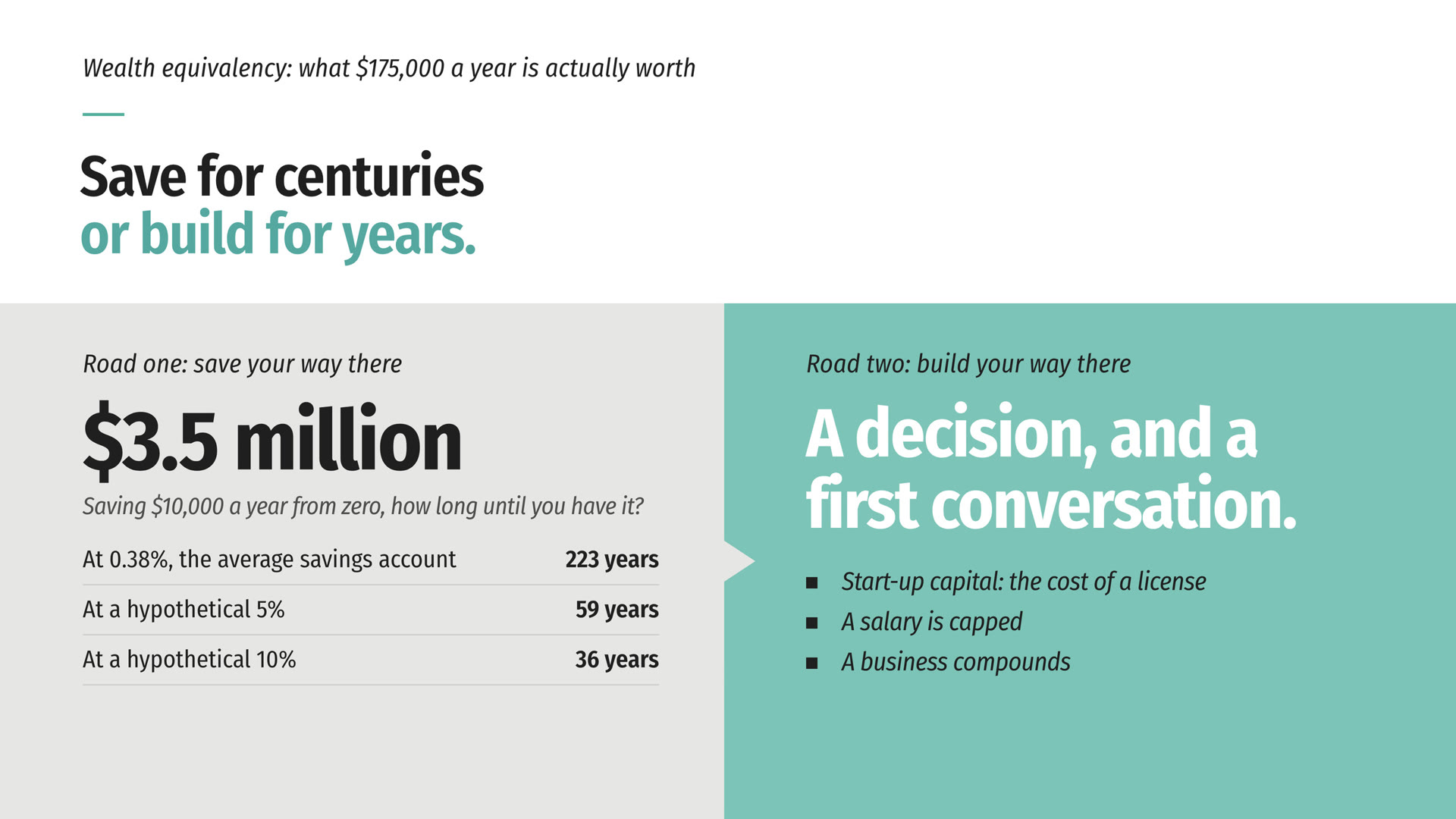
If you read the $175,000/year receipt and realize your paycheck can’t close the gap, you have two options: save your way there or build your way there. The first takes millions in savings. The second takes entrepreneurship: find a problem people need solved and build a profitable business around the solution.
The American Dream income gap is a massive problem. The need is the problem. Teaching people how money works, and showing them how to take action, is the business.

WealthWave is a team of top-performing leaders with World Financial Group (WFG), a world-class business platform at the vanguard of today’s financial industry. WealthWave helps Americans master financial concepts and access the products and services they need to become more financially secure. And most importantly, if you have an income gap, you can decide to become an independent financial professional with our company.
At WealthWave we know it’s possible to bridge the gap to $175,000 and beyond, because we watch it happen on our team every day. From every earning and experience level, age, background and nationality, everyday Americans like you are crossing from a place of limitation to a position of possibility.

WealthWave is a team of top-performing leaders with World Financial Group (WFG), a world-class business platform at the vanguard of today’s financial industry. WealthWave helps Americans master financial concepts and access the products and services they need to become more financially secure. And most importantly, if you have an income gap, you can decide to become an independent financial professional with our company.
At WealthWave we know it’s possible to bridge the gap to $175,000 and beyond, because we watch it happen on our team every day. From every earning and experience level, age, background and nationality, everyday Americans like you are crossing from a place of limitation to a position of possibility.
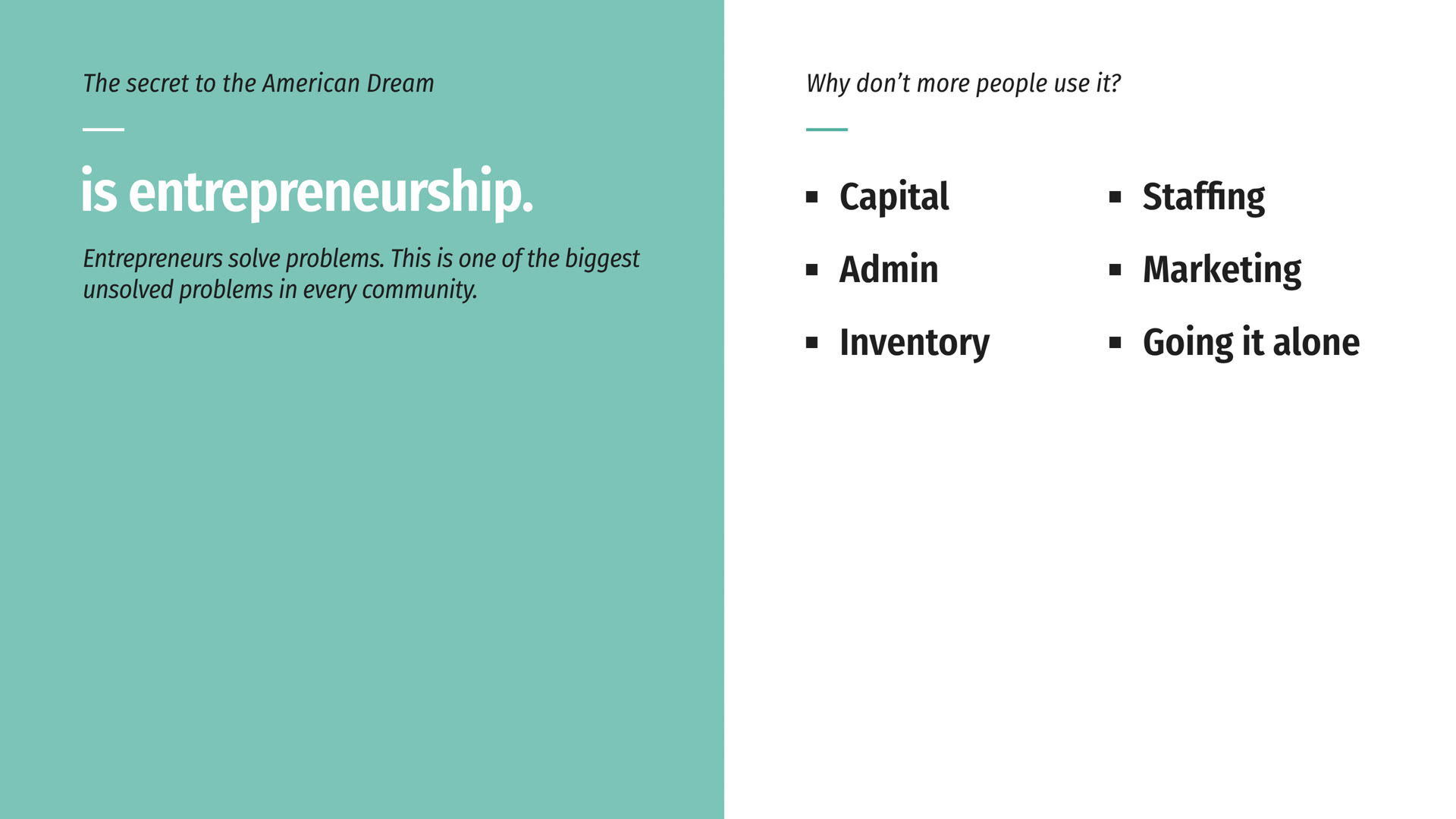
Entrepreneurs solve problems, and the problem you just heard about is one of the biggest unsolved problems in every community in America.
Start-up capital, staffing, administration, marketing and inventory are just a few of the risks that deter many Americans, along with the fear of going out on your own, alone.
by providing the infrastructure, product providers, training and leadership necessary to make it easier, more affordable and less intimidating to start your own business. If you’re unwilling to give up on your dreams, consider our platform the game changer you’ve been seeking to bridge the gap.
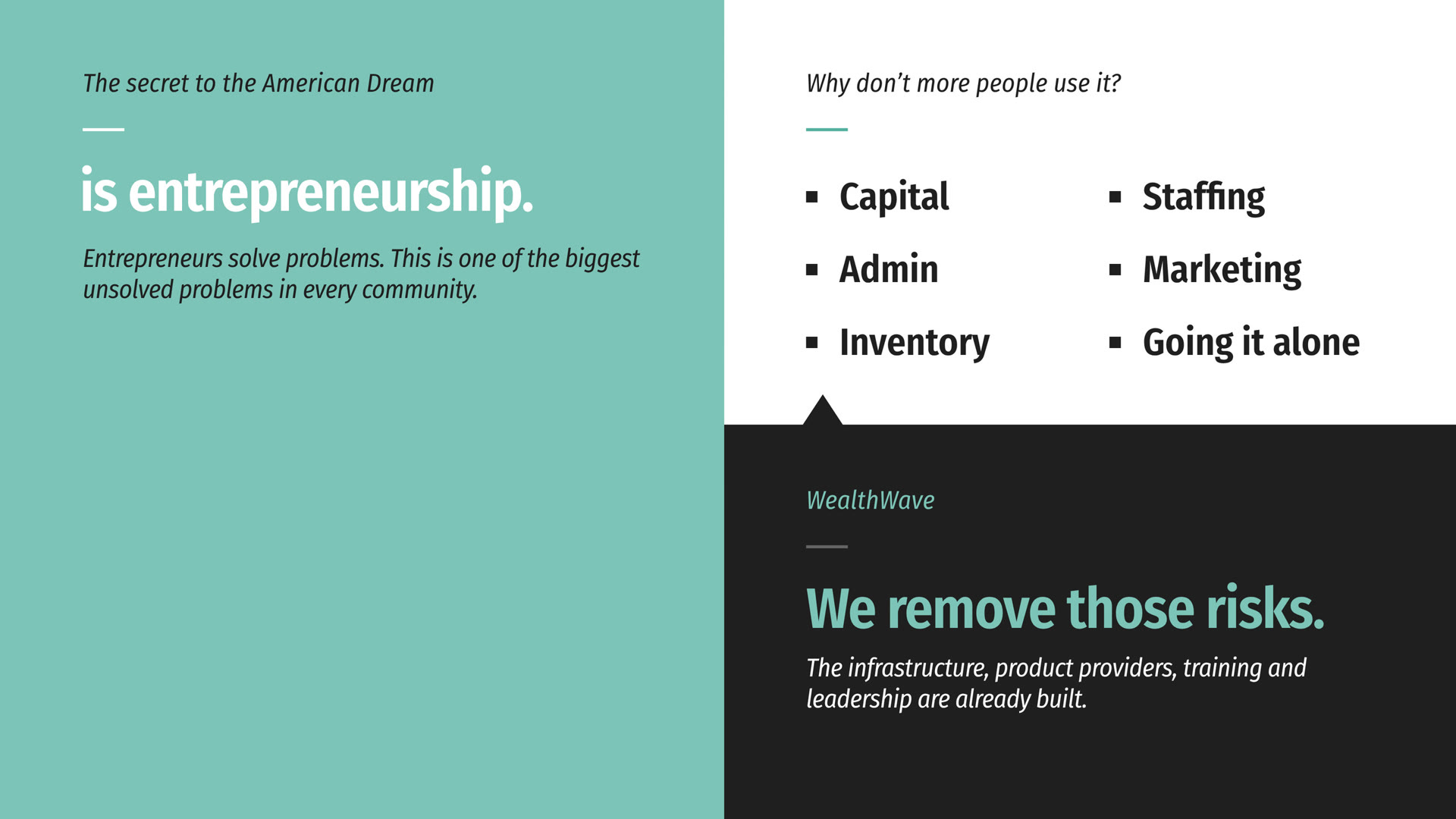
Entrepreneurs solve problems, and the problem you just heard about is one of the biggest unsolved problems in every community in America.
Start-up capital, staffing, administration, marketing and inventory are just a few of the risks that deter many Americans, along with the fear of going out on your own, alone.
by providing the infrastructure, product providers, training and leadership necessary to make it easier, more affordable and less intimidating to start your own business. If you’re unwilling to give up on your dreams, consider our platform the game changer you’ve been seeking to bridge the gap.
You need a license to offer financial products. But you need no license to introduce someone to this business.
Most people want to get licensed before they talk to anybody, because they feel unqualified. Then they introduce a friend, the friend wants to become a client, and suddenly the doubts are gone, the questions are answered, and the license gets done.
You can start today.

You need a license to offer financial products. But you need no license to introduce someone to this business.
Most people want to get licensed before they talk to anybody, because they feel unqualified. Then they introduce a friend, the friend wants to become a client, and suddenly the doubts are gone, the questions are answered, and the license gets done.
You can start today.
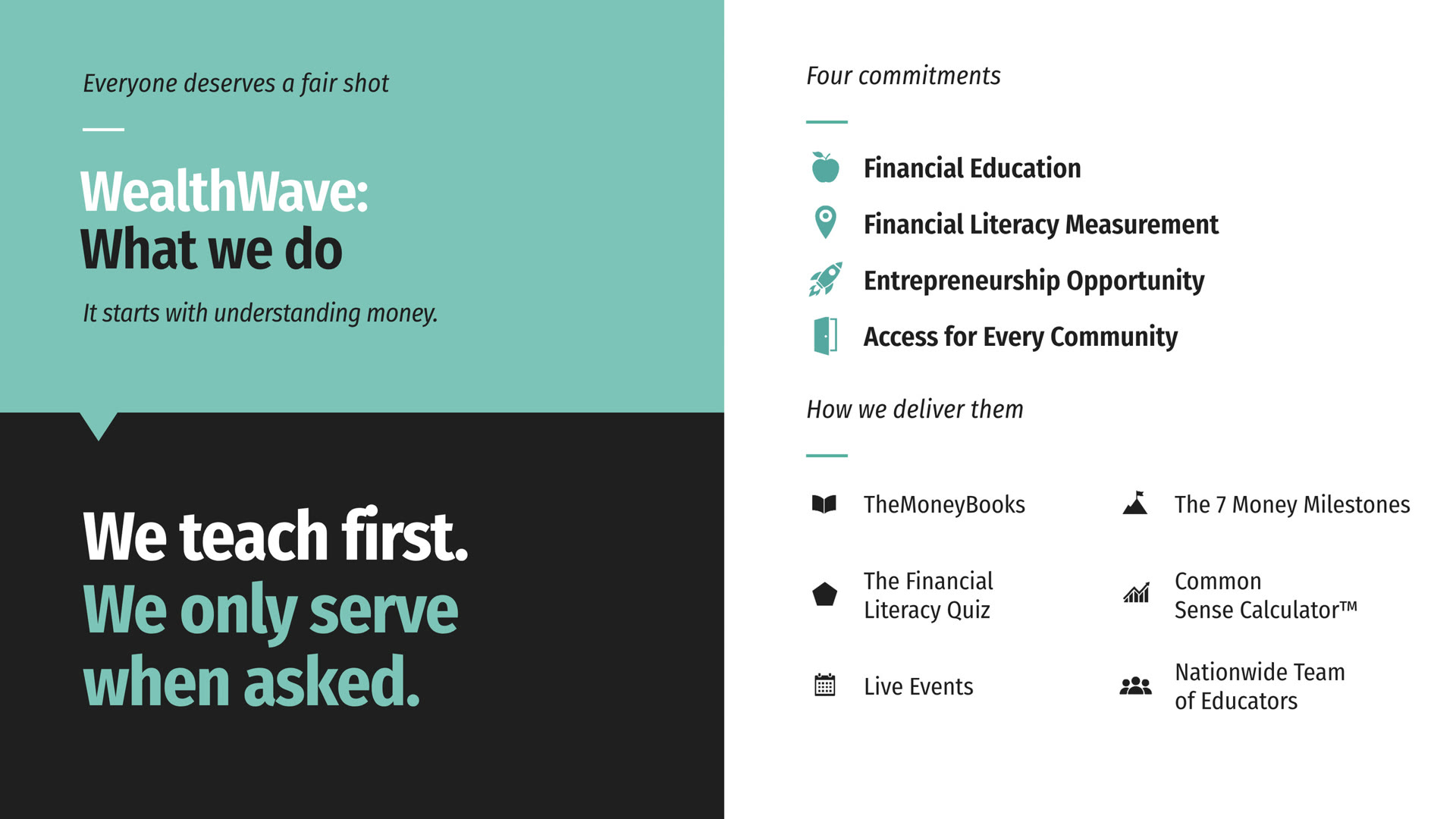
The idea at the heart of the American Dream is simple: no matter who you are or where you come from, you deserve a fair shot at a better life. We believe that shot begins with understanding money.
We teach first.
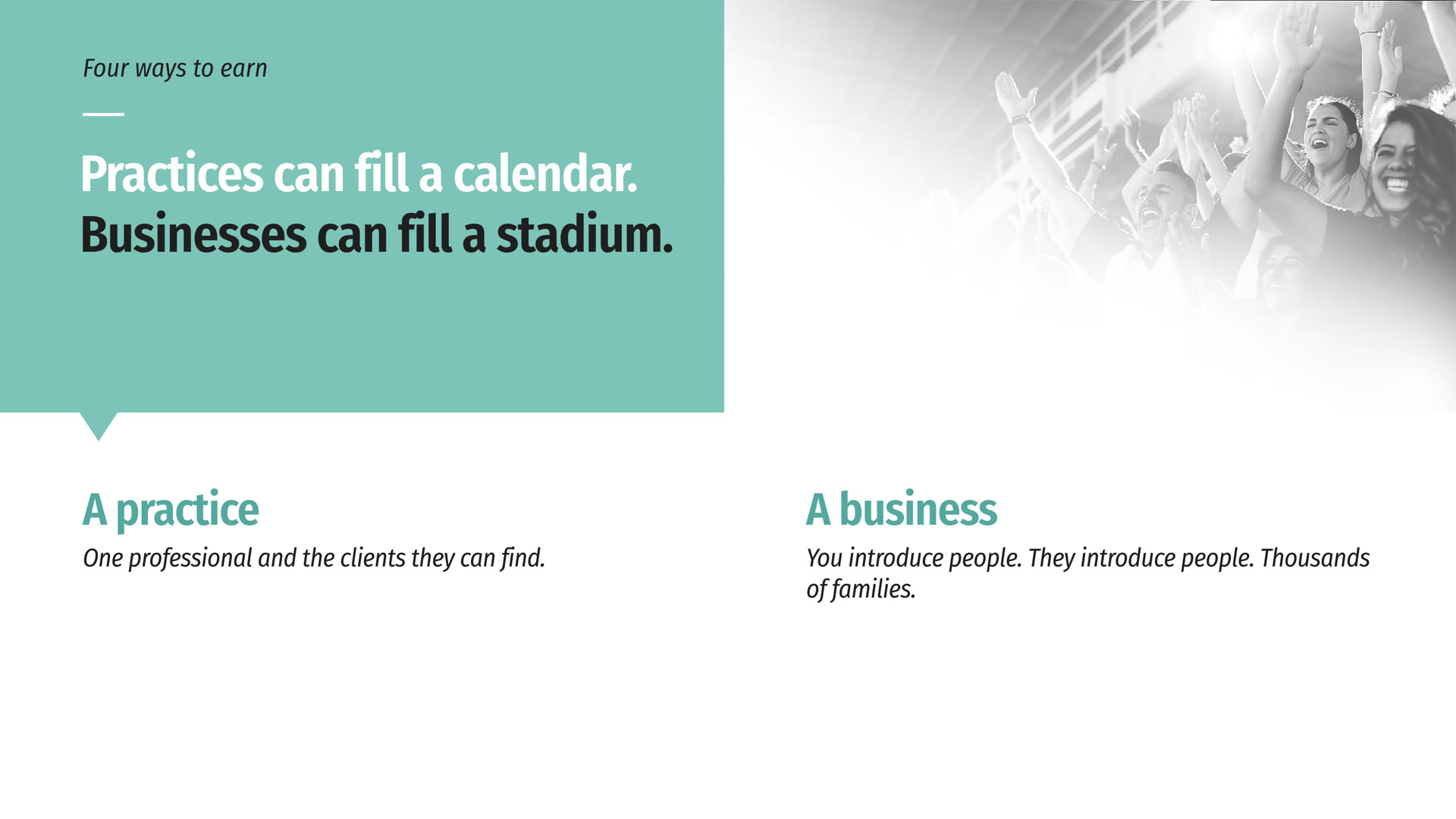
A practice is one professional serving the clients they can personally find. A business is different. You introduce people to the business. They introduce people. Between the ones you bring and the ones they bring, you’re connected to hundreds and eventually thousands of families you would never have met.
There’s friendship in those connections, and trust, and our books, our media and our leaders bring credibility to every one of them. Our compensation plan offers four distinct ways to earn income and grow at every stage of your success.
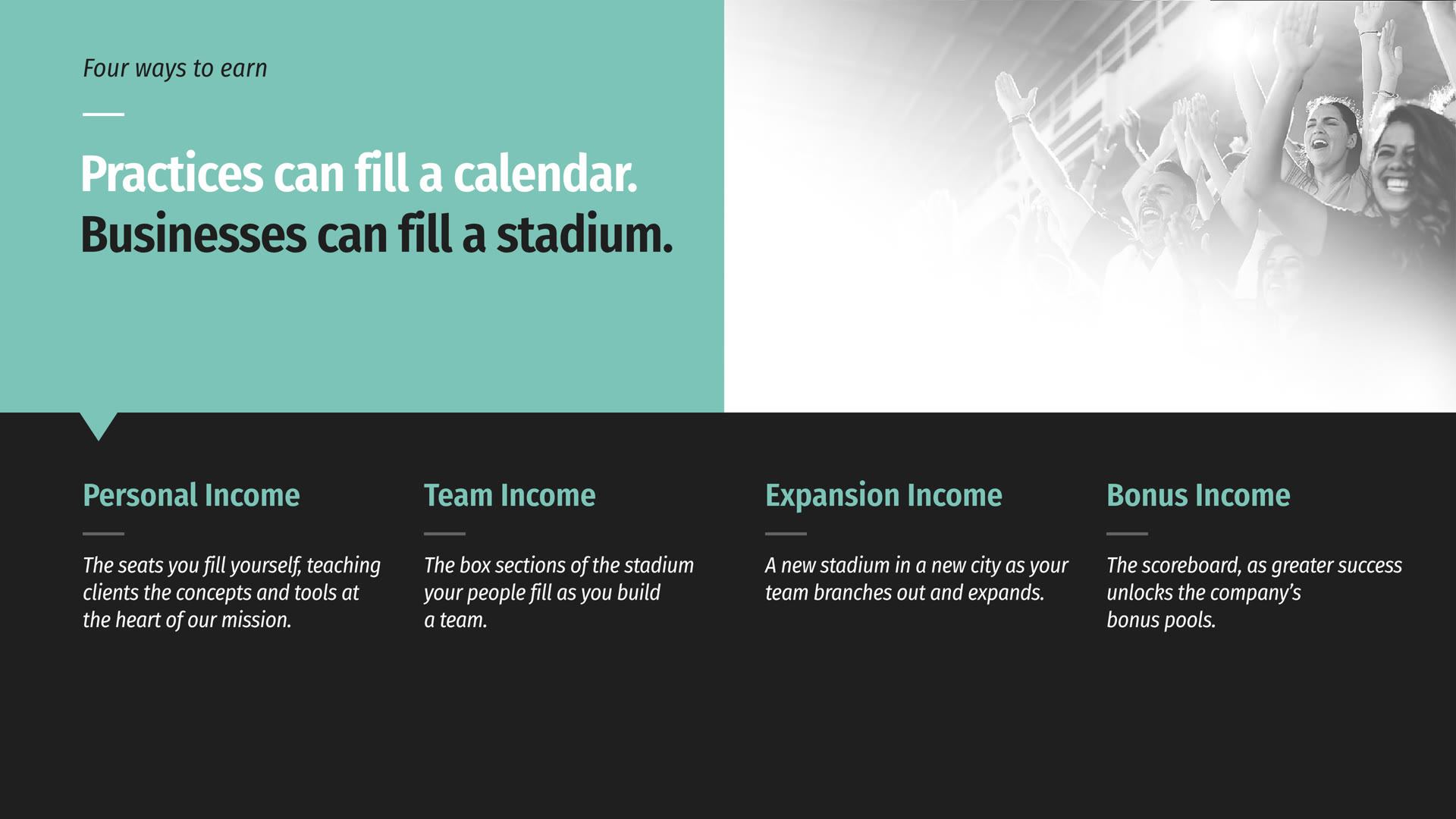
A practice is one professional serving the clients they can personally find. A business is different. You introduce people to the business. They introduce people. Between the ones you bring and the ones they bring, you’re connected to hundreds and eventually thousands of families you would never have met.
There’s friendship in those connections, and trust, and our books, our media and our leaders bring credibility to every one of them. Our compensation plan offers four distinct ways to earn income and grow at every stage of your success.
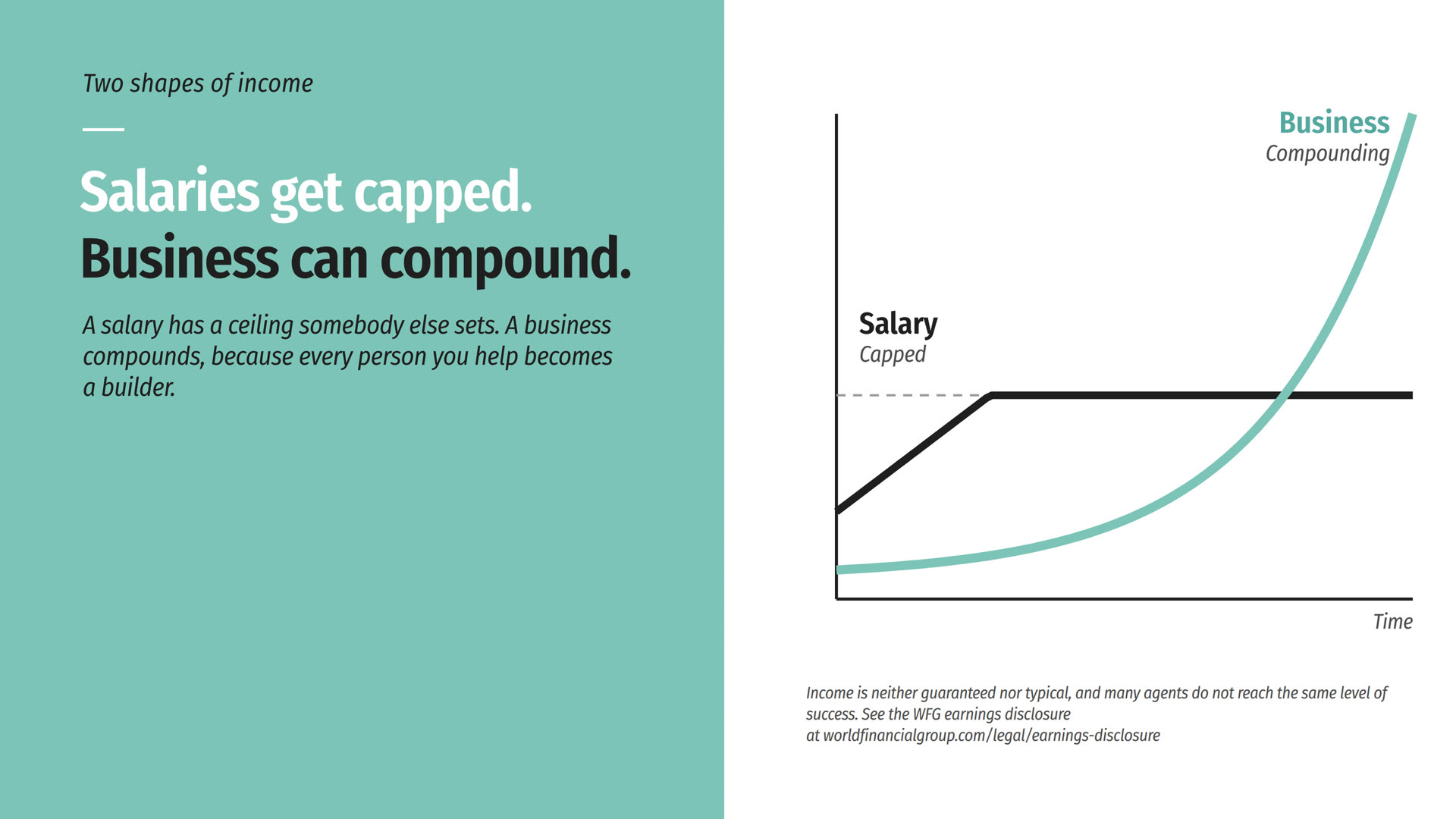
A salary has a ceiling, and somebody else sets it. A business has a different shape. It compounds, because every person you help build becomes a builder. There’s money in this, and it’s the byproduct of helping people.
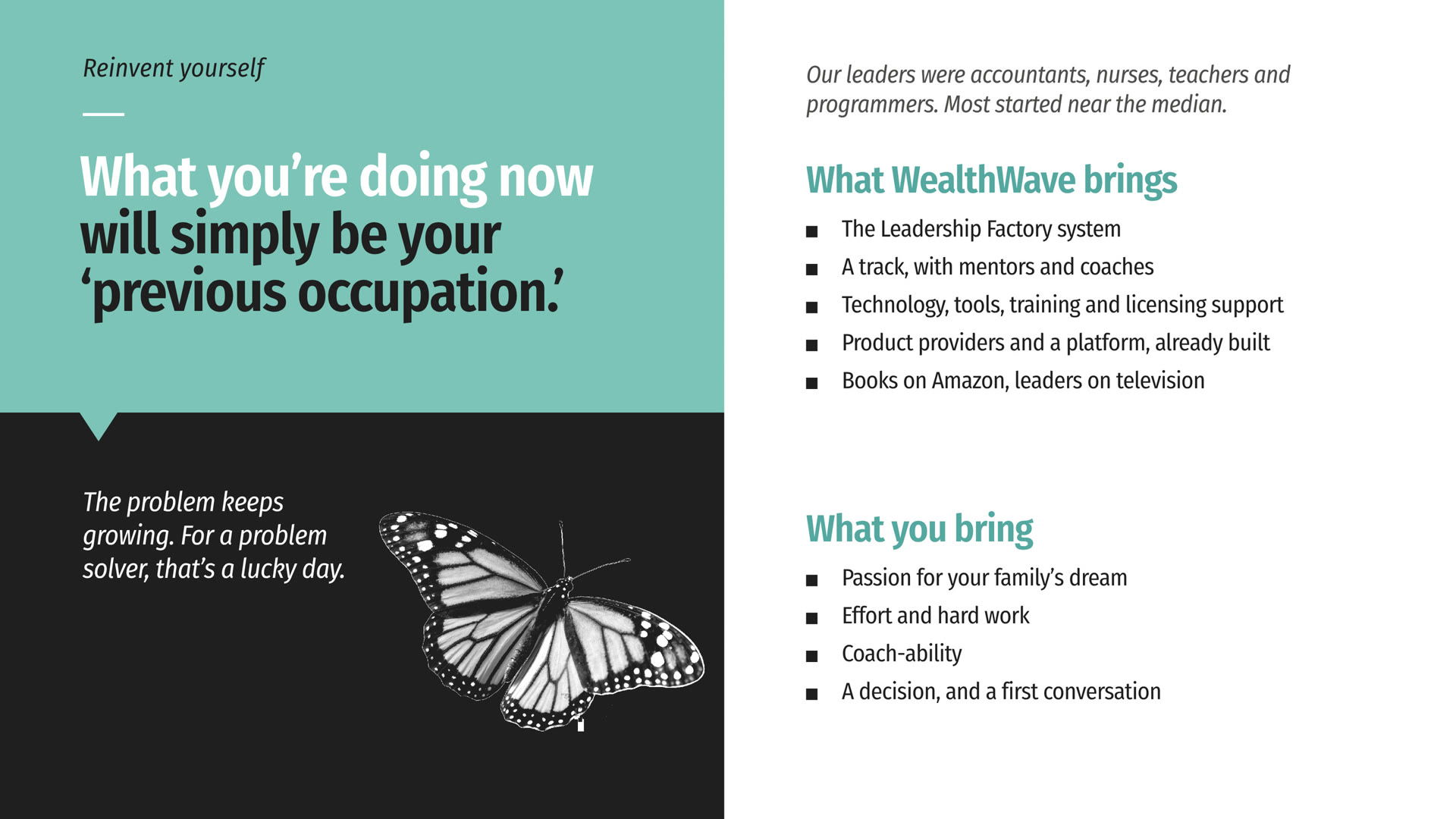
When you were born, nobody stamped an occupation on you for the rest of your life. Our leaders were accountants, nurses, contractors, realtors, mechanics, teachers, flight attendants and programmers. Most of them started right around the median. The difference that made them anything but average is that they closed the income gap and are now on their way to, or already living, their version of the American Dream.
The problem keeps getting bigger, and it is still taught in almost no school. For a problem solver, that’s a lucky day.
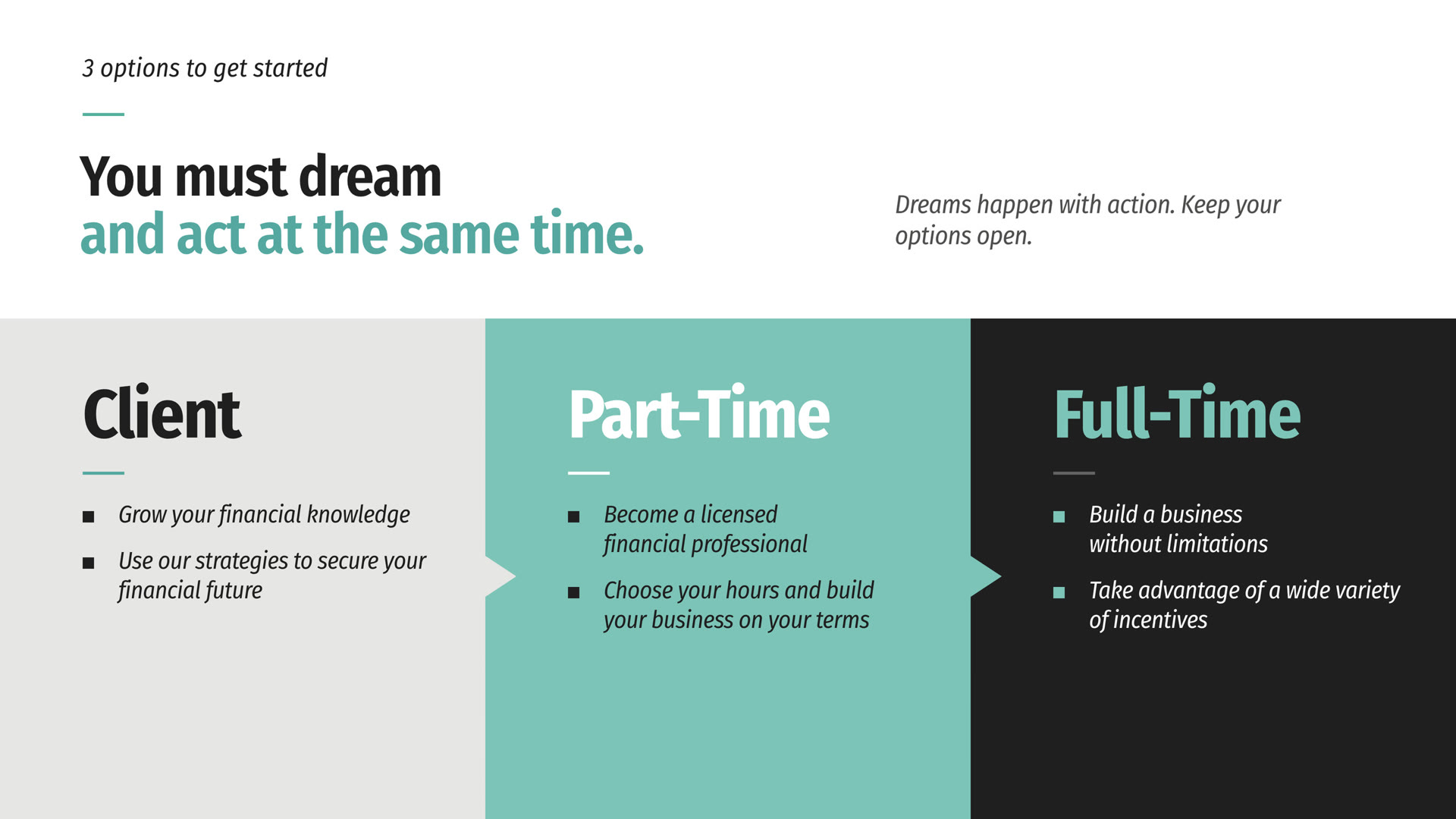
Our philosophy is that dreams happen with action. You must have both. Once you’ve made the decision to explore a WealthWave business, there are three ways to begin. Work with your WealthWave leader to choose the option that best fits you and your situation.
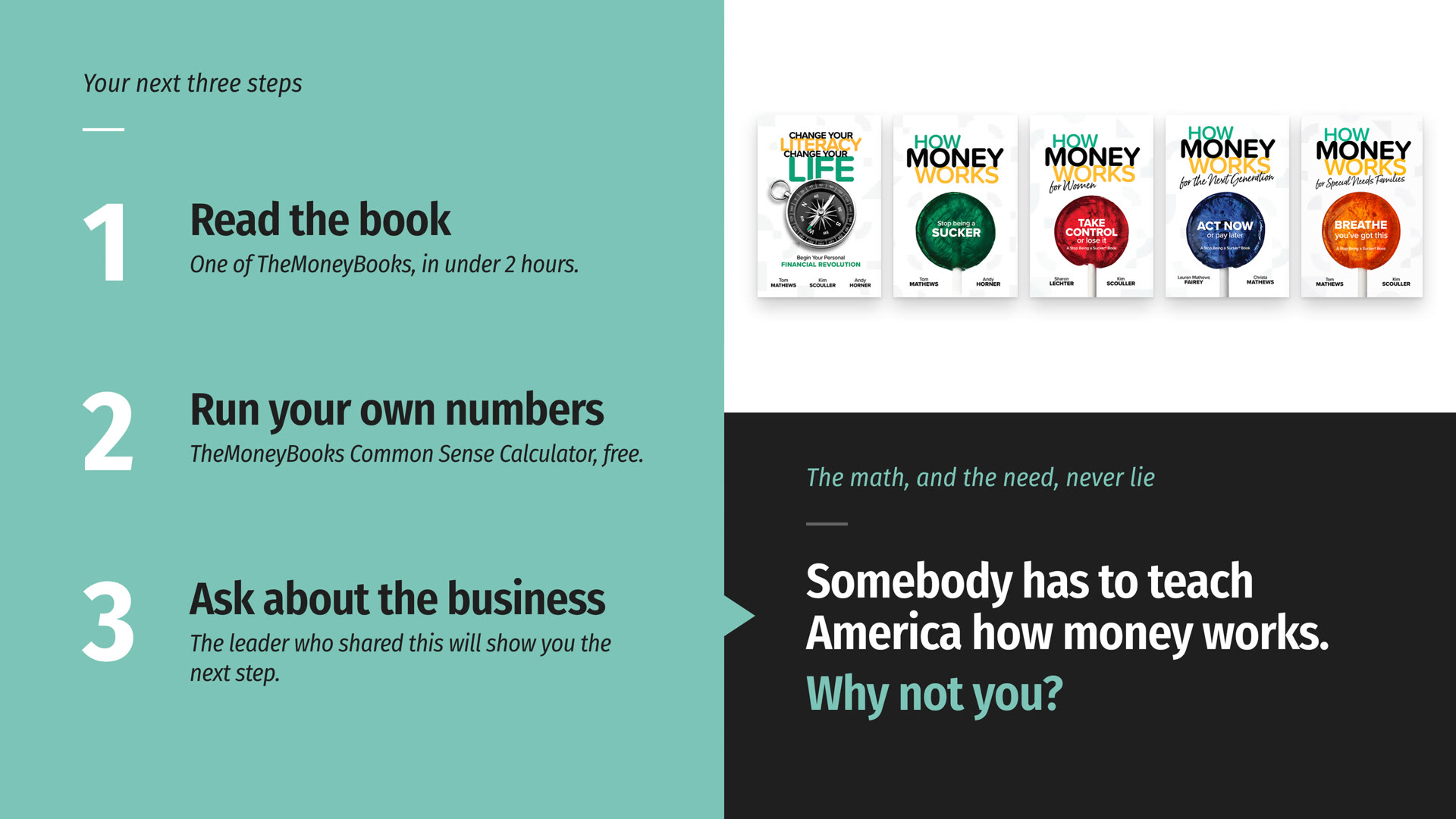
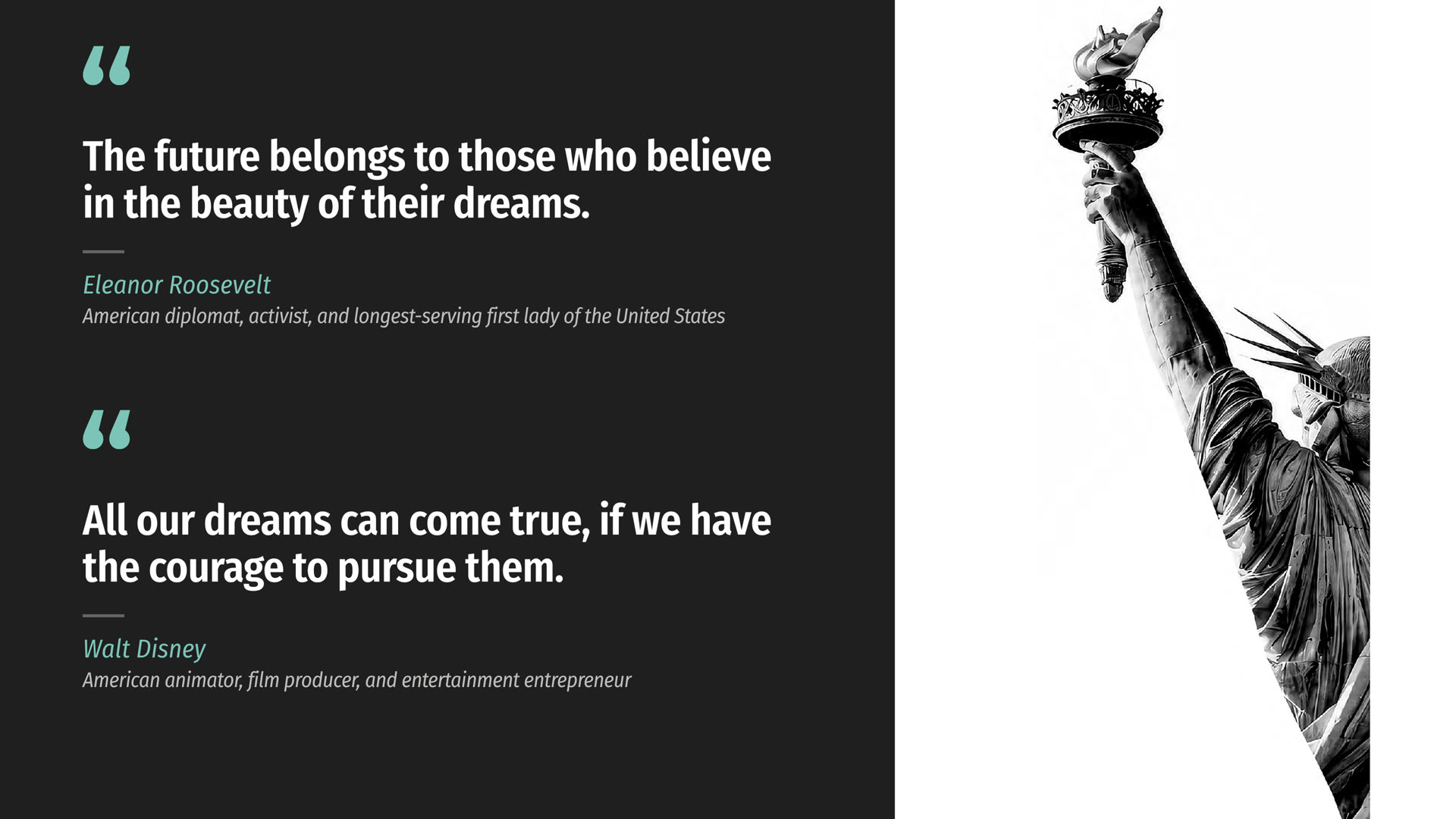
The combination of these two ideas forms the core mindset that fuels our success at WealthWave. If your dreams are too important to you to give up, then your next step is to act. Set a meeting today and let’s explore the future together!